Perceptions of Management Practices in Montreal Companies among Information Technology Workers from India
Master of Science in Management (M.Sc.) thesis, HEC Montréal
Simon Kreis & Claude. Made with AI, mainly Claude (Anthropic), which contributed in part or in whole to the work. Simon Kreis is responsible for the result. Written by Simon Kreis-Richard at HEC Montréal in 2019; this web edition was converted from the PDF and translated from French with Claude.
A thesis in cross-cultural management: how IT professionals from India perceive the management practices of Montreal companies, drawn from 14 semi-structured interviews, between India, Quebec and the Anglo-Saxon world.
Web version of the thesis submitted to HEC Montréal in August 2019. The text, tables and notes are those of the thesis; the title page, the certificate of ethics approval, the acknowledgements, the table of contents and the list of tables remain in the PDF, which is the version of record: the thesis at the HEC Montréal library. Interviewees are referred to by pseudonyms. © Simon Kreis-Richard, 2019.
Summary
This thesis is a research project on the perception of management practices and on the integration of information technology professionals of Indian origin working in Montreal. This thesis is divided into three main parts: a literature review, an interview report and an analysis of this report. The literature review explores the major management practices and cultural traits of the three major cultural entities under study in this thesis, at whose intersection Montreal lies, namely: India, Quebec and the Anglo-Saxon world. Comparative analysis and the paralleling of the main traits of these three cultural entities are favoured throughout the thesis. The semi-structured interview method is the preferred method for collecting our data. Thus, a sample of 14 Indian information technology professionals was selected for interviews on their experiences of the differences in management practices and in Montreal, Quebec and Indian cultures. These interviews also allow us to assess the quality of their integration into their organizations and into Quebec society. Finally, the data collected during the interviews are analyzed and related to the scientific literature. In conclusion, the research highlights several major differences between India and Quebec, which fall essentially within the dimensions of individualism (versus collectivism), of hierarchical and symbolic distance and finally of the strength of social control and its nature.
Keywords: National and organizational culture, India, caste system, Quebec, Anglo-Saxon societies, cross-cultural management, sociology and anthropology of organizations, semi-structured interviews, cultural logics of Philippe d’Iribarne, cultural dimensions of Geert Hofstede.
Abstract
This master’s thesis is a research paper on the perception of management practices and the integration of information technology professionals of Indian origin working in Montreal. This thesis is divided into three main parts: a literature review, a report of interviews, and an analysis of this report. The literature review explores the major management practices and cultural traits of the three major cultural entities at the center of which Montreal is at the intersection in our study, namely: India, Quebec and the Anglo-Saxon world. The comparative analysis and the paralleling of the main features of these three cultural entities are privileged throughout the thesis. The semi-structured interview method is the preferred method for collecting our data. Thus, a sample of 14 Indian IT professionals was selected to conduct interviews on their experiences of differences in management practices and cultures in Montreal, Quebec and India and by extension on the quality of their integration into their organizations and in Quebec society. Finally, the data collected during the interviews are analyzed and put in relation to the scientific literature. In conclusion, the research work highlights several major differences between India and Quebec, which are essentially part of the dimensions of individualism versus collectivism, of hierarchical and symbolic distance and finally of the strength and nature of social control.
Keywords: National and organizational culture, India, caste system, Quebec, Anglo-Saxon societies, Cross-cultural management, sociology and anthropology of organizations, semi-directed interviews, cultural logics of Philippe d’Iribarne, cultural dimensions of Geert Hofstede.
Introduction
The West today faces a problem that is recent in human history: the aging of its population. Western countries were the first to be affected by the phenomenon known as the demographic transition, generally characterized by rapid economic growth marked by rising living standards and wider access to health care, thereby resulting in the fall in infant mortality and subsequently in better family planning. Most Western countries have thus experienced, for several decades already, a decline in the fertility rate (number of children per woman), a demographic slowdown (decrease in population growth) and an increase in life expectancy. In this context, the oldest generations are proportionally more numerous than the youngest in the population, thus resulting in a decline of the active population (the working-age population) (Ined, 2019).
With the notable exception of Japan, the world leader on this issue, Western countries, including Canada1 and Quebec2, are today among the most affected by this phenomenon. The latter is particularly worrying from an economic point of view, since a smaller active population translates into reduced economic growth and a heavier tax burden for the taxpayers who must finance the retirement pensions and social services of the aging population. Faced with this issue, the most common solution, notably for developed economies, is to open their doors to economic immigration in order to meet their labour needs and renew their active population.
Quebec, with one of the lowest fertility rates in Canada at 1.7 children per woman, a rate insufficient to renew its population, also resorts to this strategy. However, compared to the rest of Canada, Quebec attracts relatively few immigrants and struggles to retain them within the province, a significant proportion of them choosing either to move to the western provinces or to leave the country3 (Ministère de l’Immigration, de la Diversité et de l’Inclusion, 2017). Faced with this need for labour, Canada has long turned to India as an important source of its immigrant population, which offers an English-speaking and highly educated immigrant population (Statistics Canada, 2007-07-16).
Indeed, unlike many Western countries, India has experienced extremely rapid population growth over the past decades and is on its way to overtaking China, in the coming years, as the world’s most populous nation (Ritchie, 2019). India is also a highly educated nation, notably in the science and technology sector, whose national industry has not grown fast enough to employ the qualified Indian workforce efficiently (India Today, 2019). Consequently, the migration of Indians outside India is very frequent and valued in this society. The international Indian diaspora has, moreover, built a reputation over the past decades as an extremely competent and competitive workforce in many international tech hubs such as San Francisco, where this population represents a significant proportion of the employees of the technology sector, a presence embodied notably by several company heads of the largest technology corporations (Wadhwa, 2012; Gibbs, 2014; Dave, 2015).
In the current context of globalization, characterized by an increasingly international and globalized job market that favours economic immigration around the world as a means of countering population aging and meeting labour needs, and by the ever-growing place of technology companies (particularly IT) in the economy, the problem arises of the successful integration of this foreign workforce (notably Indian), in the company as well as in the host society. This issue is even more important in Quebec than in the rest of Canada insofar as Quebec is currently trying to develop its information technology industry and the province has a negative interprovincial migration ratio, characterized by a significant departure of immigrants of Indian origin in particular and, more generally, by their small number in Quebec (Ministère de l’Immigration, de la Diversité et de l’Inclusion, 2017; Lalonde, 2017).
My research project therefore aims to study the socio-professional integration of skilled economic immigrants of Indian origin working in the information technology sector in Montreal. This project aims to develop a better understanding of the integration of the members of this community, first and foremost from a scientific perspective. It also seeks to contribute to developing potential tools for the better management and integration of Indians within Quebec society and companies, from a cross-cultural management perspective. Our research question is therefore the following: what are the cultural differences at work between India and Quebec as perceived by Indian immigrant workers in information technology? Throughout this research, we will thus adopt a comparative analysis, aiming to compare the social, cultural and organizational traits of India with those of Quebec and Canada. We will also draw on a theoretical perspective strongly influenced by structural functionalism and on a conceptual framework strongly inspired by the work of Philippe d’Iribarne in his book La logique de l’honneur.
Our data collection method, divided into two main parts, will first take the form of a review of the scientific literature surveying the studies already conducted on the subject. The themes explored will be the following: 1-the profile of the Indian diaspora in North America, 2-the characteristics of Indian management, organizations and culture, 3- the characteristics of Anglo-Saxon management, organizations and culture and 4-the characteristics of Quebec management, organizations and culture. In light of the authors studied, the end of the literature review will mark the choice of a theoretical position and of a methodology. Second, data collection will take the form of semi-structured interviews of one to two hours each with information technology professionals of Indian origin working in Montreal, thereby aiming to enrich and test the data of the literature review. The data from these interviews will then be presented in a chapter reporting the experiences and perceptions of the Indians interviewed. We will then analyze the content of these interviews in light of our theoretical framework and our literature review, relating the accounts of our interviewees to one another. The main parts of this thesis are therefore the following: chapter 1 “Comparing the Indian, Canadian and Quebec management models” covers the literature review on the Indian diaspora in North America, Indian management, Anglo-Saxon management and Quebec management; chapter 2 “Theoretical framework” discusses the main authors, schools and theoretical influences of this research; chapter 3 “Methodological framework” addresses the methodological considerations relating to the characteristics of the research sample and its composition; chapter 4: “Indians in search of study and career opportunities” offers an interview report in the form of a synthesis of the main themes, trends and accounts from the interviews; chapter 5 “The major oppositions between India and Quebec” develops an in-depth analysis of the preceding accounts in relation to the literature review, as well as of the main cultural and managerial differences and oppositions between India and Quebec; and finally the conclusion offers a recapitulative synthesis of this entire thesis and presents the research results. Let us begin with the first part of our literature review, that is, the profile of the Indian diaspora in North America and in Canada.
Chapter 1: Comparing the Indian, Canadian and Quebec management models
Section 1.1: The Indian diaspora in North America and in Canada
The Indian-American community
The Indian diaspora in the West has become known in recent years notably through its presence in scientific fields (STEM) and in high-technology industries. Indeed, it is largely made up of skilled professionals working in the fields of the natural sciences, technology and engineering, thus constituting a workforce in high demand in many fast-growing technology industries worldwide. The success of this community abroad in this sector, particularly in Silicon Valley, is embodied in the emblematic figures of Sundar Pichai and Satya Nadella, both Indian immigrants and now chief executive officers of Google and Microsoft (Dave, 2015; Gibbs, 2014).
The Indian-American community numbered 4,402,362 people in 2017, thus constituting the third-largest ethnic group of Asian origin in the United States (U.S. Census Bureau, 2017). This community is also reportedly the most entrepreneurial immigrant group in the United States, having founded 13.4% of Silicon Valley start-ups, 6.5% of American start-ups and 8% of American technology start-ups in 2007, despite its relatively small demographic weight, accounting in 2017 for just over 1% of the American population. This trend reportedly holds in all regions of the United States, where the Indian-American community is said to dominate the other immigrant groups in its propensity for entrepreneurship, accounting for 33.2% of all start-ups founded by immigrants in the United States (Wadhwa, 2012).
The Indo-Canadian community
The Indo-Canadian community, for its part, is the second-largest non-European ethnic community in Canada, with 1,374,710 members in 2016, just after the Chinese-Canadian community. This community is mainly established in the provinces of Ontario and British Columbia. In 2016, these two provinces counted 774,495 Indo-Canadians settled in Ontario and 309,315 in British Columbia, for a total of 1,083,810 individuals, corresponding to 79% of the entire Indo-Canadian community. Most of them are concentrated in the cities of Toronto and Vancouver, which in 2016 counted 643,370 Indo-Canadians in Toronto and 243,135 Indo-Canadians in Vancouver, for a total of 886,505 individuals, corresponding to 64% of the country’s entire Indo-Canadian community. By comparison, Quebec counts only 51,650 Indo-Canadians, almost all of whom, namely 48,485, live in Montreal, which obviously represents a much smaller proportion than Quebec’s demographic weight within Canada (Statistics Canada, 2018-02-14).
Indo-Canadians by province and city
| Canada | Ontario | British Columbia | Quebec |
|---|---|---|---|
| 1,374,710 | 774,495 | 309,315 | 51,650 |
| Toronto | Vancouver | Montreal |
|---|---|---|
| 643,370 | 243,135 | 48,485 |
(Statistics Canada, 2018-02-14)
The majority of the Indo-Canadian community is of Sikh or Hindu origin, counting in 2001 34% Sikhs, 27% Hindus, 17% Muslims and 16% Christians (Statistics Canada, 2007-07-16), or 454,965 Sikhs in 2011 (Statistics Canada, 2019-01-23). There is therefore an overrepresentation of the Sikh population and, by extension, of the Punjabi population in Canada compared to its demographic weight in India, where it represents only 1.72% of the Indian population in 2011 (Census Population, 2015).
The Indo-Canadian community is very strongly anglophone: in 2001, 85% of its members said they could hold a conversation in English, 8% in French and English and only 1% in French only. A majority of 61% of them had a mother tongue other than French or English, and 41% said they spoke a language other than French or English at home. Yet only 4% of this population in employment speaks a language other than French or English, being employed thus seeming to be correlated with mastery of an official language (Statistics Canada, 2019-01-23).
The Indo-Canadian community is also more structured around the family than the rest of the Canadian population. This population is more likely to be married: in 2001, 61% of those aged 15 and over were married, compared to 49% in the Canadian population as a whole. Only 4% of the Indo-Canadian community lived alone, compared to 13% for the Canadian population as a whole. Moreover, only 8% of seniors (aged 65 and over) in the Indo-Canadian community lived alone, compared to 29% of seniors in the Canadian population as a whole. 24% of Indo-Canadian seniors lived with a member of their family, compared to 5% for the Canadian population as a whole (Statistics Canada, 2019-01-23).
The Indo-Canadian community is, moreover, highly educated and present in scientific fields: in 2001, it counted 26% university graduates and 9% graduate-degree holders, compared to 15% university graduates and 5% graduate-degree holders for the Canadian population. In addition, this ethnic group accounts for 2% of all postsecondary graduates, but for 6% of graduates in mathematics, physics and computer science and for 5% of graduates in engineering and applied sciences (Statistics Canada, 2019-01-23).
Finally, the propensity for self-employment and entrepreneurship within the Indo-Canadian population is slightly lower than that of the Canadian population as a whole, with 10% self-employed workers among Indo-Canadians against 12% for the Canadian population as a whole in 2001, which is surprising considering the very strong entrepreneurial tendency of the Indian-American diaspora (Statistics Canada, 2019-01-23).
The Indo-Quebec community
The Indo-Quebec community also has several characteristic traits. Like the rest of the Indo-Canadian community, the Indo-Quebec community is characterized by its strong urban presence: in 2016, 48,485 of the 51,650 Indo-Quebecers were settled in Montreal (Statistics Canada, 2018-02-14). Among the immigrant population admitted to Quebec from 2006 to 2015, there was, for Indians as for all the other nationalities, a majority of economic immigrants, namely 3,851 individuals. By comparison, there was also a proportionally large number of immigrants admitted through family reunification (that is, the arrival of the family members of an already established immigrant), numbering 2,969 individuals. Finally, there was also a proportionally high number of refugees, numbering 1,908 individuals.
The presence rate is defined as the proportion of immigrants who had remained in Quebec at the time of the study, in January 2017, following their admission between 2006 and 2015. We note that immigrants of Indian origin admitted to Quebec from 2006 to 2015 have a very low presence rate in 2017, of only 30.6%, for economic immigrants, compared to a higher rate, of 67.9%, for immigrants admitted in the family reunification category. Nevertheless, these two presence rates are the lowest for economic immigrants and the second lowest for family reunification immigrants (after Pakistan at 27.2%), among the 30 main countries of birth of immigrants to Quebec. Overall, regardless of the type of immigration, Indians are the group by country of immigration with the 3rd lowest presence rate in Quebec, with only 50.4% of Indians remaining in Quebec in 2017 after their admission between 2006 and 2015, after the Chinese (47.4%) and the Iranians (50.0%) (Ministère de l’Immigration, de la Diversité et de l’Inclusion, 2017).
Immigrant population admitted to Quebec from 2006 to 2015 and presence in 2017
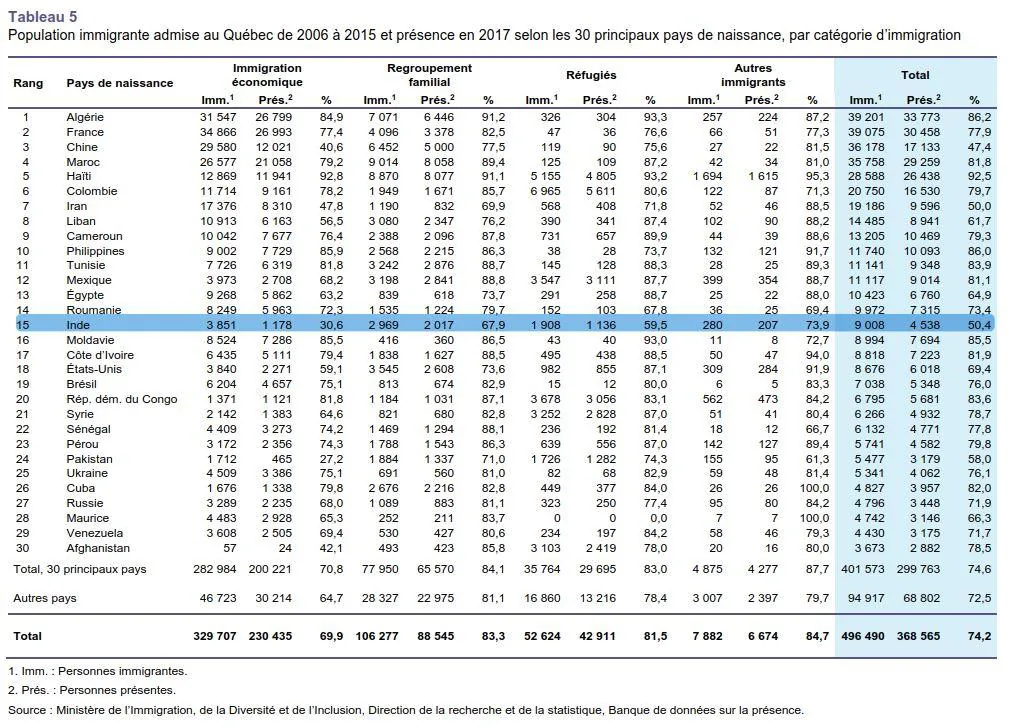
(Ministère de l’Immigration, de la Diversité et de l’Inclusion, 2017)
The interpretation of these data therefore leads to the following observation: a smaller proportion of Indian immigrants than of other nationalities remain in Quebec following their admission, in particular economic immigrants, who are assumed to have better professional qualifications and fewer family constraints than family reunification immigrants, which makes them more mobile. Quebec therefore seems to have difficulty retaining its Indian diaspora, unlike the provinces of Ontario and British Columbia. Several explanatory factors can be considered, such as the low level of francization and the small presence of the diaspora in Quebec (Ministère de l’Immigration, de la Diversité et de l’Inclusion, 2017).
The Indian diaspora in Canada is therefore essentially characterized by its presence in Ontario and British Columbia, particularly in the cities of Toronto and Vancouver, and by its strong urban presence. This diaspora has little presence in Quebec and has a low francization rate as well as a low presence rate in Quebec in the years following its admission. The Punjabi ethnic group, of Sikh religion, is overrepresented in the Indo-Canadian community, as is their presence in the fields and industries of science and technology.
Section 1.2: Managing the Indian way
The caste system
India is an extremely heterogeneous and diverse country; with its 15 official languages and its many religions, among them Hinduism, Islam, Christianity, Sikhism, Jainism and Buddhism, it can be problematic to speak of an Indian culture or of an Indian management (Harris, 2004). Yet, in the management and social science literature, one element of India’s cultural system still seems today to structure most of the cultural expressions and social relations of Indian society and organizations. This element is the Hindu religion and, more precisely, the caste system, which is an integral part of this religious system.
One of the major authors to have theorized Indian culture and society in the French-language literature is the French anthropologist Louis Dumont. According to Dumont, the Hindu religion is indeed the structuring factor of social relations within Indian society (Dumont, 1964; 1966). The caste system has three main characteristics: first, social separation; second, the division of labour; and third, social hierarchy, these elements being applied according to caste membership.
Traditional Indian society is divided into 4 major social classes or “castes”, called “Varna”, as well as into an indeterminate and constantly changing number of subcastes called “Jati”. The “Varna” represents the traditional functions that its members must in theory perform in society, whereas the “Jati” is associated with the actual occupational function practised by a given occupational body. For the sake of simplicity, we will refer to these two concepts without distinction, except in particular cases, by the general term “caste”. Members of castes must avoid all direct or indirect contact with members of other castes, for example physical contact or contact through the preparation of food. Consequently, castes are in principle endogamous and hereditary, that is, the members of a caste can marry and reproduce only within their own group, and membership in the caste and in the occupational field is transmitted by birth from generation to generation. The belief underlying this separation is that a specific, shared “essence” exists within the caste and its members and must be kept pure and preserved from contamination through contact with other castes. This belief is said to remain alive today, especially at the level of the subcaste, the “Jati” (Deliège, 2004).
The traditional and hereditary functions of the four major “Varna” castes are the following: the “brahmins”, the upper class, are associated with the functions of priests and teachers; the “kshatriyas” with the functions of warriors and administrators of the state; the “vaishyas” with the functions of merchant and peasant; and, last, the “shudras”, the lower class, are relegated to the functions of artisans and servants.
Finally, the caste system is hierarchical and rests, according to Dumont, on a cultural logic of opposition between two fundamental values: the pure and the impure. In keeping with this belief in a common essence, each caste is associated with a certain degree of purity or impurity and is ranked in a hierarchy according to this criterion. This classification extends beyond the social body alone to encompass all the elements of the natural world in a great hierarchy of purity, for example the right hand being pure and the left hand impure, or gold being purer than copper (Dumont, 1964; 1966). The concept of social class must therefore be understood here in a religious, symbolic and hereditary sense rather than in the economic sense in which it is most often understood in the West, the hierarchical status of the caste not being correlated with economic status: a merchant “vaishya” could, today as historically, be wealthier than a Brahmin priest who is nonetheless higher in the hierarchy.
The social implications of the caste system are numerous. The hereditary specialization of castes creates relations of interdependence among them, in which each caste can subsist only by resorting to the professional services of the other castes. Traditional Indian society can therefore be understood as a set of hierarchical relations of dependence and duty of the castes towards one another. According to Dumont, this society is therefore highly coercive, the individual being obliged to fulfil his hereditary duty and being ultimately at the service of the social body, in contrast to Western societies, several of whose fundamental values are freedom, equality and individuality (Dumont, 1964; 1966).
The caste system in Indian management
The caste system and the hierarchy inherent in Indian society therefore have many implications for Indian management. According to a study conducted in an Indian aluminum smelter, Indian management, at least in industrial organizations, advocates an extreme division of labour in the Taylorist sense of the term. There is a clear division between management decisions and the execution of subordinate tasks. Each worker knows his place in the hierarchy and in the organization of work and performs his tasks repetitively and mechanically, with great obedience. Subordinate employees are, moreover, little motivated to advance in the hierarchy of the organization, and physically demanding tasks give rise to more complaints than lower hierarchical status or the nature of the work. Because of this extreme hierarchical division, there is often a lack of cooperation among Indian workers, who have difficulty working in teams (Matheu, 1987). Indian management, because of the hierarchical nature of the caste system and perhaps also because of India’s highly industrial economy, therefore still remains largely in line with the principles of Taylorism.
The family in Indian organizations
Other characteristics of Indian management are said to derive from the model of the traditional Indian family. The traditional Indian family consists of an extended family made up of several generations living under the same roof and having a patriarchal structure. Position in the family hierarchy being determined by seniority of age and by male sex, the oldest man in the family therefore holds the authority and the responsibility for managing the entire family (Hickson and Pugh, 1995).
In Indian organizations, the company head and the executives take on the figure of this patriarch, the father of the family; relations between bosses and employees are then said to take the form of a father-son relationship. Hierarchical professional relations are consequently highly unequal, executives being authoritarian and paternalistic towards their subordinates, who nonetheless seek the recognition and protection of their bosses. The Indian executive must thus show attention and paternalism and communicate with his subordinates to the point of creating a bond of complicity (Matheu, 1987).
Indian management, in the image of the Indian family, is extremely centralized, power and authority being held at the top of the organization’s hierarchy, as the patriarch is responsible for the entire extended family. An additional reason explaining the paternalistic centralization of power in Indian industrial and manufacturing organizations is the large disparity between the education of executives and that of workers, the former having been trained in modern management techniques and the latter sometimes being illiterate, hence the importance of direct management and of oral directives in the Indian organization (Lewis, 2006).
The notions of private life and of a distinction between professional life and private life are little developed and little respected concepts. Paternalistic relations at work translate into the sharing of personal problems with colleagues, into sermons and reprimands from bosses regarding the personal lives of subordinate employees, and into the invitation of colleagues to family events such as weddings. The organization’s employees are therefore treated as full human beings rather than as human capital. Consequently, nepotism also plays an important role in hiring and promotion processes, which also rest on personal relationships. Despite the complex and stratified hierarchical structure of Indian organizations, the nature of leadership and of professional relations there remains personal (Matheu, 1987; Lewis, 2006; Hickson and Pugh, 1997).
Ingroup and outgroup
However, despite the collectivist appearance of Indian society, collectivism in Indian organizations and loyalty to the company quickly reach their limits. The concept of “ingroup” refers to the social group with which one deeply identifies, whereas the concept of “outgroup” refers to the broader, external social groups with which one does not identify, or only very superficially. In India, the “ingroups” are the Indian extended family and the subcaste, the “Jati”, within which the endogamous marriages of one’s community in principle take place. The extremely collectivist character of Indian society seen so far applies essentially to these “ingroups”. The company, on the other hand, is considered an “outgroup” with which the individual identifies little or not at all and to which he feels little loyalty. Consequently, in the spirit of the ethics of the caste system, holding one’s job is above all perceived as a duty whose purpose is to provide for the needs of one’s family. The sense of belonging, identification and loyalty are directed towards the family and not towards the company, which is nothing more than a livelihood; the result is low motivation and loyalty of Indian professionals towards their companies and towards other “outgroups” (Hickson and Pugh, 1995; Lewis, 2006).
Hinduism in Indian management and organization
Other implications of the Hindu belief system manifest themselves in the organizational behaviour of Indians. Indeed, Hinduism sees in the natural and social world a great cosmic order in which everything has its place; the caste system is in a way the social representation of this broader cosmic order. In light of this conception of the world, the dharma, that is, Hindu doctrine, teaches among other things that result-oriented action is morally questionable, even completely futile. The Hindu ideal therefore consists in accepting the harmony and the natural order of the world and in fulfilling one’s duty within this order while remaining indifferent to the result, in other words in doing one’s duty without expecting anything in return, seeking neither to intervene nor to change things. The consequence of this belief is the low motivation of Indian employees towards the company’s objectives and production quotas. Most Indian employees stick solely to meeting the norms and production standards respected by their colleagues, thus displaying very conformist organizational behaviour, seeking to work as little as possible while avoiding standing out from the crowd. There is thus reportedly a lack of cohesion and contradictory behaviour within the Indian organization between management and subordinate employees. Management, trained in commercial logic, is said to reason in terms of performance objectives, whereas workers and subordinate employees are said to reason in terms of seeking minimal effort and comfort within the norms of conformism. The main conflicts in industrial relations within organizations reportedly stem in large part precisely from increases in productivity standards and quotas and from the other initiatives aimed at promoting the company’s profitability but harming the comfort of employees (Matheu, 1987).
Another explanation rests on the notion of karma, the religious concept underlying reincarnation. This notion holds that our earthly life is determined by the actions taken in our previous lives and, consequently, that human beings are to a large extent subject to a religious determinism and prisoners of their destiny; more than that, that each person’s fate is deserved for these reasons. This belief reportedly also leads to a certain fatalism and a certain passivity in the behaviour of Indians. This fatalism is said not to be limited to organizational behaviour alone, but also to have repercussions on everything relating to initiative-taking and innovation, and thus to be able to affect management issues such as, for example, the propensity for entrepreneurship (Matheu, 1987). Finally, the notions of karma and reincarnation also imply a cyclical conception of time, which reportedly translates into character traits such as patience, the acceptance of postponed opportunities and a lack of punctuality (Lewis, 2006). All these elements may help explain a certain lack of dynamism in Indian ethics and behaviour at work.
Geert Hofstede’s major cultural dimensions
Louis Dumont’s work having been conducted mainly in the 1960s, a more contemporary author, the renowned psychologist and leading figure of cross-cultural psychology Geert Hofstede, updates Dumont’s work by adding major cultural dimensions established by quantitative methods. Indeed, Hofstede’s originality consists in proposing a quantitative model of culture made up of major cultural dimensions which, according to him, are universal to all the national cultures of the world. It was initially between 1967 and 1973, within the multinational IBM, that Geert Hofstede conducted his survey of the attitudes and behaviours of the multinational’s employees according to the different countries and national cultures. This study, whose initial purpose was to assess the job satisfaction of the multinational’s employees, ended up highlighting consistent cultural differences between the company’s various national subsidiaries, which led Hofstede to deepen his research on national cultural differences in organizations. Hofstede was thus able to draw on the international presence of IBM, which had many national subsidiaries in different countries, these being similar in size, organizational structure and activities but different in national culture. This research approach thus allowed him to isolate the variable of national culture as the cause of the differences in behaviour among the multinational’s employees spread across different cultural regions. Hofstede thus conducted an absolutely colossal questionnaire survey, involving 116,000 questionnaires distributed in two waves, around 1968 and 1972, to IBM employees in the subsidiaries of 72 different countries. The originality of this survey in the field of cultural studies is therefore that it is quantitative in nature and uses a method of statistical analysis to quantify national cultures on different axes or “cultural dimensions” of universal value. The scope and methodological rigour of his study, as well as the universal reach of his model, have made Hofstede, since the publication of his survey in 1980 in his book Culture’s Consequences: International Differences in Work-Related Values, the reference researcher, and his approach the dominant school, in the field of cross-cultural management. Since then, subsequent research has been conducted by many researchers on Hofstede’s work and model, for the most part confirming his results and enriching his model with new dimensions (Hofstede, 2001; Dupuis, 2013). Over the years and the studies, Hofstede and his collaborators identified the following major cultural dimensions, which correspond to his current model: 1-Power distance index (PDI), 2-Individualism versus collectivism (IDV), 3-Masculinity versus femininity (MAS), 4-Uncertainty avoidance index (UAI), 5-Long term orientation versus short term normative orientation (LTO), 6-Indulgence versus restraint (IND) (Hofstede Insights, 2019). The definitions of these different cultural dimensions are the following:
“POWER DISTANCE INDEX (PDI): This dimension expresses the degree to which the less powerful members of a society accept and expect that power is distributed unequally. The fundamental issue here is how a society handles inequalities among people. People in societies exhibiting a large degree of Power Distance accept a hierarchical order in which everybody has a place and which needs no further justification. In societies with low Power Distance, people strive to equalise the distribution of power and demand justification for inequalities of power.
INDIVIDUALISM VERSUS COLLECTIVISM (IDV): The high side of this dimension, called Individualism, can be defined as a preference for a loosely-knit social framework in which individuals are expected to take care of only themselves and their immediate families. Its opposite, Collectivism, represents a preference for a tightly-knit framework in society in which individuals can expect their relatives or members of a particular ingroup to look after them in exchange for unquestioning loyalty. A society’s position on this dimension is reflected in whether people’s self-image is defined in terms of ‘I’ or ‘we.’
MASCULINITY VERSUS FEMININITY (MAS): The Masculinity side of this dimension represents a preference in society for achievement, heroism, assertiveness, and material rewards for success. Society at large is more competitive. Its opposite, Femininity, stands for a preference for cooperation, modesty, caring for the weak and quality of life. Society at large is more consensus-oriented. In the business context Masculinity versus Femininity is sometimes also related to as ‘tough versus tender’ cultures.
UNCERTAINTY AVOIDANCE INDEX (UAI): The Uncertainty Avoidance dimension expresses the degree to which the members of a society feel uncomfortable with uncertainty and ambiguity. The fundamental issue here is how a society deals with the fact that the future can never be known: should we try to control the future or just let it happen? Countries exhibiting strong UAI maintain rigid codes of belief and behaviour, and are intolerant of unorthodox behaviour and ideas. Weak UAI societies maintain a more relaxed attitude in which practice counts more than principles.
LONG TERM ORIENTATION VERSUS SHORT TERM NORMATIVE ORIENTATION (LTO): Every society has to maintain some links with its own past while dealing with the challenges of the present and the future. Societies prioritize these two existential goals differently. Societies who score low on this dimension, for example, prefer to maintain time-honoured traditions and norms while viewing societal change with suspicion. Those with a culture which scores high, on the other hand, take a more pragmatic approach: they encourage thrift and efforts in modern education as a way to prepare for the future. In the business context, this dimension is referred to as ‘(short-term) normative versus (long-term) pragmatic’ (PRA). In the academic environment, the terminology Monumentalism versus Flexhumility is sometimes also used.
INDULGENCE VERSUS RESTRAINT (IND): Indulgence stands for a society that allows relatively free gratification of basic and natural human drives related to enjoying life and having fun. Restraint stands for a society that suppresses gratification of needs and regulates it by means of strict social norms.” (Hofstede Insights. 2019; 2019).
For India, the scores on these cultural dimensions, on a scale from 0 to 112, 0 being the lowest and 112 the highest, are the following: PDI=77, IDV=48, MAS=56, UAI=40, LTO=51, IND=26. As we can see, the two cultural dimensions with the most significant values are PDI and IND. Indeed, India’s “power distance index” (PDI) dimension, with a score of 77 out of 112, confirms the portrait of Indian society and of the caste system drawn by Louis Dumont and highlights India’s cultural preference for strong power distance, the centralization of power and a “top down” type of management within Indian organizations. The “indulgence versus restraint” (IND) dimension, with a score of 26 out of 112, also confirms the coercive character of the caste system by describing India as a very restrictive and constraining society that controls the gratification of individual desires and actions through social norms.
For the 4 other dimensions, India obtains average scores between 40 and 51 points out of 112, thus not describing a preference of Indian society for one extreme or the other of the spectrum that these cultural dimensions represent. This is once again very surprising for the “Individualism versus collectivism” (IDV) dimension, with a score of only 48 out of 112, for a society described so far as extremely collectivist, at least within the “ingroups” represented by the extended family and the subcaste, the “Jati”. Hofstede’s justification for this score is that the notions of karma and reincarnation imply a notion of individual responsibility for one’s actions. Even if the traditional duties and functions of the caste are prescribed by tradition and society, the individual remains, according to the notion of karma, solely responsible for his actions and their morality, and the only individual who must ultimately bear the spiritual consequences of his behaviour. It was also expected that the “Uncertainty avoidance index” (UAI) dimension, with a score of 40 out of 112, and the “Long term orientation” (LTO) dimension, with a score of 51, would both have higher scores insofar as Indians accept the natural and determined order of events, which would suggest a higher degree of risk tolerance. However, according to Hofstede, this score describing risk aversion is explained by the opposite logic, Indian fatalism translating into acceptance of the status quo rather than into acceptance of the risks underlying initiatives aimed at changing things. Finally, one would also expect the cyclical conception of time to produce a higher long-term orientation score; Hofstede notes, however, that this score is already considerably higher than that of most Western countries, where time is conceived as linear and finite (Hofstede Insights, 2019).
Section 1.3: Managing the Anglo-Saxon way
Let us now turn, in general terms, to the major characteristics of management in a group of countries that share a common heritage and form one large cultural family: the Anglo-Saxon peoples. We are interested in Anglo-Saxon management practices because, first, Montreal is an international, cosmopolitan and bilingual metropolis that historically experienced a strong Anglo-Saxon cultural influence through England and English Canada, and that today remains strongly influenced, culturally and in its management practices, particularly by the United States. Moreover, our sample identifies mainly with Montreal’s anglophone and allophone community; all of its members work in English in bilingual or entirely anglophone Montreal organizations, most often of foreign origin; namely, the main employer of our sample is a large international consulting firm of American origin.
The Anglo-Saxon peoples share a common history and culture as a result of the British colonial project, which gave rise to overseas societies that share, to varying degrees, the culture, organization and techniques that originated in England. The Anglo-Saxon peoples are characterized by their wide geographical dispersion, populating regions as distant as insular England, continental North America, Australia and New Zealand. These Anglo-Saxon countries are distinguished from other “ethnocultural families” and regions of the world by certain cultural characteristics identified by Geert Hofstede’s model, particularly their strong individualism and their low power distance (Hickson and Pugh, 1995). Hofstede’s model assigns the following scores to the Anglo-Saxon countries:
Scores on the dimensions of Geert Hofstede’s model
| power distance index (pdi) | individualism versus collectivism (idv) | masculinity versus femininity (mas) | uncertainty avoidance index (uai) | long term orientation versus short term normative orientation (lto) | indulgence versus restraint (ind) | |
|---|---|---|---|---|---|---|
| Canada | 39 | 80 | 52 | 48 | 36 | 68 |
| United States | 40 | 91 | 62 | 46 | 26 | 68 |
| United Kingdom | 35 | 89 | 66 | 35 | 51 | 69 |
| Australia | 36 | 90 | 61 | 51 | 21 | 71 |
| New Zealand | 22 | 79 | 58 | 49 | 33 | 75 |
| Quebec (for comparison) | 54 | 73 | 45 | 60 | N/A | N/A |
(Hofstede Insights, 2019).
We can already see the relative homogeneity of the Anglo-Saxon countries’ scores on Hofstede’s model, evidence of the common cultural heritage of these societies. The major cultural tendencies of this group of countries are the following: a low power distance index (PDI), a high individualism index (IDV), a medium-to-high masculinity (versus femininity) index (MAS), a medium uncertainty avoidance index (UAI), a low long-term orientation (versus short-term orientation) index (LTO) and a high indulgence (versus restraint) index (IND) (Hofstede Insights, 2019).
The first index is power distance (PDI), or “POWER DISTANCE INDEX”, which is defined as the acceptance and tolerance of inequalities of power and authority in society and in organizations. A lower score signifies less tolerance for inequality and, conversely, a higher score signifies greater tolerance for inequality. It should be noted that this index does not represent economic inequality but rather inequality of power, authority and status in social relations, which is why the United States has a low power distance while having strong economic disparities, whereas France has much smaller economic disparities while having a higher power distance. Social distinction is therefore, in this case, symbolic rather than economic in nature. The Anglo-Saxon countries stand out for their low score on the power distance index (PDI), which thus reflects the weak symbolic and cultural distinction of class and social status in these societies. This implies that in Anglo-Saxon organizations, superiors are generally easily accessible and approachable for subordinate employees, and communication there is informal and convivial in nature. Anglo-Saxon societies therefore tend to be egalitarian with regard to the distinction of social status and hierarchical relations (Hofstede Insights, 2019).
The individualism (versus collectivism) index (IDV) is defined by the degree to which individuals belong to, or are independent of, the social groups to which they belong (ingroup), which translates into the degree of loyalty, responsibility and services rendered, or not, to their community. A low score on the index will translate into the pursuit of the group’s interests, whereas a high score will translate into the pursuit of personal interests. Here again, the Anglo-Saxons stand out for their very strong individualism: indeed, the Anglo-Saxon countries all come out at the top of the “individualism (versus collectivism) (IDV)” index, and are therefore very strongly individualistic and essentially motivated by the pursuit of personal interest. Compared with other groups and regions, the Anglo-Saxons have little responsibility and loyalty towards their community, responsibilities in the Anglo-Saxon world being essentially individual in nature. In this respect, we also note that Canada differs slightly from England and the United States by its stronger collectivism, which could be explained, as we will see further on, by the cultural influence of Quebec within Canada (Hickson and Pugh, 1995; Hofstede Insights, 2019).
The masculinity (versus femininity) index (MAS) is defined, for its part, by the primacy of so-called “masculine” values of competition, such as achievement, assertiveness and material success, over so-called “feminine” values based on cooperation, such as mutual aid, modesty and quality of life. A society with a high score on this index will be more competitive, aggressive and confident, whereas a society with a low score will be more tolerant, accommodating and inclusive. According to Hofstede’s model, Anglo-Saxon societies are thus moderately masculine and competitive, with a slight preference for values associated with competition as opposed to cooperation. It should be noted that the United States is characterized by a stronger masculinity, whereas Canada once again stands out for its greater femininity and its preference for cooperation, which could also be related to the influence of Quebec (Hofstede Insights, 2019).
The uncertainty avoidance index (UAI) is characterized by a society’s capacity to tolerate uncertainty and ambiguity, as well as its desire to control or to accept that uncertainty. Societies with a high score on this index will have difficulty adapting to events, behaviours and ideas that are out of the ordinary and will tend to be intolerant of them, falling back on rigid behaviours and values that reflect tradition. By contrast, societies with a low score on this index will be more tolerant of and open to such novelties. Consequently, this index can to some extent be correlated with tolerance for risk and risk-taking in business, as well as with a society’s capacity for innovation. Here again, the Anglo-Saxon societies have a medium uncertainty avoidance score, not preferring control to the acceptance of uncertainty. We also note that England has a greater tolerance for uncertainty than Canada and the United States, which are more conservative societies. It is surprising to see the merely medium score of the United States, which is nonetheless reputed to be one of the countries most characterized by risk-taking in business and by technological innovation. Hofstede, while recognizing the exceptional capacity of the United States for risk-taking and technological innovation in the business world, justifies this score by observing that Americans have become very distrustful and ideologically conservative in the context of the war on terror (Hofstede Insights, 2019).
The long-term orientation (versus short-term orientation) index (LTO) is characterized by the intersection between tradition and the current and future challenges of society. A society with a low score on this index will be short-term oriented and will tend to close itself off in conservatism and traditional values, whereas a society with a high score will be long-term oriented and will have a pragmatic, adaptive and solution-oriented approach to its current and future problems. We therefore observe that all the Anglo-Saxon countries except England have a short-term orientation and display a preference for conservatism (Hofstede Insights, 2019;).
Finally, the indulgence (versus restraint) index (IND) is characterized by the degree of control a society exercises over its members’ desires and impulses with respect to the pleasures of life. A high score on this index characterizes an indulgent society that allows the gratification of desires and drives, whereas a low score characterizes a society of restraint that tries to repress and regulate the drives and desires of its members by imposing strict social norms on them, which may be associated with a certain puritanism. Despite the historical stereotypes associated with the “puritanism of the Protestant ethic”, Anglo-Saxon societies would nonetheless be, according to Hofstede, indulgent societies characterized by a preference for the immediate gratification of desires and by a pursuit of the pleasures and leisures of life (Hofstede Insights, 2019).
Consequently, Anglo-Saxon societies have as their main common cultural characteristics: low power distance (PDI), strong individualism (IDV), a short-term orientation (LTO) and strong indulgence (IND). With regard to management, we will focus particularly on low power distance and individualism to explain the characteristics of the Anglo-Saxon schools of management.
Bureaucracy
The management models of Anglo-Saxon organizations are essentially bureaucratic in type, particularly North American organizations. The sociologist and economist Max Weber, who studied the different types of organization extensively in his work, attributes the following characteristics to the bureaucracy inherent in the Anglo-Saxon world:
“The purest type of legal domination is domination by means of a bureaucratic administrative staff. Only the head of the organization occupies the position of holder of power, by virtue either of appropriation, or of an election, or of designation as successor. But his attributions as holder of power themselves constitute legal ‘competences’. The whole of the administrative staff consists, in the purest type, of individual officials [Einzelbeamte] (monocracy, the opposite of ‘collegiality’), who, 1) being personally free, obey only the objective duties of their office, 2) within a firmly established hierarchy of offices, 3) with firmly established competences of office, 4) by virtue of a contract, hence (in principle) on the basis of an open [frei] selection according to 5) professional qualification: in the most rational case, they are appointed (not elected) according to a professional qualification revealed by examination and attested by a diploma; 6) are paid fixed salaries in money, most of them carrying the right to a pension, terminable in some cases (particularly in private companies) by the employers, but always terminable by the officials; these salaries are graded above all according to hierarchical rank and at the same time according to the responsibilities assumed, and otherwise according to the principle of ‘conformity to rank’ [Standesgemäßheit]; 7) treat their office as their sole or principal occupation; 8) see a career open before them, an ‘advancement’ according to seniority, or according to performance in service, or else according to both, advancement depending on the judgment of their superiors; 9) work entirely ‘separated from the means of administration’ and without appropriation of their posts; 10) are subject to a strict and uniform discipline of their office and to control.” (Weber, 1971, p. 226).
Consequently, Weber thus describes the power, authority and legitimacy of bureaucracy as resting essentially on respect for the bureaucratic rule. It is for this reason that Weber categorizes bureaucracy as a form of “legal domination”, that is, a form of submission to authority resting more generally on legitimacy and on belief in the soundness of the laws. Other authors, such as Malcolm Warner, still drawing on Weber, describe bureaucracy as resting particularly on the principles of departmentalization, delegation and decentralization. Departmentalization consists in grouping all employees performing similar functions within the same department. Delegation consists in the assignment of work by the manager to subordinate employees. Finally, decentralization consists in decision-making at lower levels of the hierarchy, most often according to formal and codified regulations (Warner, 2000). Hickson and Pugh (1995), for their part, define bureaucracy as a mode of organization characterized by a division of labour based on the specialization of functions within the company, a clearly defined hierarchical structure and, finally, codified rules and processes known to all: “It means just an organization in which who does what, specialization, is demarcated; who is over whom, hierarchy, is defined; and what should be done, rules and procedures, is laid down.” (Hickson and Pugh, 1995, p. 49). This description of bureaucracy offered by Weber, as well as by his disciples, is what he calls an “ideal type”, that is, an ideal theoretical model of a general category of organization, which therefore cannot apply perfectly to, or describe the complexity and specificities of, all the real cases corresponding to that category.
This mode of organization is thus a corollary of the transition from the small “family”-type business to the large multinational corporation encompassing countless sectors of activity, which therefore has different cultural codes. The main advantage of this mode of management is to manage these very large organizations efficiently and in a decentralized way, with as little direct supervision as possible, by transferring the respect and authority owed to the chief to the codified regulation. The principle of bureaucracy is therefore to make employees autonomous through transparency and explicit knowledge of directives, regulations, processes and the hierarchy. It is thus a matter of making explicit the behaviours and procedures that are sometimes implicit in smaller, more informal organizations (Warner, 2000; Hickson and Pugh, 1995).
Hickson and Pugh (1995) describe several of the consequences of bureaucracy as a mode of organization, in which we see obvious links with the scores of Hofstede’s model. First, bureaucracy, combined among other things with new means of electronic communication such as email and electronic messages, has the consequence of making professional relations within bureaucratic organizations extremely formal and impersonal; employees have fewer and fewer direct contacts and relationships of a personal nature (Hickson and Pugh, 1995).
Selection and promotion in the bureaucratic organization would, moreover, be meritocratic. Weber himself describes the great importance given to the real competences and professional autonomy of bureaucrats within the bureaucratic and legal regulatory framework, thereby leaving room, in his view, for a meritocratic system (Weber, 1971). According to Hickson and Pugh (1995), the individualism of Anglo-Saxon societies and the formalism of professional relations in bureaucratic organizations go hand in hand. Indeed, insofar as favours and obligations towards one’s ingroup carry little weight in individualistic Anglo-Saxon societies, the influence of personal relationships and nepotism in obtaining a job and in career advancement is much less important in Anglo-Saxon societies than in other regions of the world where personal relationships are the determining factor. This leaves room for a more meritocratic selection based on real competences rather than on personal relationships (Hickson and Pugh, 1995).
Consequently, the employees of a bureaucratic organization would also be less emotionally involved in their work, in their professional relationships and in their sense of belonging to the company, compared with a smaller and more personal organization such as a family business. This can translate into lower motivation and, above all, lower loyalty among employees. Paradoxically, since family and community responsibilities and obligations carry less weight in Anglo-Saxon societies, employees also have fewer personal constraints and are better able to devote themselves fully to their career rather than to their family and their community (Hickson and Pugh, 1995).
Because of this formalism, personal life and privacy are highly valued and respected in Anglo-Saxon societies, which are characterized by a clear separation between the professional, personal and family spheres. The underlying conception is that work must be carried out impersonally, independently of the constraints of personal and family life. Life in Anglo-Saxon society is therefore divided into different spheres (professional, personal, etc.), unlike many non-Western societies such as Indian society, where the concepts of private life and of a distinction between the private sphere and the professional sphere are non-existent or very little respected (Hickson and Pugh, 1995).
Finally, because of the formality of bureaucratic relations and the lesser importance of the ingroup and the community, the Anglo-Saxons would find it easier, and would have more confidence, to collaborate with individuals outside their network of personal relationships (Hickson and Pugh, 1995).
Consequently, there is a continuity between individualism as the main characteristic of Anglo-Saxon societies and their dominant mode of organization, insofar as individuals are more inclined to display the autonomy and independence that bureaucracy values.
Managing the American way
We will now turn more specifically to the three main national schools of Anglo-Saxon management, namely American, Canadian and English management. Each of these three national schools has exerted its influence and left its mark on the organizations and management practices found in Montreal, particularly in anglophone organizations, and indeed in the large foreign multinationals, often of American origin, that are the main employers of our sample. Let us begin by focusing on the characteristics of American management, insofar as it has had an international influence and has very often been the reference model in large multinationals since the second half of the 20th century. Its particularity is that it bases the bureaucratic logic on the contract. Indeed, according to authors such as Hickson and d’Iribarne, American management would push the logic of bureaucratic formalism to the extreme by basing American bureaucracy on the legal contract. According to Hickson, American organizations burden themselves with more administrative documentation than any other country in the world, in the form of regulations and detailed descriptions such as: job descriptions, technical manuals, interview reports, internal regulations, etc. Americans prefer to codify everything in the form of rules and contracts, leaving nothing to implicit and informal understanding. The United States is therefore a society in which the professions associated with the codification of legal documents, such as notaries, lawyers and accountants, take on crucial importance. The reason, according to Hickson and Pugh (1995), is that the United States, as an “ethnocultural melting pot”, had no common and uniform history and tradition allowing mutual understanding of implicit social codes (Hickson and Pugh, 1995).
This is why, according to Philippe d’Iribarne (1989), the “cultural logic” of the United States would be that of the contract. Indeed, according to d’Iribarne, himself drawing on Alexis de Tocqueville, one of the first and most influential authors to have studied 19th-century American society, the American logic of contract would be the means by which Americans preserve freedom, equality and equity (“fairness”) among individuals through free, voluntary and consented adherence to the contract. Insofar as all the signatories of the contract in theory choose and adhere to its terms without constraint, the American conception holds that the freedom and equality of all the parties involved are protected. Thus, no individual right is violated, no one is forced into a situation to which he has not himself consented, and there is therefore no exploitation. For this, however, the contract must set out in detail each party’s contribution and compensation, hence the complexity of American legal and administrative documents.
Equality of conditions
The conception of equality in the United States, also called “equality of conditions” by Tocqueville, consists essentially in equality of legal, political and social status, as opposed to economic status. Americans are equal insofar as they possess, in theory, the same rights and freedoms, as opposed to historical European societies, strongly marked by the hereditary class rights and privileges of the nobility. Whereas in Europe the condition of servitude, that is, the fact of being in the service of a master, historically manifested itself in one’s social class, in the United States, Tocqueville remarks, the difference in social status and the condition of servitude manifest themselves only within the contractual relationship and the limits of the contract, and end with the contract; it is therefore a temporary status, voluntarily accepted. Consequently, unlike in other cultures, the “sale” of one’s labour power is not viewed pejoratively in the United States, insofar as it does not imply unequal differences of status. Moreover, Americans would be equal insofar as social mobility is possible in America; differences in economic and professional status are not fixed either, and it is possible for the employee to take his boss’s place, for the poor man to become rich or for the rich man to go bankrupt:
“In democracies, servants are not only equal among themselves; it can be said that they are, in a way, the equals of their masters. (…) At every moment the servant can become master and aspires to become one; the servant is therefore not a different man from the master. Why, then, does the first have the right to command, and what compels the second to obey? The momentary and free agreement of their two wills. By nature they are in no way inferior to one another; they become so only momentarily, through the effect of the contract. Within the limits of this contract, one is the servant and the other the master; outside it, they are two citizens, two men.” (d’Iribarne, 1989, p. 166).
Thus, according to Tocqueville, Americans perceive themselves as mutually equal, regardless of their origin and of their economic and professional status. It is for this reason that American society has few symbolic and cultural distinctions of class or hierarchy, that is, social distinction based on manners, tastes and symbols. This is shown by Hofstede’s model, which gives the United States a low power distance score of 39, despite very large gaps in wealth within American society. There follows a great ease of communication within the hierarchy, according to d’Iribarne, who observes that “open-door policies” are common practices in some American organizations, thereby allowing, in theory, a subordinate employee to make contact and communicate easily with the upper levels of the hierarchy (d’Iribarne, 1989; Tocqueville, 1835). Consequently, because of this relative absence of social distinction, Harris (2004) remarks that American etiquette in relationships is generally informal and friendly in nature; Americans give very little importance to any code of conduct or politeness, even in official meetings. Indeed, the logic of contract and the importance of legality constitute the most formal aspect of American business culture; outside the contract, however, informality is the rule (Harris, 2004). Moreover, in matters of communication and negotiation, Americans are very direct, explicit and transparent. They go straight to the point and present the facts, their intentions and their offers without reserve or hidden intentions. This attitude makes them fierce and aggressive negotiators. This behaviour, which can easily be considered rude and impolite by other cultures, is nonetheless analogous to the American logic of contract, which consists in setting out all the details of the agreement unambiguously, transparently and explicitly (Lewis, 2006).
Likewise, because of their individualism and their organizational behaviour based on rules and the contract, Americans are particularly autonomous, showing initiative within the limits of their functions without waiting for directives from their superiors. American society is characterized by an individualistic ethic and autonomy that combine perfectly with the logic of contract and with bureaucratic management, which is meant to create organizational environments conducive to employee autonomy within the organization (Hickson and Pugh, 1995; Hofstede Insights, 2019).
Time management
Another important characteristic of American business culture is the importance of time management. Indeed, American management is characterized by speed, time being perceived as a resource to be exploited and managed for profit. In an economy characterized by competition and change, the speed of innovation and of market penetration becomes a major competitive advantage. Time is generally perceived by Americans as a means of getting ahead of the competition, and they act quickly when they see a business opportunity. American management is therefore oriented towards change and innovation as well as towards the future, but essentially for short-term results. Great importance is given to short-term profits and to the satisfaction of investors every quarter. There follows a veritable obsession with the control and management of time as the main criterion of efficiency, which here again translates into a codification of time management, the entire management of the company having to be considered in the light of planning, deadlines and time-bound objectives. Moreover, Americans are deeply pragmatic and bother little with theoretical considerations as long as results are achieved. They are mainly interested in action and in getting the work done. Consequently, American management has an analytical approach, giving great importance to quantitative data in strategic planning, such as financial results and market data (Hickson and Pugh, 1995; Harris, 2004; Lewis, 2006).
Masculine values
This cultural preference for action and pragmatism makes the United States a society with a masculine tendency, with a relatively high score of 62 on the masculinity index of Hofstede’s model. American society is characterized by the typically masculine values of competition at work, such as hard work, material success, ambition, achievement and the desire for excellence. Indeed, American society is marked by strong competition, notably on the job market and within organizations, as well as by the conception that in life there are winners and losers. Moreover, American behaviour, particularly in business, is characterized by assertiveness and sometimes even a certain arrogance. Indeed, Americans have a reputation for a great capacity for risk-taking. Confident in the very long history of success of the United States since its creation, from the American Revolution to the space race and then to victory in the Cold War, Americans tend to think that, as a people, they can meet any challenge with enough will (Harris, 2004; Lewis, 2006; Hofstede Insights, 2019).
The state and freedom
The founding myth of the American nation is mainly that of the struggle, and eventual emancipation, of a small nation against a tyrannical state, namely the British Empire, and, more broadly, against the other European states that curtailed individual freedoms such as religious freedoms and economic freedoms in matters of taxes and trade. Since its creation, the United States has therefore been extremely distrustful of the power of the state and even of institutions, above all of their capacity to restrict individual freedoms. American culture thus strongly values freedom, private property and individual responsibility as opposed to the public good, thereby adhering to the ideal of the “self-made man” who has succeeded by his own means, without help or intervention from the state. American ideology is therefore fundamentally characterized by classical liberalism as a distinctive national ideology, marked by values such as individualism, freedom and distrust of power and of the centralization of government.
This myth, as a major founding element of American cultural and legal values, is certainly the main factor explaining the individualism inherent in American society, as illustrated by Hofstede’s model. According to this conception of life in society, access to goods and services is a matter of merit and individual responsibility; the American economy is therefore largely dominated by the private sector. Consequently, the United States remains among the industrialized states with large economic disparities within its population and offering little social protection. Americans nevertheless tolerate these economic inequalities because of the conception of equality of conditions, according to which social mobility on a meritocratic basis still very much exists in the United States. For this reason, the belief that there are no distinct social classes in the United States is still fairly strong among Americans (Lipset, 1990).
Managing the Canadian way
Let us now turn to English-Canadian management, insofar as Montreal is a bilingual city that has experienced, for most of its history, a very strong English-Canadian influence, and our sample works mainly in anglophone Montreal companies. One of the greatest differences between Canada and the United States is Canada’s greater trust in the state. Indeed, compared with the United States, Canada is respectful of the authority of the state as well as of political and legal elites. It is also much more comfortable with state intervention in civil society, even at the cost of a certain infringement of individual freedoms. Canadian cultural values stand out for their preference for order and security guaranteed by a strong, interventionist and, to a certain extent, paternalistic government, as opposed to American society’s preference for freedom and independence. Consequently, the concepts of social justice, equality and inclusion take on more importance than the concept of freedom and thus translate into a more “socialist” society. Several political programs illustrate these values, such as the stronger social security in Canada than in the United States, as well as the mechanism of equalization, whereby the richest provinces redistribute part of their tax revenue to the poorest provinces (Lipset, 1990).
In the economy, this conception of the social contract translates into a mixed economy made up of both private companies and numerous Crown corporations, as well as a long and strong tradition of cooperation between business and the Canadian government. One of the reasons is that Canada, because of its very wide geographical dispersion along the American border, has had to depend throughout its history on state intervention for the development of transportation infrastructure in order to provide access to small, geographically isolated populations. The development of the Canadian National railway network, among others, is the fruit of collaboration between the Canadian government and private companies. The Canadian economy is also characterized by a long history of protectionist measures against competition from, and the dominance of, the American economy, notably since the era of Pierre Elliott Trudeau’s government. This state intervention for protectionist purposes has always been motivated by the need to defend Canada’s relative economic independence, insofar as the Canadian economy rests largely on its exports of natural resources and manufactured goods to the United States (Lipset, 1990). Consequently, the Canadian economic model is closer to the European interventionist and social-democratic model than to the American model (Warner, 2000; Lipset, 1990).
Multiculturalism
This conception of the role of the state also affects ethnic integration and multiculturalism in Canada. Indeed, according to Lewis (2006), Canada would be the most multicultural country in the world, with more than 60 languages and 70 ethnic minorities on its territory and 40% of its population reporting origins other than French or English. Just as with intervention in the economy, the Canadian federal government is also very active in protecting vulnerable groups such as ethnic, linguistic and even religious minorities, thereby encouraging the preservation of the distinctive traits of these populations. Consequently, immigrants in Canada preserve and express their religious and cultural identity and heritage and, unlike Americans, have no problem identifying with several distinct nationalities and cultures. Cultures are thus, according to Warner (2000), more heterogeneous and regionalized in Canada than in the United States. By contrast, the American conception of ethnic integration, the fruit of a long history as a multiethnic melting pot, is very different and holds that immigrants must voluntarily abandon their cultural and national heritage in order to voluntarily assimilate American culture, ideology and values. This is why, according to Lipset (1990, p. 19), the United States would be the result of an ideological project centred on American values, belonging to the American nation being defined by ideological adherence to American values: “Being an american, however, is an ideological commitment. It is not a matter of birth. Those who reject american values are un-american.” We therefore observe that Canadian policies and justice are, here again, much more oriented towards the protection and defence of groups, compared with the United States, where justice is centred on the individual. Canada considers it the responsibility of the federal government to defend vulnerable groups, whereas the United States considers it an individual responsibility to integrate. These differences again reflect Hofstede’s model, which gives Canada a lower individualism score (80) than the United States (91) (Warner, 2000; Lipset, 1990; Hofstede Insights, 2019).
Feminine values
Faced with American predominance in most fields, not only in North America but throughout the Western world, one of Canada’s main challenges in terms of national identity has always been to dissociate itself, to assert itself and to be recognized as a nation independent of the United States. According to Lipset, one of the fundamental characteristics defining Canadian identity is precisely its difficulty in defining a truly unique and distinctive identity for itself. The reason is that, unlike the United States, Canada would never have developed a founding myth, founding national heroes or a truly distinctive political ideology of its own. Thus, Canada would never have broken completely with its colonial past, or dissociated itself completely from England and France as societies of origin, as the United States succeeded in doing. Furthermore, the United States has always imposed on Canada its representation of Canada as a nation that never wanted, or never managed, to free itself from British tutelage; the Americans would therefore be the “winners” where Canadians would be the “losers” of history (Warner, 2000; Lipset, 1990). Consequently, Canada defines itself essentially not in terms of what it is through its own national history, but in terms of what it is not, that is, its southern neighbour: “Canadians have tended to define themselves not in terms of their own national history and traditions but by reference to what they are not : americans.” (Lipset, 1990, p. 53).
The main consequence of this situation of “domination” of Canada, existing in the shadow of its southern neighbour, would be the temperament of Canadians, who have become more hesitant and marked by “feminine” values according to Hofstede’s model, unlike Americans, who have become arrogant and more marked by “masculine” values following their long history of success. Indeed, compared with Americans, Canadians would have an aversion to conflict and would thus be less characterized by aggressiveness and competitiveness. Canada would also be a more open and tolerant society, notably with regard to diversity, than the more intransigent American society. Canadians also tend to respect the rules of etiquette and courtesy more, rules that may be neglected in the United States, hence the Americans’ stereotyped view of “polite” Canadians. Canadians would thus be friendlier, more polite, calmer and more reserved than their more direct and aggressive American counterparts. These character traits are also reflected in organizations, where Canadian executives are more accommodating. Moreover, because of the long history of success of the United States, Canada can sometimes display a certain inferiority complex towards the United States. Canadians would thus be hesitant and pessimistic about their own capacity and would lack confidence as a people compared with Americans. They would thus be more modest and would place little value on success and material ambition. Thus, Canada, which remains very close to the United States from an organizational and societal point of view, nonetheless differs from it mainly through the greater size and involvement of its government and through its more feminine cultural values and behavioural traits. Canada is indeed the most feminine of all the Anglo-Saxon countries, with a score of (52) on the masculinity index of Hofstede’s model (Lipset, 1990; Harris, 2004).
Managing the English way
Let us now turn briefly to the characteristics and traits of English management, insofar as it is the oldest form of Anglo-Saxon management and has thus necessarily influenced American and Canadian management practices, having played an important historical role in the founding of the United States and Canada. Bureaucracy is also the norm in England; however, the English particularity is to have a relatively informal bureaucracy compared with American management, one that is less codified and relies on less complex and less cumbersome written documentation. The English nevertheless remain very bureaucratic compared with most non-Western countries. England, too, has a long history and a heritage strongly marked by liberalism, by the values of individualism, autonomy, independence and respect for privacy, which are thus very pronounced in English society and organizations. The delegation of work is a highly respected principle in England, probably even more so than in the United States; respect for autonomy is thus highly valued. English bosses rarely intervene in the affairs of subordinate employees and sometimes even refuse to intervene in solving their problems, insofar as doing so would amount to an invasion of their autonomy. English management rarely seeks to actively manage the processes taking place at the lower levels of the organization, employees most often being left to themselves in carrying out their functions. Consequently, the English organization is highly decentralized and expects autonomy. One of the problems with this approach is the tendency of English executives to reject taking personal responsibility for the work of others. They constantly seek to diffuse personal responsibility through the delegation of powers and authority. For example, Hickson and Pugh (1995) remark that, when confronted with problems, the English will tend to organize committees and meetings in order to diffuse their responsibility over the whole group.
Anglo-Saxon culture and organization are thus characterized in general by individualism and autonomy, as well as by a bureaucratic organization that is most often impersonal and informal, which is consistent with these cultural traits. All Anglo-Saxon societies are thus particularly marked by strong individualism (IDV) and low power distance (PDI) according to Hofstede’s model.
Section 1.4: Managing the Quebec way
Let us now turn to Quebec management. One of the works that has most shaped the scientific literature on the particularities of Quebec management is unquestionably Norman W. Taylor’s (1961) ethnography: “L’industriel canadien-français et son milieu”. This work offers a first-hand description of the Quebec or “French-Canadian” cultural traits and values in the management of Quebec’s francophone companies in the 1950s and 1960s.
According to Taylor, Quebec’s economic lag at the time is largely explained by the Quebec business culture, as opposed to other explanatory factors put forward at the time, such as geographic isolation or the accessibility of natural resources, for example (Taylor, 1961; Bélanger and Lévesque, 1994). Indeed, Taylor notes that, despite the demographic majority of French Canadians in Quebec, they are under-represented in business, being less often company owners and less often holding management positions within companies, these responsibilities most often falling to English Canadians. Moreover, the few companies owned by French Canadians are in poorer financial health than the English-Canadian companies, most of which are flourishing during this period (Taylor, 1961).
Taylor describes traditional French-Canadian culture as having been forged by centuries of peasant, rural and communal life. According to him, the characteristics of historical Quebec society were the following: geographic isolation and, consequently, the importance of the family, the home and the village community; the personal and convivial character of social relations; and the self-sufficiency of a subsistence agricultural economy, reflected in risk aversion and the desire for independence in economic activities. In other words, historical Quebec society is steeped in most of the values that can be associated with traditionalism, conservatism and communitarianism (Taylor, 1961).
Some thirty years later, Aktouf, Bédard and Chanlat (1992) would place particular emphasis on the importance of the collective system of values and representations derived from Catholicism, as well as on the sociocultural homogeneity of French Canadians within these village communities, characterized by low economic disparity and the absence of symbols of hierarchical or class distinction. These authors also describe, to a lesser extent, the generalized feeling of powerlessness combined with a feeling of moral superiority on the part of the English-Canadian population owing to its economic and political domination. They in a sense continue Taylor’s work by exploring the roots of Quebecers’ behaviour in management.
From these cultural and historical traits emerge three main characteristics of traditional Quebec management identified by Taylor: first, the importance of the family in the conduct of business as the model and purpose of the company; second, individualism in the sense of the desire for independence and autonomy in doing business; and third, the importance of relationships of a personal nature in work relations (Taylor, 1961).
The family
The family is said to have been the fundamental value of traditional French-Canadian society, being in many respects the foundation on which the whole traditional social system was built. In the French-Canadian parishes, the individual’s status was largely defined on the basis of kinship ties. Moreover, the family is the main object of its members’ loyalty as well as of their ambitions: “The family is first of all, and quite naturally, the principal object of the individual’s loyalty. In making his decisions, he must therefore bring in the security of the family as a consideration of the very first importance. The prestige of the individual and his status in the social hierarchy are, on the other hand, determined by his family membership. Thus an individual’s success is assessed in terms of the family: what is good for his family is also good for him.” (Taylor, 1961, p. 128).
Moreover, the family is also in many respects the model of the traditional company, most of these being family businesses that base the recruitment and training of personnel on kinship ties. Most hiring in French-Canadian companies was done on the basis of favouritism towards family members as well as relatives and personal acquaintances (Taylor, 1961). This is why Cloutier and Hamel (1998, p. 72-75) describe kinship relations as constitutive of relations of production, kinship relations constituting, in their view, a structure on which the organization of work in French-Canadian companies is superimposed. These kinship relations have a direct bearing on, among other things, decisions about recruiting the workforce, the running of operations and the training of employees within the company.
It follows that the company is then regarded as a family asset whose function is to provide for the needs of the family. Consequently, there was then no real distinction between the business and interests of the company and those of the family, the company’s affairs being by extension family affairs. Thus, the French-Canadian businessman develops an emotional and personal attachment to the company, which according to Taylor is reflected at best in a fear of risk-taking, or even in a complete “economic irrationality” in the conduct of business, favouring the well-being of his employees and his family over financial profitability. Taylor indeed notes that French Canadians systematically refuse the risk inherent in the company’s growth, which could threaten the stability of the family’s income. They also denounce the additional workload and stress required for the company’s growth as harmful to their family responsibilities. Past a certain threshold of growth, French-Canadian businessmen thus prefer to use the company’s revenues to provide for the needs and well-being of their family rather than to reinvest those revenues in order to make the company grow. French Canadians thus prefer stability to growth, the family being the purpose of the entrepreneurial project. The conduct of business by French Canadians is therefore characterized by risk aversion, fear of failure, lack of ambition and the desire for security and stability. By contrast, English Canadians, as the American business ethos conceives it, advocate the strongest possible growth of the company, growth being natural and desirable, and at the cost of a considerable workload and personal risk-taking (Taylor, 1961).
Individualism
Despite French Canadians’ strong loyalty towards their family, Taylor nonetheless notes a certain form of individualism among them, which would be expressed in the desire for independence, autonomy and respect for their cultural particularity: “individualism is expressed rather through the search for independence in the exercise of much more modest activities. They are individualists, but individualists whose ambitions are limited” (Taylor, 1961, p. 133). Given this form of individualism, the main motivation for entrepreneurship in the accounts collected by Taylor would be the desire to be one’s own boss. This trait shows up even in the company’s financing choices, where French Canadians viscerally reject the forms of financing that compromise their autonomy and their control of the company, such as issuing shares, which would give decision-making power to shareholders, or bank loans, which would place the owners at the mercy of creditors. This reluctance towards certain forms of financing essentially limits French-Canadian entrepreneurs to self-financing through personal or family capital or, to a lesser extent, to issuing corporate bonds, all these forms of financing limiting the company’s capacity for growth all the more. Financing aside, French Canadians are also skeptical about the collaboration and the delegation of powers within the company that the organization’s growth entails. Consequently, the majority of French-Canadian companies remain small businesses, often family-owned with a single owner, who exercises paternalistic and centralized power over his employees (Taylor, 1961).
Personal relationships
Finally, in continuity with the two previous traits, Taylor observes that French Canadians attach great importance to the personal nature of social relations in the conduct of business, even when business is conducted outside family circles. Recall that most hiring in French-Canadian companies is done on the basis of kinship relations and the network of personal acquaintances. Consequently, a very strong sense of belonging and loyalty exists towards these personal relationships, leading here again to “economically irrational” behaviours of loyalty. Taylor describes the refusal to lay off people close to the bosses, sometimes to the point of endangering the profitability and even the survival of the company. Another example is that of workers following their foreman to another factory after his departure (Taylor, 1961).
Loyalty among French Canadians was therefore based essentially on direct and personal relationships rather than on more abstract concepts such as bureaucratic rules or the company. Management in the French-Canadian company is therefore direct and charismatic in nature; the French-Canadian company head is reluctant to delegate his responsibilities or to establish a bureaucratic mode of governance, as he wishes to keep direct and personal contact with his employees. This mode of management is therefore also reflected in an authoritarian and centralizing paternalistic attitude, the French-Canadian businessman feeling responsible for his company and his employees. A very popular analogy in the literature on this type of management is that of the company as a big family, the employees as children and the company head as the good father of the family (Dupuis, 2002).
Consequently, because of all these negative but largely accurate stereotypes about the French-Canadian businessman, he was at the time the object of a double stigmatization. On the one hand, he is perceived by English Canadians as a poor businessman and, on the other, he is associated by French Canadians, within his own community, with English domination and with the immoral nature of the business world. This devaluation and the low social status attributed to business circles in French-Canadian society mean that it is most often the lowest and least educated social classes that decide to go into business, the higher classes preferring to devote themselves to the salaried liberal professions, which contributes even further to the lack of skills and to the commercial failures of French-Canadian companies. This stigmatization of the business world thus contributes even further to the lack of entrepreneurial initiative and to Quebec’s economic stagnation during a long part of its history, as well as to its retreat into conservative and traditional values such as the family and religion (Dupuis, 1995; Aktouf, Bédard and Chanlat, 1992; Noël, 1994; Lévesque and Bélanger, 1994).
Later, in the 1980s to 2000s, other authors such as Aktouf, Bédard and Chanlat (1992) and Dupuis (2002; 2008) would turn to the characteristics of Quebec management and culture in the context of a Quebec in the midst of a process of political, economic and identity affirmation, characterized in particular by the economic emancipation of francophone companies, openness to the world and the sovereignty project, signalling the rise of the Quebec nation.
Religious and communal culture
One Quebec company in particular comes up constantly in the scientific literature as a model of typically Quebec management and values: Cascades inc. According to Aktouf, Bédard and Chanlat (1992), most of the traits and values, notably the communal traits of the traditional Quebec company identified by Norman Taylor in 1961, were still very much alive in Quebec society and organizations, at least in rural regions, in the 1990s at the time of their research. Cascades is a family pulp and paper company founded in 1964 in Kingsey Falls by the brothers Bernard and Laurent Lemaire after the purchase of a bankrupt mill. Despite its modest beginnings, the company would experience meteoric growth, going from a turnover of $368,416 in 1964 to $7.2 million in 1974 and finally crossing the threshold of a billion dollars in turnover in 1992, buying up and reviving along the way dozens of companies that had gone bankrupt in Quebec, the United States and France. Cascades’ management model reportedly takes root in traditional Quebec values, being characterized by conviviality, solidarity and the near absence of hierarchy and of formal corporate structure. According to the statements of the company’s executives, Cascades has put the human being back at the centre of management (Aktouf, Bédard and Chanlat, 1992; Cascades inc, 2019).
Cascades’ mode of management shows itself first of all in a certain break with classical management of the Taylorist type in favour of a more charismatic and collaborative managerial approach. Indeed, Cascades has no official hierarchical structure, no organizational chart and no signs of symbolic distinction. Employees are left autonomous in carrying out their duties; no position is assigned to the supervision or control of personnel or to enforcing an official structure. Professional relations between employees there are essentially direct, personal and informal. The possibility of addressing one another regardless of position, as well as access to the executives’ offices for all employees of the organization, applies:
“What strikes the outside observer most is first of all the near-total absence of the visible signs of the rationality of classical management, which are particularly numerous in the North American setting: no organizational chart, almost no titles, nor distinctive official statuses; no job description, nor job sheet; hierarchical levels that are symbolic and reduced to three or four at most; generalized self-discipline, no function devoted to the supervision or control of others and a hierarchy systematically bypassed; direct and informal relations, the possibility of addressing anyone and of addressing one another at all levels, the right to make mistakes for all; the transparency of all information, including financial data, the offices of all the executives constantly open to all employees, the self-organization of work teams and profit-sharing independent of individual performance.” (Aktouf, Bédard and Chanlat, 1992, p. 94-95).
According to Aktouf, Bédard and Chanlat, it is mainly the strong sociocultural homogeneity as well as the low economic and symbolic disparity of historical Quebec society that would explain this near absence of hierarchy, of a feeling of superiority and of authoritarian behaviour among Quebec bosses, even in the exercise of their duties. Quebec management and Quebec society as a whole are thus said to be strongly marked by conviviality (Aktouf, Bédard and Chanlat, 1992; Lévesque and Bélanger, 1994).
This mode of organization and the authority it exercises over its employees would therefore, according to the authors, come close to the ancient “oikos”, a traditional communal mode of organization such as feudalism and domestic agrarian organization, in which social and economic behaviours were more communal than individual in nature. Indeed, belonging to the “big Cascades family” also shows itself in the company’s very intense “communal” social life, embodied in the many recreational company activities (parties, sports activities, outings, etc.) financed by the company and in which almost all members of the company, including the bosses, take part (Aktouf, Bédard and Chanlat, 1992). In continuity with Taylor’s work, here again the distinction between the professional, family and private spheres is slight, Cascades employees being able to use the company’s resources (tools, vehicles, materials, etc.) for personal purposes, everything being put in place to support the spirit of unity and identification with the company as a big family (Lévesque and Bélanger, 1994). Moreover, given such solidarity, the same “economic irrationality” exists at Cascades, often putting loyalty towards the company’s employees ahead of the optimal pursuit of profit: “I am prepared to give up profit in order to keep an employee,” the owner-president and chief executive officer confided to us” (Aktouf, Bédard and Chanlat, 1992, p. 95).
Consequently, management and leadership at Cascades are mainly charismatic in nature, giving a special place to the history and values of the company, and more particularly to the person of the company’s president. In most modern organizations, the company head is generally perceived by subordinates without any particular attachment, as a mere technical manager, or even a bureaucrat holding the position by virtue of his technical skills. At Cascades, Bernard Lemaire, the longest-serving former head and principal co-founder of the company, was perceived by the company’s employees during his tenure until 1992 as a kind of “mythical hero”, able to transgress the rules and possessing great merit as well as strong moral values of a social character, such as his humility and his attachment to his community. These kinds of virtues and this “cult of personality” are also passed on, to a lesser extent, to the other members of the Lemaire family holding important positions within the company, such as Laurent and Alain Lemaire, who succeeded their brother as president, as well as the latter’s daughter, who holds a management position. If we add the immense economic and social involvement of the Lemaire family and of Cascades, which brought jobs and the financing of communal goods and activities to the small municipality of Kingsey Falls, the Lemaires are treated as true village chiefs. One can thus understand why the presidents of Cascades, in particular Bernard Lemaire, are associated within Cascades and Kingsey Falls with the figure of the good father of the family, in line with Taylor’s work and with traditional Quebec management (Aktouf, Bédard and Chanlat, 1992; Cascades inc, 2019).
Traditional Quebec management, as illustrated by the case of Cascades and as described by Aktouf, Bédard and Chanlat (1992), therefore resembles a form of “charismatic domination”, that is, one based on the charisma, the qualities and the personal merits of the leader, according to the ideal type drawn up by Max Weber:
“We shall call charisma the extraordinary quality (originally regarded as magically determined, among prophets and sages, healers and jurists, as much as among the leaders of hunting peoples and war heroes) of a personality, who is, so to speak, endowed with supernatural or superhuman forces or qualities, or at least with forces or qualities outside everyday life and inaccessible to ordinary mortals; or who is regarded as sent by God or as exemplary, and consequently regarded as a ‘leader’ [Führer].” (Weber, 1971. p. 249).
Without saying much about the importance of the family described by Taylor as the model and purpose of the traditional Quebec company, Aktouf, Bédard and Chanlat (1992) therefore nonetheless assert that the communal traits and values characteristic of Quebec management in the 1960s were still very much alive in the Quebec management model and, beyond it, in Quebec society, at least in the rural regions of Quebec in the 1990s.
Minority society and consensus
Another author, Dupuis (2008), while acknowledging the validity of the observations of Aktouf, Bédard and Chanlat (1992) at Cascades, interprets the origin of these traits differently. Unlike Aktouf, Bédard and Chanlat (1992), who regard these cultural characteristics specific to Quebec society, organization and management as stemming from the Catholic, communal and village values of historical and traditional Quebec, Dupuis for his part sees these same characteristics as explained by Quebec’s historical trajectory as that of a minority society, isolated, even dominated, in the North American context of the Anglo-Saxon majority and of the domination it exercises. Dupuis, drawing on Bouchard (2001), explains that Quebec is a “new” society, that is, a society born of a colonial project starting from scratch on a new, foreign territory and initially intended as an attempt to reproduce the society of origin (France, in Quebec’s case). These societies, which include in particular the societies of the Americas as well as Australia and New Zealand, all cut off to varying degrees from their ties with their mother country, must ultimately redefine their identities, cultures, histories, etc. They would thus have difficulty asserting their own national identities and distancing themselves from their original identity references. Quebec in particular has been caught, at different moments in its history, in a back-and-forth movement between different cultural models and identity references, those of France, England and the United States (Dupuis, 2008).
In addition to this status of a new society having to define and assert its own identity, Quebec reportedly also experienced, throughout its history, the trajectory of a “minority society”, or even a dominated society, that is, a small society, politically weak and ignored by its powerful Anglo-Saxon neighbours. This status of a minority and dominated society would lie at the intersection of many dimensions in which Quebec is said to have found itself in a “relationship of dependence”, of submission and of domination at different moments in the course of its history. Historical Quebec was politically and culturally dominated by France and then by England as a colony, and spiritually dominated by the Vatican as a Catholic nation. Subsequently, Quebec was politically dominated by the Canadian Confederation and then economically dominated, within Quebec’s own territory, by the English-Canadian economic elites. More recently, Quebec has been economically and culturally dominated by the United States. Add to this Quebec’s relative geographic and economic isolation during most of its history, located outside the major trade routes and doing little trade with the rest of North America. Finally, note Quebec’s very small demographic weight in the predominantly Anglo-Saxon North American context, which, according to Dupuis (2008), is directly proportional to a nation’s capacity to impose its models of representation.
Consequently, Dupuis, drawing on Philippe d’Iribarne’s theoretical model of “cultural logics”, asserts that Quebec culture rests on the cultural logic of the opposition between “the same and the different”, which is said to have largely characterized Quebec’s historical trajectory. It would be the sometimes contradictory desire of Quebecers to be recognized and respected by their Anglo-Saxon neighbours, or even to achieve political and economic success comparable to theirs, while wishing to remain a distinct society from the point of view of identity and culture and to be politically autonomous in this predominantly Anglo-Saxon context. Many of Quebec’s cultural traits would thus be explained, according to Dupuis, in the light of this cultural logic and of the tension between the desire to be at once the same (to be North Americans like the Anglo-Saxons) and different (to be francophone in America). This is why he places particular emphasis on the cultural traits generated by this situation of a minority society, namely an attitude of hesitation and ambiguity, as well as the tendency towards accommodation and consensus, as the dominant traits of Quebec society and culture. According to him, these traits characterize the political behaviour of societies in a situation of minority and domination, such as the small societies of Northern Europe that evolved on the periphery of great neighbouring powers, with which Quebec would share the same traits of hesitation and search for consensus (Dupuis, 2008).
“It is well known that the small European societies, at least the northern ones, such as Holland, Belgium and the Scandinavian countries, are more accommodating, more consensual societies13. The attitude of the minority, of small societies hemmed in by hostile territories, next to great powers, favours accommodation and consensus among the population. Minorities always have an interest in being conciliatory, even accommodating. They favour dialogue, compromise, consensus. As the anthropologist Renato Rosaldo (1989, p. 189) puts it, the minority knows the majority well, but the reverse is not true14. It must therefore learn to be supple and flexible in dealing with the majority, because the majority will not be so in dealing with it and, in any case, does not need to be in order to exist. (…) The combination of all these factors [including its minority character, cf. p. 81] has made Quebec a hesitant society which, every time it has been faced with decisive choices, has run up against its divisions, its uncertainties, and has fallen back either on the status quo or on half-measures, following a spirit of accommodation that has often led it into impasses, into contradictory positions, into a way of thinking condemned to equivocation because too anxious and unable to reconcile opposing ideals.” (Dupuis, 2008, p. 11-12).
Quebec’s historical trajectory as a minority society would therefore, according to Dupuis, be the cause of the attitude of hesitation and conciliation of Quebec society. Quebec, like the other new and/or minority societies, would thus be hesitant and conciliatory insofar as it must assert and redefine its national identity independently of its society of origin, France, in addition to asserting itself and being recognized in the face of the dominant power of the region, the United States. Namely, Quebec seeks to ensure its survival essentially as a francophone people within Canada and North America; these elements therefore help to explain Quebec’s withdrawal into itself and its refuge in the traditional values of religion and the family (Dupuis, 2008).
Dupuis notes, however, that since the Quiet Revolution of the 1960s and 1970s, thus shortly after Taylor’s ethnography, Quebec has gradually asserted itself as a nation in terms of identity, politics and economics and has also, more recently in the context of globalization, gradually opened up to the world and to foreign influences, thus marking a break with the period of isolationism and of withdrawal into identity of historical Quebec. Note, for example, the political initiatives aimed at fostering the rise and the autonomy of the Quebec people, such as the founding of the Parti Québécois, the sovereignty project or Bill 101. We have also witnessed a transformation of the Quebec economy, formerly dominated by anglophone businessmen. Over the last 50 years, Quebec’s economy has seen a major development of francophone companies and jobs, particularly in management positions. Quebec has therefore experienced, to varying degrees over recent decades, an economic, political and identity emancipation (Dupuis, 2008).
Quebec has, moreover, also opened up to foreign influences in recent decades owing to an increase in immigration and, consequently, through the contribution of many ethnocultural minorities to the Quebec population, some of these foreign ethnic groups identifying more with the French language (Algerians, French, Vietnamese, etc.) and others with English (Indians, Chinese, etc.). This opening of Quebec to the rest of the world has been accompanied by Americanization (the industries and products of mass culture, for example). Studies in cross-cultural management on Quebec also highlight the growing Anglo-Saxon and American influence on Quebec management practices and cultural values, notably on the individualism of Quebecers and, more broadly, of francophone Canadians living in a minority situation.
Consequently, Quebec society and culture in the context of globalization are therefore characterized, according to him, by openness to foreign influences, fostering the acculturation and cultural “hybridization” of Quebec society, thus mixing the historical French and English influences with more recent influences, including the American influence: “The Quebec manager has thus moved away from the authoritarian model that characterized him according to most studies prior to the 1980s. In fact, we have been observing for several years now a fairly clear break with the French model, an obvious flirtation with the Anglo-Saxon model (individualism) and above all the expression of so-called ‘feminine’ values specific to certain small societies of Northern Europe.” (Dupuis, 2002, p. 191). He thus highlights a break in the cultural characteristics and management practices of traditional Quebec. Where the Quebec of the 1950s and 1960s was isolated, turned in on itself and characterized by traditional values such as the family, the village community and the Catholic religion, as described by Taylor, the 1980s and 1990s mark, according to him, Quebec’s opening to external influences and the shift from a paternalistic, authoritarian and communal company model to more modern management practices of essentially American influence, as well as to more Anglo-Saxon cultural traits, while retaining a certain number of traditional traits (Dupuis, 2002; 2008).
Since Quebec’s national affirmation and rise are still very recent in its history, contemporary Quebec continues to be defined by this traditional cultural logic as well as by the traits of a new and minority society. Quebec would thus still be characterized today, according to Dupuis, by its attitude of a minority society and its tendency towards behaviours such as hesitation, ambiguity and consensus. These traits of a minority society can also be associated with so-called “feminine” values, in Hofstede’s terminology, characterized by the tendency towards cooperation. According to Dupuis (2002, 2008), these traits and values persist in contemporary Quebec culture, society and organizations:
“There is a strong prevalence of so-called ‘feminine’ values such as equality, fluidity between the sexes, interdependence, quality of life and attentiveness among Quebec managers, who would therefore be less marked by so-called ‘masculine’ values such as assertiveness, independence and insensitivity (…) it clearly emerges, in the eyes of the Germans at least, that Quebec managers are
open, sociable, tolerant, considerate, patient, kind, flexible, etc.12, so many qualifiers associated more with so-called ‘feminine’ values in Hofstede’s model. (Dupuis, 2002, p. 190-192).
Consequently, despite the relative rise of individualism among managers, owing to the influence of the American management style and of Anglo-Saxon values since the second half of the 20th century, Quebec managers would nonetheless remain much less individualistic and more marked by the “feminine” values of cooperation and consensus than their anglophone counterparts. Quebec would therefore, according to Dupuis, still be largely characterized by community spirit as well as by the “feminine” values representative of communal organization (cooperation, consensus, conviviality, etc.), as highlighted by the research of Aktouf, Bédard and Chanlat (1992). However, Dupuis notes that this primacy of the community and of feminine values would no longer be characterized today by isolation and withdrawal into itself, nor even by the importance of the family as the model and purpose of the company of historical Quebec, as described by Taylor in the 1960s (Dupuis, 2002; 2008).
Conclusion
In conclusion to our literature review, we can therefore illustrate the main cultural and organizational characteristics of our three major cultural regions in the form of this comparative summary table:
Summary of the ideal types from the literature review
| Axes: | India: | Anglo-Saxon world, mainly the USA: | Quebec: |
|---|---|---|---|
| Cultural logics: | -Caste system, hierarchy and social distinction based on the dichotomy between pure and impure. -Order and social harmony through the maintenance of hierarchy. |
-Individual freedom and symbolic equality through the logic of contract and equality of conditions. -Individualism and respect for the private sphere. |
-The desire to be “the same and different” in a dominant Anglo-Saxon context. -Desire to preserve and assert its distinctive identity and its political, cultural and economic autonomy and independence. |
| Conception and model of the company: | -Entrepreneurship as a social cause, among other things as a means of providing for the needs of the family. Predominance of the family business. -Organization of work sometimes communal and based on the ingroup. -Little loyalty towards the company. Loyalty is towards the ingroup, while the company constitutes the outgroup. Particular loyalty towards the company only if it is a family business. -Unfamiliar with, or even passive towards, the notion of risk, the order of the universe being already established. -Moral conception of work in itself without regard for actual results. Hinduism: detachment from the results of one’s actions. Conformism and apathy at work. |
-Material success as a spiritual goal. Desire for ambition, success and excellence in business. Conception of the “self-made man”. -Non-communal organization of work. The organization as a free market based on voluntary membership. -Very little loyalty towards the company; job mobility is valued and easy on the basis of the contract. -Very high tolerance of risk, desire for the growth and greatness of the company. -Moral conception of results in themselves without consideration for the quantity of work or working methods. Pragmatism: what counts is the result. Predominance of management by objectives. |
-Entrepreneurship as a means of being independent and autonomous in one’s professional activity. -Communal component of the organization of work, halfway between India and the United States. -Declining loyalty of professionals, characteristic of the contractual logic. Traditionally, strong loyalty towards the company, which was structured on the kinship network and consequently perceived as an ingroup like the family. The company is perceived as a family asset. -Relative risk aversion owing to the predominance of feminine values, particularly compared with Americans. Traditionally, refusal of growth for fear of the workload, of risk and of the loss of autonomy. |
| Type of management: | -Traditional and paternalistic management. Based on the personal relationship and direct communication. -Recruitment and promotion based on the network of personal contacts. Great importance of the ingroup. |
-Bureaucratic management, based on explicit rules, protocols and objectives. -Recruitment and promotion based on bureaucratic, meritocratic and impartial selection. Little importance of the ingroup. |
-Charismatic and paternalistic management based on the personal values and moral qualities of the leader as well as his accessibility. -Recruitment and promotion based on bureaucratic, meritocratic and impartial selection. Traditionally and in the regions, strongly based on the personal network and kinship relations. |
| Power distance and distribution of power: | -High power distance and power differential owing to the traditional caste system. -Strong segmentation and social distinction on a symbolic basis. -Authority and power centralized in the hands, and on the model, of the patriarch as head of the family. -Difficulty in getting in touch with a superior; very strong symbolic distinction between boss and employee. |
-Low power distance and power differential owing to the conception of “equality of conditions”. -Weak social distinction on a symbolic basis. -Decentralized authority and power based on the bureaucratic logic, bureaucratic rules constituting a diffuse authority while encouraging autonomy. -Relative ease in getting in touch with a superior; weak symbolic distinction between boss and employee. |
-Low power distance and power differential owing to Quebec’s historical sociocultural homogeneity. -Weak social distinction on a symbolic basis. -Decentralized authority and power based on the bureaucratic logic, bureaucratic rules constituting a diffuse authority while encouraging autonomy. In certain rural regions and small businesses, symbolic rather than authoritative functions of the company head as the image of the father of the family. -Very great ease in getting in touch with a superior; very weak symbolic distinction between boss and employee. |
| Nature of social relations: | -Social relations of a personal, direct and formal nature. -No distinction between the private and professional spheres. -Primacy of collectivism. Communal organization structured mainly around the family and the ingroup. The individual belongs to the group. -No predominance of masculine or feminine values. -Strong competition within the company and lack of cooperation, particularly in teamwork. |
-Social relations of an impersonal and informal nature (indirect and electronic communication). -Very strong distinction between the private and professional spheres according to the professional responsibilities defined by the contract. Respect for professional autonomy and freedom within the limits of the contract and of bureaucracy. -Primacy of individualism. Conception of individualism, freedom and individual responsibility. -Predominance of “masculine” values. Low respect for authority and for the protection of the state. Self-confidence, arrogance and ease in asserting oneself following the long history of success of the United States. -Strong competition within the company owing to the masculine values of professional ambition. Americans’ attraction to negotiation. |
-Social relations of a personal, direct and very informal nature (relations characterized by conviviality). -Moderate distinction between the private and professional spheres, a stronger distinction than in India but weaker than in the United States. -Halfway between American individualism and Indian collectivism. Quebec is characterized by strong collectivism in a dominant Anglo-Saxon context, but is currently experiencing a rise in individualism owing to the growing American and Anglo-Saxon cultural influence. -Predominance of “feminine” values. Strong respect for authority and for the protection of the state. Hesitation, ambivalence and difficulty in asserting itself on the part of Quebec as a “new society”, dominated and lacking identity references. -Weak competition and strong cooperation and conciliation within the company owing to feminine values. Quebec’s character of politeness and conviviality. |
Chapter 2: Theoretical framework
Our literature review therefore mainly brings out the influence of two major theoretical schools in the social sciences: the school of functionalism, or structural functionalism as some now call it, represented by authors such as Émile Durkheim, Louis Dumont, Claude Lévi-Strauss and Philippe d’Iribarne, and the school of culturalism, represented by Geert Hofstede. Although our theoretical perspective is mainly rooted in these two major theoretical schools, we will also enrich our analysis by drawing on several other classic authors in the social sciences without regard to the schools they belong to, namely: Max Weber, Pierre Bourdieu, Alexis de Tocqueville, Michel Foucault and Erving Goffman.
The influence of culturalism
The theoretical school of culturalism is mainly concerned with the impact of culture on personality and individual behaviour, and with the way culture is internalized by individuals through socialization, which places this school at the boundaries of sociology, anthropology and psychology. Culturalism holds that the members of a society are socialized during childhood in a more or less homogeneous way and thus share, to varying degrees, common social conventions and cultural references. This baggage inherited from culture corresponds to what culturalism calls the “basic personality”, on which a more complex and individualized personality develops with age. There would thus be a causal relationship between ethnic and national culture and individual personality. Each society would thus possess a “spirit” of its own, a typical personality characterized by broad common traits and permeating each of its members in a relatively homogeneous way. Consequently, culturalism is particularly interested in individual personality traits and in the social and organizational behaviour of the members of societies, mainly at a microsociological level. Culturalism is therefore interested, among other things, in the mechanisms and processes of socialization through which the members of a society internalize and incorporate the cultural traits specific to that society (language, code of conduct, religious beliefs, symbolic references, mannerisms, tastes, etc.), particularly during childhood (Deliège, 2006, p. 99-101).
Culturalism thus emphasizes the cultural differences, variances and specificities proper to different societies, and the typical personality traits and behaviours that follow from them, as opposed to the conceptions of the universality of culture, of “progress” and of the unity of the human race characteristic of other theoretical schools of positivist influence, such as the evolutionist school dominant at the end of the 19th century. Culturalism thus gives great importance to the concept of cultural relativism, that is, the view that cultural particularities have no objective or absolute point of reference and are always relative to, and rooted in, a particular social, historical or symbolic context in which they have a meaning, or even a moral value. For example, the notion of spiritual purity has a meaning, and the notion of endogamy has a function, in the particular context of traditional Indian society, while being considered absurd in the context of another society. Culturalism thus advocates a conception of “equality” in diversity.
We thus note the influence of culturalism on the work and the model of Geert Hofstede, which is essentially concerned with the major national cultural differences and their influence on behaviour, mainly organizational behaviour (Hofstede, 2001; Hofstede Insights, 2019). Other authors drawn on in the literature review, such as Harris et al. (2004) and Hickson and Pugh (1995; 1997), likewise essentially draw portraits of the major cultural characteristics and typical personality traits of the world’s major cultural regions, from a more “practical” perspective of intercultural cooperation and communication.
This school is moreover in line with one of the premises of cross-cultural management, namely that management practices cannot be entirely universal and neutral in their application, nor even purely “economically rational” in the sense of a mechanical pursuit of profit alone, but that national culture influences management practices and organizational behaviour, so that management shows many regional variances. Understanding these cultural differences is therefore necessary for intercultural cooperation and for the implementation of foreign management practices, most often American ones. According to cross-cultural management, these practices must therefore be applied and adapted with respect for local cultures and traditions. This theoretical school is thus relevant to any comparative analysis concerned with interethnic relations and intercultural interactions at work4.
The influence of structural functionalism
The other main school of theoretical influence brought out by the literature review is structural functionalism. This school rests on the view that society and culture would form a large system whose different elements would be interrelated and would function interdependently. The biological analogy is thus often invoked: Durkheim in particular, founder of “institutionalized” French sociology, drawing on the scientific models of biology, compared society to a living organism whose different institutions have “functions” similar to the roles of the organs in a biological entity. In the eyes of structural functionalism, society is therefore a unified entity, an “integrated” whole often called the “social structure”, whose different social institutions would have social “functions”, that is, a role for the system as a whole, rather than a set of elements and individuals separate from and independent of one another. This theoretical model is therefore strongly associated with the concept of methodological holism, which consists in considering the phenomenon under study as an integral part of a larger structuring whole. Consequently, the different sociocultural phenomena and institutions cannot be considered as isolated phenomena, but must on the contrary be studied and analyzed in the light of their relations of interdependence and within their sociocultural context of origin and reference. For example, endogamy, the notion of spiritual purity, etc. have tangible functions that go beyond a purely symbolic interpretation, but that can only be understood in relation to the overall system, as an integral part of the caste system as the overall organization of traditional Indian society (Deliège, 2006, p. 139-143).
Several authors in our literature review were strongly influenced by this theoretical school, beginning with Louis Dumont, insofar as he portrays traditional Indian society as a social structure resting on the duality between two opposed and dichotomous values, namely the caste system organized and structured on the opposition between the cultural values of the pure and the impure. Philippe d’Iribarne, in his book La logique de l’honneur, adopts a theoretical perspective very close to Louis Dumont’s and strongly influenced by structural functionalism. Indeed, d’Iribarne also posits the existence of a fundamental social structure characterized by a relation of binary opposition between two opposed cultural values that would lie at the foundation of each culture. This is what the author calls a “cultural logic”, such as the opposition between “the fair and the unfair” in the United States, which explains the logic of contract still practised in American companies, or the opposition between the “noble and the base” in France, which explains the logic of honour practised in that society. It would moreover be this duality, this relation of fundamental opposition, that gives the culture its unity, its stability and its continuity through time. A national culture would thus have distant historical origins whose implications would still be very much alive today. Each national culture would thus have a cultural logic that would explain, holistically, the sociocultural phenomena specific to that society and, in particular, to its professional organizations. This fundamental and structuring relation of binary opposition is reminiscent of the work and the “structuralist” perspective on culture of one of the fathers of French structuralism, the anthropologist Claude Lévi-Strauss, whose theoretical influence d’Iribarne claims (d’Iribarne, 1989, p. 5-7). Indeed, Lévi-Strauss asserts in his work Mythologiques that the mythologies of every society are systems of binary oppositions, and that the human mind by nature tends to organize its thought through oppositions and to create systems of classification and symbolic representation, in short mental structures based on this same logic of binary and dichotomous opposition (thesis/antithesis). This relation of opposition is illustrated in particular by Lévi-Strauss in his famous illustration of “the raw and the cooked”, which is an important and symbolic opposition marking the passage from the domain of nature to that of culture in some of the societies he studied (Lévi-Strauss, 1964).
Where more “classical” functionalism is concerned with studying a society in the present, without regard for its past, the main break and originality of the perspectives of Louis Dumont and Philippe d’Iribarne is to explain the “cultural logics” proper to societies by tracing them back to historical causes. Indeed, d’Iribarne, in particular in his book La logique de l’honneur, adopts a socio-historical approach, combining an ethnographic approach of field data collection, including observations and interviews, while building his theoretical model, his “cultural logics”, on the basis of the national history and the defining historical events of the societies studied. For example, the cultural logic of France, the “logic of honour”, characterized by the opposition between “the noble and the base”, would be historically inherited from the feudal society of historical France, marked by relations of serfdom, and hence from the will of the French to preserve their honour through the autonomy of their professional roles. Likewise, d’Iribarne, drawing largely on Tocqueville, asserts that the cultural logic of the United States, the “logic of contract”, characterized by the opposition between the “fair and the unfair”, would also be historically inherited from American bourgeois and “democratic” society, as well as from the values of liberty and equality deeply rooted in the context of the American struggle for independence against English aristocratic society and, more broadly, the European societies of the time. Thus each society, each national culture, would have its own “cultural logic”, which would ultimately find its roots in its national history. This cultural logic would have a strong influence on values and behaviour, organizational behaviour in particular. Consequently, according to d’Iribarne, the management of organizations and organizational behaviour are culturally situated rather than neutral, and are therefore not based on universal principles of management. By claiming the theoretical influence of authors such as Louis Dumont and Claude Lévi-Strauss, as well as, to a lesser extent, Max Weber for his historical approach, d’Iribarne nonetheless stands in continuity with the structural-functionalist school.
Thus d’Iribarne, drawing on the definition of culture in modern anthropology, and more specifically on that of the anthropologist Clifford Geertz, defines culture as a symbolic system, as a “universe of meaning” in his words, offering frames of reference through which social actors perceive and categorize the world and behave according to their particular cultural representations of the world:
“But if we turn to contemporary anthropology, from Lévi-Strauss to Geertz, and to the understanding of culture it proposes, these difficulties disappear. Human beings live in a universe of meanings. They constantly decode not only the words of their fellows, but their expressions, their postures, their acts of every kind, and give them a meaning. And likewise, when they act, they take into account the meaning their actions will take on. Now, far from being universal, this meaning is always tied to a kind of particular language. And culture is above all language, code. It provides a frame of reference allowing actors to give meaning to the world in which they live and to their own actions. It designates, classifies, marks out and puts in order. It defines the principles of classification that make it possible to order society into distinct groups, from totemic groups to occupational categories. It provides schemes of interpretation that give meaning to the difficulties of existence, presenting them as the elements of an order, which must therefore be endured, or as the fruit of its disturbance, which must therefore be corrected.” (d’Iribarne, 1989, p. 5-7).
Our literature review thus rests largely on historical analysis, indeed on the analysis of historical social structures, for the Anglo-Saxon, Indian and Quebec societies. Note for example the caste system in India with Dumont (1964; 1966), bourgeois and democratic society in the United States with d’Iribarne (1989), Tocqueville (1835) and Lipset (1990), and communal, family-based and “minority” society in Quebec with Taylor (1961), Dupuis (2002; 2008) and Aktouf, Bédard and Chanlat (1992). Moreover, some of these theoretical perspectives are strongly influenced by structural functionalism, as we saw with Dumont (1964; 1966) and d’Iribarne (1989). In our thesis, we therefore adopt the socio-historical perspective of Philippe d’Iribarne as well as his theoretical model of the “cultural logic”. Philippe d’Iribarne, in his work La logique de l’honneur, identifies several major categories of organizational behaviour through which national cultural logics are manifested in particular. Among these categories, note the sense of duty, hierarchical relations, the perception of control, the definition of responsibilities, sanctions, the quality of cooperation, problems and regulators. These categories obviously have a different meaning from one culture to another and, according to d’Iribarne, would draw their meaning and significance precisely from their national cultures and histories. These major categories would therefore be perceived and managed differently from one organization and one country to another, according to their cultural context of reference. For example, in France according to d’Iribarne, the sense of duty consists in fulfilling the duties that correspond to one’s social class and that are dictated by custom5. Hierarchical relations are characterized by the plurality of different, sometimes confused, hierarchical relationships, determined by the different “estates” or historical social classes brought into relation with one another, whose status in the hierarchy is not always clearly defined6. The perception of managerial control in France is characterized by an aversion to control and by the valuing of and respect for professional autonomy, insofar as honour is characterized, among other things, by respect for autonomy7. The definition of precise responsibilities within the broader framework of custom thus also belongs to the individual interpretation of professionals8. In practice, sanctions are seldom or never applied formally and are therefore not acknowledged either, in order to protect the honour of the individuals concerned, insofar as punishment would be humiliating9. The quality of cooperation in this cultural environment depends largely on the quality of personal relationships10. The most common organizational problems in this national culture consist of verbal conflicts between colleagues within the same organization11. Finally, the regulating principle in relationships and conflicts consists of moderation and adjustment of an informal nature. For d’Iribarne, managing the French way therefore essentially means knowing what wounds honour and respecting its importance. By taking up Philippe d’Iribarne’s theoretical model of cultural logics and the categories we have just seen, while enriching them with the data collected on India and Quebec in our literature review, we arrive at the following conceptual framework:
Conceptual framework
| India: “The logic of caste” | Quebec: “The logic of consensus” |
|---|---|
| 1-Sense of duty -Respect for the social hierarchy and the cosmic order. -Respect for the personal relationship. -Service to one’s community and one’s in-group. 2-Hierarchical relations -High power distance, but direct and personal. 3-Perception of control -Based on emotions, the personal relationship and direct authority. 4-Definition of responsibilities -Collective responsibilities borne by the whole group or work team. 5-Sanctions -Personal and emotional sanctions: disappointment, fear, intimidation, shame. -Strict and summary sanctions, dismissals. 6-Quality of cooperation -Poor cooperation, perception of colleagues as rivals. -Perception of one’s colleagues’ interests as contrary to one’s personal interests. 7-Typical problem -Strong intra-organizational competition. -Lack of cooperation. 8-Regulator -Micromanagement, supervision and direct control. Managing the Indian way means, among other things, offering and respecting the personal and direct relationship as well as the hierarchy. |
1-Sense of duty -Respect for rules and bureaucracy. -Respect for autonomy and for political and cultural independence. 2-Hierarchical relations -Low and impersonal power distance. 3-Perception of control -Based on regulations, administrative processes and objectives. 4-Definition of responsibilities -Individual responsibilities based on individual work objectives. 5-Sanctions -Weak sanctions. -An approach favouring conciliation and learning. 6-Quality of cooperation -Good cooperation, perception of colleagues as educational resources for learning and of the work environment as a field of cooperation and exchange. -Perception of personal interests as dependent on the interests of colleagues and of the organization. 7-Typical problem -Concessions that are sometimes too great. -Weak bargaining capacity and power. 8-Regulator -A spirit of cooperation, consensus and accommodation (feminine values). Managing the Quebec way means, among other things, cooperating and showing accommodation and consensus while respecting the autonomy of the actors. |
Recall here, then, our initial research question, namely: what are the cultural differences at work between India and Quebec as perceived by Indian immigrant workers in information technology? We will therefore attempt to answer this research question in the following sections by drawing on this conceptual framework. Our research approach is thus intended to be essentially a comparative analysis of Indian and Quebec cultures, management practices and cultural logics. As we have seen so far with the literature review, the comparative summary table and the conceptual framework, the elements studied are systematically related to and compared with their Indian or Quebec equivalent, and this approach will continue to the end of the thesis. Consequently, our research object concerns the cultural and organizational differences and interactions between individuals from the Indian and Quebec cultures and societies, and their influence on the professional as well as the sociocultural integration of Indian immigrants.
Chapter 3: Methodological framework
Section 3.1: Characteristics and composition of the sample
In this chapter we will now address the methodological choices and contingencies of our research project, notably with regard to our main data collection method, the semi-structured interview, and the building of our interview sample.
Sample selection criteria
Our data collection method is therefore qualitative and rests on the method of the semi-structured interview. Our research sample, sometimes simply called “the Indian engineers” in the following sections, consists mainly of newcomers of Indian origin working as professionals in the broad field of information technology. The selection criteria for our study population and our sample were therefore the following: 1-originating from India, hence first-generation newcomers born and raised in India, having completed most of their studies and having professional experience in the country of origin 2-employed in the broad “information technology” sector in Montreal 3-economic immigrant status, or about to begin an immigration process for professional and economic reasons. We thus deliberately sought to exclude, among others, second- or third-generation immigrants and those who came through family reunification or with refugee status. However, for practical reasons, these criteria and categories, although respected most of the time, nonetheless allowed a few exceptions: notably, the sample includes an immigrant of Pakistani origin, who nonetheless comes from the Indian subcontinent and immigrated with his family as an “immigrant investor” through the Quebec government’s “Investor Program”.
In addition, the category of “information technology” professionals also proved to be more blurred and permeable than we had initially anticipated, insofar as most jobs today involve information technology to varying degrees. In this context, even interviewees who do not primarily hold an IT job, such as Prashant, who works in the manufacturing sector, end up taking on many IT tasks, while several of the IT consultants say they take on tasks not solely related to IT, such as management and client relations tasks.
Also, the sample, which at the start of the research project was meant to be drawn from within one or two consulting firms specialized in IT, was in the end drawn from several different companies. The largest “subgroup” of the sample, that is, 6 interviewees, come from a large IT consulting firm; the others are spread across several other companies: 3 in the computer security department of a single company, 3 in customer service and sales for a single telecommunications services company, 3 in the industrial production sector of different companies and, finally, one last in a company producing special effects. Our research is therefore, despite everything, mainly structured around Montreal’s Indian cultural community rather than around a professional group, an ethnic group or a specific, particular organization.
Finally, the employers of our study population are for the most part foreign companies whose Montreal subsidiary is either bilingual or even mostly anglophone. Namely, THE large consulting multinational that is the main employer of the sample is of American origin. Consequently, the professional settings of our sample are likely to be dominated by bureaucratic management practices of essentially Anglo-Saxon influence as management standards, hence our exploration of managing the Anglo-Saxon way in our literature review. Indeed, although we initially wanted to compare managing the Indian way with managing the Quebec way, our sample obliged us to include managing the Anglo-Saxon way. Thus, it is possible to find in these companies traces of the three modes of management of our literature review, namely Indian, Quebec and Anglo-Saxon.
Another reason led us to include managing the Anglo-Saxon way, namely the fact that our study population is mostly anglophone and identifies more with English Canada. None of them claims to be truly bilingual, although several of them are in the process of learning French, notably for immigration purposes. All the interviewees work in English in bilingual or mostly anglophone organizations.
Building the sample
Most of the interviewees are in their twenties, have just finished or are about to finish their master’s degree in various fields of engineering, arrived in Quebec on a student visa and have begun or are about to begin their official immigration process. The profile and nature of our sample are mainly explained by the recruitment method used: it was essentially built as a “convenience sample” on the basis of our network of personal contacts and through word of mouth within this network. One strategy consisted in asking friends and acquaintances to put us in touch with their own networks of contacts, thus creating a “snowball effect”. A few interviewees outside our network of contacts were selected through searches on the search engine of the social network LinkedIn. This search engine makes it possible, among other things, to search on the basis of professional skill criteria, within the pool of employees of a specific company. After searching by IT skills within a large IT consulting company, the Indian origin of the search results was easy to infer from information displayed on the employee’s profile, such as the name, the languages spoken, and professional and study experience in India. Consequently, all approaches to the study population were made more or less informally, by me or through a mutual acquaintance in our network of personal contacts, by electronic message, either through the messaging application of the social networks Facebook or LinkedIn or by email.
Ethical constraints
Every measure was put in place to ensure the anonymity and confidentiality of the sample; no company or organization was thus approached directly or informed of the study being conducted, out of concern for complying with the requirements of confidentiality and anonymity of the study subjects with respect to their respective professional organizations, as required by the ethics certificate issued by the HEC Montréal Research Ethics Board (REB). No request for authorization to conduct research in an organization and no request to cite the names of the companies were made. No name or other information that could identify the research participants or the companies they work for will be disclosed in the following sections. Consequently, the names of the interviewees have been replaced by pseudonyms in the biographical descriptions and in the references to the interviews, while the companies are always referred to as “a company, such-and-such company”; the most recurrent company, where the largest share of the sample works, is sometimes called “THE IT consulting company”. All participants were informed from recruitment, and before the interview itself, that their companies had not been approached and that their names and those of their companies would not be disclosed. At the start of the interview, all participants read and consented in writing to a consent form meeting the standards and requirements of the ethics certificate granted by the HEC Montréal Research Ethics Board, setting out the risks, benefits and implications of the interview and of the present research. The consent form includes, among other things, consent to the recording of the interview. All participants agreed to be recorded for their interview. Thus, 14 interviews in all, of one to two hours each, were conducted; they mainly took place in public or semi-public places according to the preferences and constraints of the interviewees, most often in cafés or university halls. Three interviewees preferred to do their interviews in private spaces, two at their offices and one other at home. For practical reasons, all the interviews were conducted in English; the interview guide and the consent form are thus both in English. (See the consent form used in the interviews in the Appendix under “Consent form”)
Data collection method
My data collection method is therefore the semi-structured interview, aimed at gathering qualitative data on the interviewees’ lived and subjective experience of immigration and integration. Indeed, the semi-structured interview allows broad, open questions to be asked and leaves room for spontaneous, unplanned questions and topics of discussion, thus allowing a better contribution from the interviewees as well as more flexibility and exploration in conducting the interview, which makes it possible to reveal unanticipated avenues of discussion.
My interview guide is essentially divided into two main themes. First, the theme of biographical origins and the immigration path. This first theme serves, among other things, to “break the ice”, to put the interviewee at ease and into the context of the interview, and then to draw an ethnic, socio-economic, educational and professional profile of the interviewee. The second main theme, which makes up the most important part of the interview, is the theme of cultural and organizational differences from a comparative perspective between India, Quebec and Canada. This part of the interview guide is systematically worded in comparative terms, with formulations such as “how does your experience of Montreal compare with that of India”. This part essentially explores the major dimensions dealing with culture, organizational practices and management, such as the relationship to authority and hierarchy, forms of social control, integration into and belonging to a group, the degree of individualism, the degree of formalism, etc. (See the interview guide used in the interviews in the Appendix under “Interview guide”)
Methodological limitations
The main methodological limitation inherent in convenience sampling is that the sample thus built is strongly limited by our personal network and by the elements on which this network was built in the first place, for example a particular university and study program, a date of arrival in the territory and a student cohort, or an ethnolinguistic group, all elements of association and proximity that encourage the spontaneous emergence of an informal social network. Consequently, the convenience sampling method has the drawback of creating a risk of bias in the representativeness of the sampling, through the overrepresentation of the members of a more or less homogeneous social network and the overrepresentation of their characteristics: ethnic, linguistic, demographic or socio-economic. As a result, some social groups may be overrepresented and others underrepresented, thus not giving a representative picture of the overall population represented by the sample.
Yet, as we will see further on, our sample is nonetheless very diverse, being made up of very many ethnic, linguistic and religious groups from the four corners of India, who studied in various engineering disciplines before eventually working in IT. This diversity may be explained, as we observed in the interviews, by the fact that young professionals and international students of Indian origin seem to make little distinction on the basis of their ethnolinguistic group and for the most part say they identify with Montreal’s broader Indian community, or even with Montreal’s large allophone immigrant community.
The most uniform characteristics of the sample seem to be international student status, urban origin and, of course, a relatively well-off socio-economic status by Indian standards. Indeed, the sample consists mostly of international Indian students from the well-off urban classes; consequently, the interviews seem to neglect the description of many traditional social phenomena that probably occur more in the rural regions of India. For example, few accounts are reported on endogamy, arranged marriage or even the persistence of the caste system, at least as practised by the youngest generations and resting on its traditional form based on the notion of purity. Consequently, the interview data may be representative only of “urban” Indian culture and may largely ignore the more traditional cultural and social logics still current in the rural regions of India.
Section 3.2 Biographical portraits of the sample members
The biographical descriptions are ordered, as far as possible, according to the interviewees’ geographical origin in India, grouping the same regions together, from north to south. In addition, each biographical description follows the chronological order of the elements of identity, beginning with the region of birth, followed by ethnic, linguistic and religious origin, and ending with the choice of studies, training and career.
Arjuna was born in Lucknow in Uttar Pradesh, but grew up in the city and territory of Chandigarh, a “union territory” located in northern India between the states of Punjab and Haryana, a city that is the capital of both these Indian states. He and his family are ethnically Bengali and speak Bengali as their mother tongue. However, having grown up in a predominantly Punjabi environment, Arjuna identifies culturally and linguistically more with Punjabi culture and language as his main group of origin. He even says he is more fluent in Punjabi than in Bengali; he also speaks (standard) Hindi, English, Marathi and Gujarati. He also wears the Kara, a metal bracelet associated with Sikhism and with the Punjab region. Arjuna says, however, that he is Hindu by birth, but now considers himself an agnostic with no affiliation to or preference for any particular religion. Born to a father working in management and a mother who is a musician, he considers himself and his family members of the upper middle class, with an above-average salary. Arjuna is an aerospace engineer by training. Having initially begun his master’s studies at McGill, he had to leave the university for reasons he did not mention, then completed his master’s degree in aerospace engineering at the Hong Kong University of Science and Technology. He nevertheless came back to Montreal because of the professional opportunities in the aviation industry and the presence of his girlfriend and his network of friends, and is currently completing a graduate diploma (DESS) in aviation management, once again at McGill University. The reason given for pursuing this additional diploma is the gateway into Canadian territory, as well as the work permit offered after graduation. Arjuna’s professional experience comes mainly from his 4 internships in India, among others at a power plant and at a farm tractor assembly company. Arjuna currently works as a sales agent for a major telecommunications services company. Arjuna says he intends to stay in Montreal, having in fact come back there for his friends and his girlfriend. He is currently taking French courses with the intention of starting his immigration process.
Amitabh was also born and raised in Chandigarh. With Punjabi as his mother tongue, he belongs to the region’s Punjabi ethnic and linguistic majority. He nonetheless stresses the importance of his knowledge of “standardized” Hindi, acquired during his education. Amitabh was raised in “the religion” without specifying which one, but now defines himself as an atheist. He comes from a family of civil servants: both his parents work in public administration, his father as an accountant in the administration of the territory of Chandigarh, while his mother works in public finance in the administration of the state of Punjab. He defines his family as part of the upper middle class. At the end of his pre-university studies, Amitabh decided to go to England to pursue university studies in 3D animation and completed a bachelor’s degree in visual effects. After his studies, he worked in England, then returned to India for 3 years because of his parents’ health problems before coming to Canada with a work permit. In this respect, he is one of only two, along with Ishwar, to have come to Canada with a work permit. He currently works as a visual artist in film special effects at a Montreal company specializing in special effects for American “blockbusters”. Amitabh says he intends to stay in Canada, but not necessarily in Quebec, job opportunities being for him the main criterion for mobility.
Shanti is the only woman in our sample. Born and raised in Chandigarh, she has Hindi as her mother tongue, but a regional dialect of Hindi strongly tinged with Punjabi. Her mother is from Chandigarh and her father from the state of Haryana; she defines herself as Punjabi, and says she respects both the principles and the beliefs of Sikhism and of Hinduism, which is a fairly widespread practice in India, particularly in this region. The daughter of a banker working for the Punjab state bank and of an architect mother, she defines herself and her family as members of the Indian middle class. Among other things, the family owns an income property. Shanti completed her bachelor’s degree in “electrical, electronics and communications” engineering at Panjab University, then found work in Pune, in west-central India, where she worked for two and a half years in IT for Accenture, a large international consulting firm. She then went through the process of applying to many North American universities before being accepted at McGill and completing a master’s degree in software engineering. She says she made her career choices almost exclusively on the basis of the criterion of professional and financial security put forward by her family and her community. She currently works in consulting for ANOTHER large international IT consulting firm. Shanti is the only one to speak explicitly of her desire and probable intention to return to India, notably in order to start a family there, stressing her difficulty adapting to individualistic Western values.
Amish, for his part, is the only Pakistani in the sample. From the province of Sindh in Pakistan, he is ethnically Sindhi. In the Montreal context, however, he also identifies with Montreal’s wider Indo-Pakistani community, insofar as the exclusively Pakistani community of Montreal is very small. In this respect, he speaks of how little interethnic conflict there is between Montreal’s Pakistani and Indian communities. He describes his family’s economic status as well-to-do (“well off”); in this respect, Amish is also the only interviewee to have immigrated to Canada with his parents through the “Quebec immigrant investors” program. Raised as a Muslim in a very religious Muslim family, he himself nevertheless attaches little importance to “social labelling”, saying that he does not identify specifically as a Muslim, any more than by any other label: “So I have been brought up into a family that consider religion a lot, I personally do not consider myself to be either muslim or whatever, I don’t prefer to fall into that category like oh my god, that doesn’t matter a lot to me”. Amish did his bachelor’s degree in computer science in Pakistan, gradually becoming interested in the field of computer security. This interest influenced the choice of the precise place of immigration with his family, once he learned of Concordia University’s expertise and of the existence of a master’s program specialized in this field. He thus holds a master’s degree in computer security from Concordia and works in the field. Amish seems to want to remain in Montreal, insofar as his family is already settled there.
Sunder was born in Patna, the capital of the state of Bihar in northeastern India. The son of a civil engineer father and a homemaker mother, he says that he, like his family, belongs to the Indian middle class, the very class which, in his view, tries to progress and climb the income ladder between the ultra-rich and the very poor in an economy marked by strong economic disparity. His youth was marked by moves and migrations within India. At the age of 10 months, he moved with his parents for professional reasons to Mumbai for a time, before returning to Bihar so that his father, an only son, could look after his aging parents. He then left to do his bachelor’s degree in engineering and computer science in Bangalore, in Karnataka, and landed a first job as a programmer analyst in the same city, before coming to Montreal to complete a master’s degree in applied computer science at Concordia University. He currently works as a developer for THE international IT consulting company. He says he left India after having had enough of office political conflicts and alliances (“office politics”) as well as of discrimination based on his status as a “foreigner”. Sunder says that ideally he would like to remain in Montreal, but that he is prepared to move West in order to facilitate his immigration process.
Ishwar is from Punjab but grew up in the neighbouring region of Uttarakhand, without specifying the city; his mother tongue is Punjabi. He is Sikh and is identifiable by the Dastar (turban) he wears. His father is a businessman and he says he comes from the middle class. Ishwar completed a bachelor’s degree in information technology in India before working as a developer for the prestigious Indian consulting company Infosys, then completing a master’s degree in information network management (“management information system”) at the State University of New York at Buffalo in the United States. He then worked as a senior consultant for the American subsidiary of THE IT consulting company before coming to work in the same position for the Montreal subsidiary of that same company, where he currently works. He is, with Amitabh, one of only two interviewees to have come to Canada with a work permit. Ishwar arrived recently in Montreal from the United States, saying he hoped to find greater tolerance in Canada towards his Sikh affiliation. His intention to stay in Montreal in particular rather than in the rest of Canada remains vague.
Pranav comes from and grew up in the city of Ranchi, capital of the state of Jharkhand, a state neighbouring West Bengal in northeastern India. He is ethnically Punjabi and says that his mother tongue is Punjabi, even outside Punjab, highlighting the importance of this ethnocultural group as well as its strong communal organization in the region. He is also of the Sikh faith, a minority religion in his region of birth, and is likewise identifiable by the Dastar (turban) he wears. Pranav grew up and studied in the city of Ranchi and graduated with a bachelor’s degree in computer science, a discipline he had been passionate about since childhood. He then went to work for two years in Hyderabad, in south-central India, for the company Tech Systems before coming to Montreal to complete a master’s degree in computer science at McGill University, from which he had (at the time of the interview) recently graduated. He currently works for THE IT consulting company.
Krishan was born and grew up in New Delhi; his mother tongue is (standardized) Hindi. He says he was raised in Hinduism with an emphasis on the practice of Hindu dietary prohibitions and rites, mainly vegetarianism and fasting, which he has practised since childhood and still practises today. His father is a businessman and the owner of a real estate development company, while his mother is a homemaker; he defines himself and his family as members of the upper middle class. He studied computer science in India partly on the recommendation and under the pressure of his family, a field he initially hated. He eventually became interested in the field of computer security and came to complete a master’s degree in this field at Concordia University, having learned that it is one of the few to offer a master’s program specialized in computer security. He currently works in the field of computer security.
Amrit is also from New Delhi and grew up with (standardized) Hindi as his mother tongue. Raised in Hinduism by his very observant family, he now considers himself an agnostic, or even an atheist, without making much distinction between the two labels. When asked about his ethnic and social origins, rather than naming an ethnic group, he spontaneously said he belongs to the caste of the “vaishyas” (the merchant class), thus coming from a line of merchants, including notably his grandparents, who practised this profession. His father is an accountant and his mother is a homemaker; he identifies his family and himself with the middle class, saying that his family has no money problems. In India, he completed a bachelor’s degree in electrical, electronics and communication engineering before completing a master’s degree in computer security at Concordia University. He currently works in the field of computer security.
Aditya was born in Nasik in the state of Maharashtra, but grew up and studied for 20 years in the city of Pune in the same state. His ethnic group and his mother tongue are Marathi. Born and raised in Hinduism, Aditya now considers himself an atheist or agnostic, his religious practice being limited, in his view, to cultural activities such as the various festivals and celebrations, without, however, following Hindu precepts. His parents having separated when he was very young (about 2 years old), he was raised by his single mother, who had to combine work, parenting and a return to school (completing an MBA) with little support from the rest of the extended family. Having depended heavily on student loans and bursaries throughout his studies, he is one of the only ones to identify as a member of the lower middle class, and this only during his mother’s return to school, stressing his progression since then to the “middle-middle” class. After bachelor’s studies in mechanical engineering in Pune, Aditya went to Bangalore in the state of Karnataka for his first job as a “business analyst” for a company in the electricity distribution and grid management sector offering solutions to power outages. He then came to Montreal to pursue master’s studies in mechanical engineering at McGill University, from which he recently graduated. He currently works as a sales agent for telecommunications services at a major telecommunications services distribution company. Aditya says he greatly likes Montreal for its tranquillity and would like to stay there; his main motivation for leaving, however, would be professional opportunities, notably in Toronto, as well as the constraints of the immigration process.
Govinda, for his part, was born in Mumbai/Bombay, also located in the state of Maharashtra. Ethnically Marathi and with Marathi as his mother tongue, he was raised in Hinduism by his family. Born to a biologist mother working in the pharmaceutical industry and a father specialized in international marketing, who had a career in the United States before returning to India, Govinda identifies his family as members of the middle class. Having strong technical aptitudes and a certain interest in science and technology since childhood, he says that engineering, valued by the Indian school system, was a convenient choice for him. He thus completed a bachelor’s degree in mechanical engineering in India and gained his first professional experience as an engineering intern in a plant dismantling obsolete helicopters before coming to complete a master’s degree in mechanical engineering at McGill University. He currently works as an “automation engineer” at a manufacturing company producing lighting equipment. Govinda seems to intend to stay in Montreal; he is currently taking French courses and has a good level in this language compared with the other interviewees. He is also preparing to submit his application for permanent residence in Quebec.
Anil was born in a village near the city of Ahmedabad in the state of Gujarat; he belongs to the dominant Gujarati ethnic group and therefore has Gujarati as his mother tongue. He was raised in Hinduism and defines himself as religious, with a non-dogmatic practice, and therefore with regular infractions of strict dogmas such as vegetarianism. His parents work in the agricultural industry, his father being the owner of a tobacco farm. He nonetheless identifies his family with the middle class, saying that the family’s economic status has improved greatly over the years and stressing the financial support offered by his parents. His family seems to have sacrificed enormously to give their son the best chances, Anil saying that he spent most (8 years) of his pre-university years at a boarding school outside his native village. He holds a bachelor’s degree in mechanical engineering from India and is currently completing a master’s degree in industrial engineering at Concordia University. He currently does odd jobs as a student, unrelated to his field of study, but is actively looking for an internship in industrial engineering.
Rajendra comes from the district of Adilabad (not to be confused with Hyderabad) in the state of Telangana in south-central India. He too says he is ethnically Gujarati, with Gujarati as his mother tongue, and of Burmese origins, both his parents having grown up in Gujarat before immigrating to Telangana in their twenties to start a small family business. He identifies his family and himself as members of the lower middle class, saying that his family had financial difficulties with the family business for a long time, but that his entry into the labour market helped. Rajendra was raised in Hinduism and considers himself a practising Hindu in faith, in respect for dogma and in involvement in communal religious activities; he is, moreover, a fervent vegetarian. Interested in physics, but anxious to acquire applied skills that are in demand, Rajendra did a bachelor’s degree in electrical and electronics engineering that would ultimately leave him disappointed. He changed direction and taught himself programming towards the end of his undergraduate studies before being hired as a software developer at the Indian subsidiary of THE international IT consulting company. He developed his programming and software development skills through professional experience, but eventually felt the need for more advanced formal education to progress in his career, and thus set out to complete a master’s degree in software engineering at Concordia University. Unable to be transferred for administrative and legal reasons, he decided, on his employer’s advice, to apply to the Montreal subsidiary of the same company and got the job. He settled in Montreal with his wife on a student visa while working part-time as a senior developer for THE famous company. Rajendra intends to stay in Montreal until the end of his master’s degree; after that, he is undecided as to his precise place of residence, but would favour professional opportunities as the criterion for choosing where to live.
Prashant comes from the state of Kerala in southwestern India; his mother tongue is the region’s dominant language, Malayalam. He defines himself, along with his family, as a practising Catholic Christian, going among other things to mass every Sunday. His mother is a former nurse and now a homemaker, while his father is a businessman who owns several businesses that are doing well; he defines himself and his family as part of the upper middle class. Prashant holds a bachelor’s degree in electrical engineering from Kerala and a master’s degree in the same discipline from Concordia University. Passionate about studying and thirsty for knowledge, he says that his main motivation for coming to settle in Montreal is the quality of a North American education. In this respect, he plans, over the coming years, to go back and complete an MBA at McGill University. Prashant currently works as a “solution designer” for THE international IT consulting company. Prashant says he greatly likes Montreal and would like to stay there, notably for its nightlife and its quality of life. Nevertheless, having started his application for permanent residence a long time ago, he is beginning to be very concerned about the slowness of the process and is therefore considering moving West in order to facilitate this process.
Chapter 4: Indians in search of study and career opportunities
This interview report attempts to describe as well as possible the reality experienced by the majority of the interviewees; this part therefore constitutes a generalization, an ideal type that excludes accounts that are too particular in order to concentrate on the accounts that are shared and representative of the sample as a whole. In addition, some themes are the subject of more homogeneous accounts than others. The elements of the interviews judged important and recurrent are therefore described in what follows. Moreover, all the names of interviewees in this part are pseudonyms intended to guarantee anonymity and protect the identity of our research sample.
Section 3.1: Diverse origins, uniform immigration
Profile and diversity of the sample
The most superficial element that I am first able to notice is the very great ethnic, religious and regional diversity of our sample, which is made up of many ethnic groups: Punjabi, Marathi, Gujarati, Bengali, as well as many religions: Islam, Hinduism, Christianity, Sikhism, along with several agnostics or atheists by choice. The members of the sample thus come from various regions of India and sometimes belong to ethnic minorities within India itself. However, the region most strongly represented in the sample is Punjab, and in particular the city of Chandigarh, and the most represented religion is Hinduism. All the interviewees speak Hindi and English as India’s unifying languages. Although all of them are engineers by training (except one), they have relatively diverse educational paths that led them to work in information technology; indeed, different specializations of engineering are represented here: computer science, software engineering, electrical engineering, mechanical engineering, industrial engineering and even aerospace engineering. The only interviewee who is not an engineer studied in the field of animation and special effects.
Finally, all the interviewees without exception identify with the very generic, “catch-all” group of the Indian middle class according to India’s income standards. Although the distribution within this middle class seems uneven, none of them defines his or her family as properly “rich” or “poor”, most identifying with the “upper middle” class. Business, engineering and public administration are the main occupational fields represented among the parents of the sample, many of whom own small or medium-sized businesses, often family-run. It goes without saying that the typical profile of our sample, that is to say that of “the migrant student”, tends to come from an upper-middle socio-economic status, and thus to have the means to bear the costs of a full-fee North American education, adding in the difference in exchange rates and income potential between India and Canada.
Study and career choices based on social prestige
The interviewees describe the very strong social pressure and the notion of prestige in Indian society to gain access to the most prestigious fields of study and careers and institutions. Generally speaking, the notion of prestige in Indian society is mainly correlated with the income potential of a field of professional activity and, to a lesser extent, with tradition, notably with regard to non-economic activities such as marriage and the family. In this respect, Amitabh and Arjuna describe Indian society as very coercive and as offering its members an ideal type of what the ideal life represents, in the form of a very standardized and uniform life path. Young people who leave this mould would then be categorized as rebels or failures. It follows that this ideal type is closely linked to the notion of prestige, and that the notions of prestige and social status therefore play an extremely important role in Indian society as criteria of social distinction and as values guiding choices and ways of life, such as the choice of career, of immigration and of family.
Consequently, fields with high income potential, such as the applied sciences, engineering and medicine in particular, are highly valued, constituting the most prestigious fields in Indian society, and are thus the object of much social pressure. Shanti and Sunder even describe the popularity of university programs as directly correlated with the economic situation and with job market demand in certain specific sectors. One interviewee in particular, Shanti, says she made her choice of studies exclusively on the basis of market demand and employability12. Krishan, for his part, says he was under a great deal of pressure from his family to study computer science, a field he did not initially like before finally developing an interest in it in graduate studies, specifically in computer security. Professional and financial stability are recurring issues in the interviewees’ accounts regarding social expectations and their career orientation; it is also one of the main, if not the main, motivations explaining their choice to study and immigrate to Canada, as they cite many times career and income opportunities far superior to those of India.
Most of the interviewees, however, say they chose their field of study and career on the basis of a compromise between their areas of interest and the scientific fields with high income potential valued by Indian society and the Indian education system. Indeed, most of them say they were heavily exposed to scientific fields and very little to other fields, such as the arts and the social sciences, throughout their studies, and then ended up choosing a field that interested them within these scientific fields. Several of them say, for example, that they developed a strong interest in physics during their studies before finally choosing, out of compromise and for professional security, electrical, mechanical or aerospace engineering rather than pure physics. Others say they ended up there through a combination of circumstances, having followed the recommendations of their parents and teachers, which led them to study engineering, a field for which they initially felt neither particular interest nor particular aversion13.
This notion of prestige also conditions the immigration path of international students, notably by determining the choice of university and of place of immigration. Indeed, the interviewees describe their university selection criteria in an extremely homogeneous way. They recount having submitted applications to a multitude of Western universities, mainly North American, but also English or German. No attempt to apply to a university in a non-Western country is mentioned. The two main criteria for selecting universities are, first, the university’s international ranking, whether the ranking of a program of study or of the university as a whole, and, second, the cost associated with the studies, in particular the “value for money” of the studies. The quality and value of an international education in North America and, by extension, the professional and income potential of this education are also put forward as one of the main motivations for leaving India14,15,16.
Ideal type of the educational path valued by Indian society
Consequently, the study and immigration path of our sample rests largely on this notion of prestige and on the model valued by the Indian upper middle class, thus making our sample’s path very standardized and homogeneous. This model of study and immigration, associated with social prestige and valued by Indian society, can therefore be represented by the following ideal type. To begin with, the student, from adolescence, chooses a science track: either the life and health sciences track with the aim of becoming a doctor, or the mathematical sciences and technology track with the aim of becoming an engineer. At the end of the equivalent of high school, the student will apply for a bachelor’s degree at the best technical universities in the country, ideally the IIT (Indian Institute of Technology) network, extremely prestigious and competitive public universities; the choice is thus made almost systematically according to the institution’s ranking. It is then customary for students to leave the family nest temporarily during the school year to go and live in a student residence at the most prestigious university to which they have been admitted. Even if this university is located in another city or province, leaving the family nest must not be a barrier to pursuing the best possible studies.
Undergraduate studies will end with one or more compulsory internships in companies, which will constitute the students’ first professional experience. Here again, as with the first job, it is not rare to migrate within India to do these internships. If the student chooses to stay in India, he will generally be hired on leaving university during a “mass” recruitment organized on campus, where a representative of a large, fast-growing company will hire a very large number of graduates from the various fields of engineering and technology. This promise of an almost guaranteed job directly at the end of studies, through a process largely managed by the university, gives students an additional motivation to be admitted to the best universities, given the scarcity of jobs in India. The exact specialization of the studies, for its part, does not matter much, insofar as these new employees will in any case undergo long in-house training lasting from several weeks to a few months. The companies most likely to hire are in the field of BPO (business process outsourcing), often in the form of technical support jobs in call centres or software development jobs. These jobs and professional internships are very strongly represented mainly in the major “tech hubs of India”, such as the cities of Bangalore, Hyderabad or Pune in south-central India, where they constitute one of the fastest-growing sectors of the Indian economy.
If the student decides, after his first job or directly after his bachelor’s degree, to go and study abroad, and then in all probability to settle there, he will most often choose to begin graduate studies at a renowned Western university; his choice will most often fall on the Anglo-Saxon countries, mainly North America, because of the language criterion and the economic and professional opportunities. The choice of foreign university will generally be determined according to its international ranking and therefore the prestige associated with it.
Finally, with the end of studies and entry into the labour market, the family then expects young people to marry and start a family. Arranged marriage, which consists of the choice of the husband or wife by the parents and the family, is still today, even among urban and well-off social classes, a very widespread practice. Even abroad, young people can be put in touch with a member of the Indian diaspora through their parents and their family networks. It also happens that a young person, once he or she has obtained permanent resident status in Canada, is quickly put in touch with and then married to a candidate living in India, whether during a return trip to India or even by correspondence. The husband or wife will then join his or her partner in Canada, benefiting from the partner’s legal status for the immigration process.
This ideal type of the ideal model of study, career and immigration valued by Indian society is thus largely correlated with the notion of prestige and social status with regard to those who take this route. Most of the informants correspond to a large extent to this ideal model, which is proposed, if not imposed, on them by Indian society.
Choosing the university and Montreal
Of our sample of 14 Indian immigrants, 11 entered Canada on a student visa, while two, Amitabh and Ishwar, came on a work permit and only one, Amrit, as an “immigrant investor” with his parents. The most representative profile of our sample is that of “the immigrant student”, for whom it is most often the choice of, and admission to, a particular university that determined the choice of city of residence. The student visa is therefore also a very popular and standardized route for immigrating to Canada among young Indian professionals. In this respect, one informant in particular, Arjuna, already held a master’s degree, but nevertheless chose to go back to school to complete a graduate diploma (DESS), mainly in order to benefit from faster entry into the country as well as a one-year work permit following his graduation. Consequently, the vast majority of our sample uses the strategy of international studies and the student visa as a gateway to settle in Canadian territory in order to begin their immigration process.
Of these 12 interviewees who studied in Montreal, all studied at McGill or at Concordia, namely 5 at McGill and 7 at Concordia. Those who studied at McGill in particular speak of the university’s excellent ranking and prestige on the international scene, and of the great opportunity they had in being accepted there. Several of those who studied at Concordia, for their part, speak of the greater specialization and technical expertise of certain courses and programs not offered at McGill, notably in the field of computer security. All speak of the excellent value for money of education in Quebec at these two universities, especially compared with the cost of education in the United States, which they describe as much more expensive, sometimes by a factor of 2 to 5 relative to the total cost of their studies in Montreal depending on the account, including the exchange rate, scholarships and all study-related expenses. Indeed, several informants recount having been admitted to American universities ranked higher than McGill in their field of study, but having nevertheless chosen the latter because of the lower cost of studies. Consequently, the notion of the institution’s prestige and the economic cost are always described in quantitative and hierarchical terms (that is, the rank of the university and of the program, the tuition fees in figures, etc.), take on an extremely important place and constitute the main criteria for choosing the university and the place of immigration17. It should also be understood that these quantitative and impersonal criteria apply to foreign international students who are outside the local context and must therefore choose, without direct experience, among a large number of institutions and international destinations.
Almost all the interviewees currently say they intend to immigrate to Canada. Among them, only Shanti, the only woman in the sample, speaks of deep doubts about settling in Canada in the long term; she thus expresses her desire to return to India to start a family in a more communal and traditional environment. The vast majority of informants say they greatly like Montreal and would like to stay and settle there if they had the opportunity: “It’s been pretty smooth.” (Aditya), “Most of my friends went to the U.S. and a few of them are now evaluating coming to Canada” (Govinda). The main reason explaining this specific choice of Montreal is always the account of the incomparable quality of life the city offers its inhabitants, especially students. Their description of Montreal’s quality of life is largely associated with the character of the city, described as having a calm and soothing atmosphere for a large city. This description is, moreover, systematically set against the stressful and oppressive environment of India’s overpopulated and polluted megacities, and even of Toronto and Vancouver, characterized by a high cost of living and high stress. Montreal is thus often compared with Toronto by several interviewees as offering a higher quality of life, but lower salaries. By contrast, Toronto would offer greater career and income potential in exchange for a more oppressive climate. Several of them also mention having read that Montreal regularly ranks at the top of many rankings of the cities offering the best quality of life in the world, Montreal’s quality of life thus being widely publicized on blogs and websites devoted to immigration and international experience. Several other, more specific reasons that can be associated with “quality of life” are also mentioned, such as:
-
Montreal’s relatively low cost of living, notably with regard to housing, thus making it possible to live in the city rather than in the suburbs, especially in a North American context. This also includes the more advantageous exchange rate of the Indian rupee against the Canadian dollar compared with the American dollar.
-
A well-balanced urban environment, neither too dense nor congested, dotted with many parks, as well as a calm and soothing atmosphere and ambience for a large city.
-
The kindness, politeness and conviviality of Canadians in general, but perhaps more particularly of Quebecers.
-
A rich cultural life and nightlife offering many events, shows and cultural and musical events, as well as many bars and restaurants.
-
The greater safety and lower crime of Canada and Montreal than elsewhere in North America, particularly in comparison with the United States, which the interviewees perceive as a country characterized by “mass shooting”.
-
Montreal’s multiethnic character, sometimes described as even more multiethnic and with a greater diversity of ethnic groups than Toronto, as well as the great degree of tolerance of ethnic minorities. Here again, Montreal’s tolerance is described in opposition to the perceived rise of racism in the United States in the context of Donald Trump’s rise to power in 2016, while most of the interviewees were planning their immigration to North America around that period.
-
A perception of immigration as much easier in Canada than in the United States, as several of the informants speak of their friends living in the United States in fear of being suddenly expelled from the country if their study or work visa is rejected.
-
And finally, simply because they are accustomed and attached to Montreal through their knowledge of the place and the presence of their social networks and circles of friends.
Integration and transnational networks
Transnational social networks, whether virtual or physical, are very important resources in the initial immigration process of international Indian students, that is, the preparation of documents, the visa and university admission applications, and then accommodation. Several interviewees notably say they made very intensive use of various groups on social networks (such as Facebook and what’s app) devoted to mutual aid in the process of studying abroad. They say they immigrated at the same time as, and then met in person, people they had first known virtually in India during their applications and research. Others, particularly Aditya and Anil, say they came into contact in person with students from their universities in India who were also preparing for studies abroad, proof of the great popularity of international studies in India. These physical “or virtual” networks initially serve to obtain information on the sometimes complex administrative and bureaucratic procedures of the application process. Once they arrived in Montreal, most of the informants were initially housed in the student residence of their host university, made up mostly of international students, thus further reinforcing the international character of their network. This process and these mutual aid groups thus help put newcomers in contact with the rest of the international student networks as well as with the Indian diaspora already established in Montreal. Extremely strong social bonds are created during this process; some of the most solid and resilient groups of friends are formed during this process of mutual aid, immigration and settlement. This is how the friends and social network of most members of our sample are, in their own words, essentially made up of “international friends”, sometimes predominantly Indian, but also made up of many diverse nationalities and ethnic origins met during the stages of the settlement process in Montreal. Consequently, association with and belonging to Montreal’s international community take precedence, in the informants’ discourse, over their belonging to an Indian ethnic or national community.
The interviewees thus tend to define themselves overall as “well integrated”, whether in society or at work. Their integration is, however, mainly characterized as being within Montreal’s international, multiethnic and allophone community, as opposed to Montreal’s old-stock francophone population. The quality of their social life and their satisfaction with it are, however, fairly heterogeneous and vary enormously from one interviewee to another. The quality of their social life, for its part, seems to depend specifically on personality, individual social skills, and the professional situation and workload of individuals, rather than on any cultural constant. For example, consultants in particular are in high professional demand and report, on the whole, going out little and having fewer social activities outside their jobs than the other informants.
Although the question of religious affiliation and practice is little discussed in the interviews, and although the vast majority of interviewees say that their religions and ethnic affiliations have little or no impact on their social and professional integration, whether inside or outside the Indian community, Prashant in particular, being Christian, speaks of his religion as an important factor of social integration with Montreal’s native population. Indeed, Prashant mainly describes his Christian affiliation as allowing him to go out and socialize, especially with his work colleagues, in bars and restaurants without being constrained by the dietary restrictions concerning the consumption of meat and alcohol to which his other practising Hindu and Muslim friends would be subject. This absence of religious restriction is said to have played a very important role in his appreciation of Montreal’s nightlife and, by extension, in his social integration. In addition, he also says that his Christian affiliation facilitates and favours his freedom to build romantic relationships in general, and particularly outside the Indian community, insofar as many romantic relationships and marriage plans in Indian society and in Montreal’s Indian community are still based on common membership in the same religion, or even, rarely, in the same subcaste, as advocated by the traditional endogamy of the caste system. Finally, he says that his Christian affiliation also contributes to his social integration and to the diversity of his interactions because of his cultural references shared with Western society, such as certain values as well as the Christian holidays. This sharing of common cultural references thus gives him a sense of belonging to “Western civilization”. According to him, his Christian affiliation has thus facilitated his social integration into varied groups and into Montreal society as a whole, compared with his Indian friends who are more anchored in the Indian community18.
Intercultural communication and interaction
Few difficulties in interethnic and intercultural interactions and communication are reported by the majority of interviewees, regardless of the particular ethnic group with which they interact. A few trivial incidents, quickly assimilated, notably related to the management of personal space on public transit, are mentioned by several of them, for example standing too close to or staring at strangers, in other words, not respecting people’s personal space, a concept little developed in India. Practically no differences of a cultural nature are reported in their interactions with francophone Quebecers, anglophone Quebecers and anglophone Canadians from the West. Some occasionally suggest slightly greater conviviality and politeness in Montreal than in Toronto, for example.
They report, however, being generally more comfortable and sociable with members of their own ethnic group, with other Indians and even with anglophone immigrants than with francophone Quebecers. The main reason is, of course, the familiarity of the language, as they feel more comfortable first with the language or dialect spoken by their ethnic group, then with Hindi and finally with English. To a lesser extent, common cultural and symbolic references, such as jokes or references to popular cultural works in socializing activities, are also put forward as facilitating socialization. The main communication and integration problems are therefore essentially linguistic in nature and attributable to the French language barrier, despite a good proportion of them having a basic knowledge of French.
The main problem of intercultural communication put forward by Rajendra and Sunder, who are particularly concerned by this issue, is the unease caused by doubt as to which topics of conversation and information it is or is not appropriate to raise. Indeed, these two interviewees describe Canadians as very reserved and as having a very strong sense of privacy compared with Indians, among whom it is common and accepted to discuss with acquaintances or work colleagues topics as personal and intimate as one’s personal and family life, one’s emotions and concerns, etc. Consequently, these two informants say they have developed a feeling of doubt regarding topics of conversation, their personal nature and what is or is not appropriate to raise in discussion. This doubt reportedly prevents them from interacting socially in a truly natural and authentic way. One of these two interviewees in particular says he feels “blocked” in his social interactions, afraid of raising a topic of conversation that is too personal and out of place, which results in social discomfort for him: “(In India), I can speak my mind, (…) I feel like formality is here even with friends, (…) that’s a cultural barrier I have not been able to cross” (Sunder). They therefore experience a social unease arising from their poor understanding of social conventions.
Racism and discrimination
The interviewees report, overall, few experiences of racism. On this theme, our sample divides into two groups: the majority of them say they have never, to their knowledge, experienced racism in any form whatsoever, and some are categorical on this point: “None whatsoever!” (Aditya). A minority of them, on the other hand, say they have experienced a little racism in very “subtle” forms, mainly in the form of “microaggressions”, that is: “brief, everyday exchanges that send denigrating messages to certain individuals because of their group membership” (Paludi, 2012). Almost all of these manifestations of racism in the form of microaggressions occur in public places and on public transit, essentially through avoidance and keeping a distance from the interviewees, for example by refusing to sit next to them when it is the only seat available. The interviewees acknowledge in their accounts, however, that it is difficult, if not impossible, to determine the real intentions behind these behaviours, and that some of these events may very well be coincidences that denote no racist behaviour. No interviewee says he or she has experienced racism or discrimination of a structural or institutional nature, that is, rooted in laws and regulations. For example, no interviewee says he or she was discriminated against in the course of employment or the recruitment process, or when using public or parapublic services such as the medical system, the school system or public administration.
In particular, the recruitment and professional selection process for a job, especially in private companies driven by the imperative of profit and efficiency, is described by the majority of interviewees as very meritocratic and largely based on the quality of skills as well as on professional experience, preferably local. Here again, the line seems thin and a matter of personal interpretation; for example, Sunder says he had more success in his job searches after deleting certain professional references from India. However, he says this discrimination is not related to his origins, but rather to the perception of his foreign professional experience, which the employer therefore judges to be of lower quality. In this respect, Pranav and Ishwar, both Sikh by religious affiliation, and therefore easily identifiable by the “dastar” or turban they wear, also say that they have never, to their knowledge, been victims of discrimination or racism at work in the field of IT consulting, nor even in public spaces: “I don’t think I faced anything as such, I would say I haven’t been discriminated yet.” (Pranav). Consequently, our sample reports, on the whole, relatively little racism. The rare remaining cases of racism manifest themselves mainly in a subtle and implicit way in public places, mainly in the form of microaggressions.
By contrast, most of the interviewees describe the Canadian system as more meritocratic and impartial, even towards them, than the one they left in India, which is characterized by corruption, political alliances within the company, sometimes on an ethnic basis, as well as the Indian “reservation” system, that is, the affirmative action system offering quotas in public services based on historical membership in a caste. The reservation system in India consists of allocating preferential and proportionally higher quotas to members of the historically segregated “lower” castes, notably in admission to universities and university programs as well as in government jobs. Indeed, the reservation system is mentioned and criticized many times by the informants without even being the subject of a specific question in our interview guide. They judge this system to be anti-meritocratic and largely outdated, the “lower” castes having, in their view, experienced social mobility since the time this system was put in place. In passing, they criticize the instrumentalization of this system for electoral purposes by politicians who promise to modify these quotas in order to win the vote of the castes concerned, which make up their electorate. Sunder, in particular, speaks of the ethnic and social discrimination that he and his family suffered in their jobs in India. Sunder, who comes from the caste of the “brahmins” and from a linguistic minority from northern India in the small province of Bihar, says he was discriminated against in his jobs in south-central India, in Bangalore. Speaking Hindi and English very well, he recounts having been deliberately excluded from office meetings on the false pretext that he did not know a local dialect, when these meetings took place in English anyway. His father was also reportedly discriminated against in his search for a job in the government of Bihar by managers from a “lower” caste that had reportedly been historically mistreated by the region’s “brahmins”. Although he is the only one to describe a very strong logic of ethnic and caste discrimination in India, he nevertheless says that this discrimination was one of the main motivations that pushed him to leave India to immigrate to Canada, where he says he is ultimately much less discriminated against, or even not at all: “if I am gonna be discriminated in my own country, I might as well come here and be paid more to be discriminated”. Consequently, most of the interviewees thus describe Montreal as a tolerant, impartial and meritocratic society, and some as a society much less prone to racism and discrimination than India.
Barrier to immigration and integration
Despite their good integration in Montreal, both in society and in employment, the interviewees nonetheless speak of certain barriers to their integration and their immigration in Quebec. The first barrier to integration according to the accounts is, unsurprisingly, the French language barrier. Few communication problems in daily life are at issue here, most of them living and working in the anglophone or bilingual areas and companies of Montreal. A few communication problems as well as a few altercations, notably with “individuals of a certain age”, are nonetheless mentioned, such as communication difficulties with older colleagues in more “traditional” organizations such as a bank, the difficulty of communicating in English with certain professionals, notably older shopkeepers, as well as a few “old-stock Quebecers” taking offence at their use of English in public places. However, the main concern regarding the learning of French and the language barrier remains the official legal immigration process, which requires passing language tests, as well as, to a lesser extent, the importance of French in the job search process. Indeed, the vast majority of informants intend to settle in Canada and most of them would like to stay in Montreal. The majority of the interviewees plan to learn French or have already begun learning it in order to immigrate through the Quebec immigration system, more particularly by applying for the “Québec Selection Certificate” (CSQ).
Although most of the interviewees say they respect the use of French in Quebec, citing the very great linguistic diversity of India as well as their willingness to learn this language, they nonetheless repeatedly denounce the difficulty of access to francization resources as well as the inconsistency of the Quebec government’s francization program. Indeed, according to them, this program gives access to free francization courses only to holders of permanent residence, whereas they must in theory already have good basic French to go through this selection process. Quebec’s francization program would thus be skipping steps by asking them to know French before even giving them the resources to learn it. The high cost of learning French through private means, notably at university and at full price ($4,000 in additional tuition fees according to Sunder), is mentioned several times as a major obstacle to their learning of French and, consequently, to their immigration and integration in Quebec. According to Rajendra, Govinda and Sunder in particular, the most important measure the Quebec government could take to facilitate their integration would be to subsidize and promote access to French courses, which should ideally be free for immigrants who hold a work permit but have not yet obtained permanent resident status.
The other main barrier to integration, the one most often mentioned, is the slowness and tedious nature of Quebec’s own official immigration process, in particular obtaining the “Québec Selection Certificate” (CSQ), that is, the step following entry into the country and obtaining the work visa, and preceding permanent residence. The majority of informants have reached this stage in their immigration process and are planning their application for this certificate in the coming months or years; most of them, including Govinda, Rajendra and Arjuna, are in fact waiting until they have developed their command of French before applying. Nevertheless, they systematically describe and criticize the slowness of this process, which involves a two-year wait in Quebec to obtain permanent residence, compared with about 6 months to obtain an equivalent status in the rest of Canada. Several interviewees say that this two-speed process could and should be simplified and standardized into a single, faster process for all of Canada. Much criticism is also directed at Bill 9 and the cancellation of immigration files carried out by the Coalition Avenir Québec government, with a few of the interviewees who had arrived in Quebec the earliest (Sunder and Rajendra) fearing, at the time of the interview, that they had been victims of the cancellation of their immigration file. Several of them say that they will probably have to leave Quebec because of the slowness and difficulties associated with Quebec’s immigration process, despite their desire to stay in Montreal, in order to benefit from a faster process less dependent on the assessment of French skills in the rest of Canada. The slowness and difficulty of the immigration process are therefore the main motivation that would push several of them to leave Quebec in the near future; the other main motivation, according to Amitabh and Aditya in particular, would be job opportunities outside Quebec.
Despite all these criticisms, the interviewees emphasize the importance and necessity of individual will in the process of immigration and integration, saying that it is above all an individual undertaking on the part of immigrants. In passing, they seem to denounce the lack of motivation and perseverance of part of the Indian diaspora in learning French, and the greater ease for them of simply leaving Quebec. Arjuna says on this subject: “If I don’t make any effort for having a citizenship why should I even deserve one?”.
Section 3.2: Working the Canadian way in Montreal
Here again, our sample offers relatively heterogeneous accounts of their experiences of cultural and organizational differences in their past and current companies. Indeed, the accounts vary enormously between the interviewees who worked in India for large international companies, notably the large consulting firms, and those who worked for small local companies. Our sample thus seems to divide into two subgroups. First, those whose work experience in India consists mainly or exclusively of jobs in large international corporations whose practices and culture are relatively uniform across the company’s different national branches and based on Western standards. These interviewees thus see very few differences between Indian and Canadian organizational characteristics upon their immigration. The second subgroup is made up of those whose professional experience in India is limited to smaller organizations or organizations native to India, and who thus describe much more readily numerous cultural and organizational differences, some of them subtle. Consequently, the size and origin of companies thus seem to play an important role in how their employees experience cultural and organizational characteristics.
Private sphere and public sphere
THE main cultural difference between India and Canada, and probably between India and the West in general, one that the interviewees repeatedly describe as “structuring” many other, more superficial cultural differences, is the difference between the private sphere and the public sphere. This duality can also be associated with the difference between individualism and collectivism, insofar as what is private belongs to the domain of the individual, whereas what is public belongs to the domain of the collective. Indeed, Indian society is very foreign to the concepts of private life, personal choice, individualism and other similar notions. In particular, the notion of private life is very little respected there, if not non-existent. When asked what first struck them here, several of them answer spontaneously: the notion of respect for privacy: “(here) people mind their own business” (Govinda) “here the need for privacy is respected, in India, it’s not always the case” (Aditya).
According to the accounts, here in Montreal, but more broadly in the West, people are extremely reserved and generally take no interest in the lives of individuals they do not know personally. Even towards individuals who may be considered “acquaintances”, neither close friends nor complete strangers, convention holds that it is out of place to take too close an interest in their personal lives, for example by asking for detailed information about their family, which is common practice in India. The information it is considered acceptable to ask for is thus generally very superficial. By comparison, the informants describe the very indiscreet and intrusive way in which the members of their extended family, their neighbours or the other members of their community take an interest in, or spy on, and pass value judgments on their lives and personal choices, such as their love life, their academic performance or their choice of career. In particular, the private life of family members, and especially of children, is not respected, insofar as their life is considered a family affair in which responsibility is shared among the different members of the family. Indian society is in this sense an environment where gossip and rumours between families, and within the community, are very frequent and valued; everyone knows about, and most often speaks ill of, the lives of others. In this respect, Aditya and Govinda describe the many conflicts and tensions with members of their families and communities caused by this social practice.
Whereas the notion of a private sphere and of anonymity in public spaces is also very widely respected in Montreal, passers-by rarely being accosted in public without reason. The most extreme and violent forms of intrusion into the private sphere of individuals in India take the form of the phenomenon known as “moral policing”, described by Govinda, who describes it as strangers who “take justice into their own hands” (Govinda) and interfere with people in public places in order to enforce “good morals” and modesty in public, by repressing and punishing behaviour “judged” contrary to traditional morality and modesty that they witness in public spaces. Most often, these “indecent” and “reprehensible” acts consist of romantic gestures of affection, kissing, hugging, holding hands, etc., displayed in public. These gestures are firmly condemned by traditional Indian society, which considers that they must be hidden. Every year on Valentine’s Day in India, many cases of public assault are reported. Couples seen in public, sometimes without even showing any visible gestures of affection, may be reprimanded, or even, in the most extreme cases, assaulted and lynched publicly, whether by ordinary passers-by or by social actors embodying authority such as police officers (Flock, 2018; Rath, 2018).
In this sense, and as we have already described with the social “mould” imposed on individuals by Indian society, Indians are generally very used to the decisions and pressures exerted by their extended family and community, having been socialized in a relationship of family dependence and in an environment where they are most often little accustomed to autonomy and to individual decision-making: “we are so close we don’t make decisions by ourself, we look for advices from our relatives” (Shanti). This conception of what belongs to the public and collective sphere in India is consequently closely linked to the degree of freedom and autonomy granted to individuals, insofar as choices are assumed more by the family and society than by individuals. All the interviewees emphasize the greater degree of freedom and autonomy of people in general, but particularly of young people, in the West. Indeed, another custom mentioned several times to illustrate the greater respect for privacy and the greater degree of personal and emotional autonomy of young people with respect to their family in the West is the custom for young people to leave the family home and support themselves relatively early (around 18 years of age, as they perceive it), whereas in India the principle of the joint family still encourages many young people today to remain within a multigenerational family home. In this respect, Govinda speaks of his intention to bring his mother here to Montreal once he is settled. They qualify their remarks, however, by explaining that this family dynamic is not always purely voluntary, but is also explained by the scarcity of student jobs in India and by low wages, which make it very difficult for a student without a degree to earn enough to support himself, thus making him financially dependent on his family. Consequently, according to some, it is mainly the economy, and the ease with which young people find a student job covering all their financial needs, that explains young people’s gaining of autonomy and independence from their parents in the West, by giving them bargaining power over the financial responsibility assumed by the parents and the social constraints the parents may demand in return (Govinda, Arjuna and Aditya). The moral interpretations of this phenomenon, for their part, differ greatly from one interviewee to another. Whereas Shanti considers this phenomenon the most obvious manifestation of the disintegration of traditional family social ties and of the social isolation of Western society, most of the others look favourably on this greater degree of autonomy of young people in the West, especially given the gain in respect for privacy that it implies (Arjuna, Aditya and Shanti).
The question of formality
Another of the major cultural differences between India and Canada is the degree of formality in social relations. Indeed, the interviewees tend to describe their relationships with their co-workers, their superiors and even their acquaintances as much more formal, cold and impersonal than in India. Although they acknowledge the great politeness and conviviality of Canadians, they also note their difficulty in communicating about subjects of a personal and emotional nature. Western formality would thus, according to the informants, once again be characterized by respect for privacy and by the difficulty of sharing information of a personal nature, such as family or emotions. The notion of formality can therefore also be associated with the different conceptions of what is public versus private in India and Canada.
Indeed, several interviewees describe Montrealers as very polite and respectful, but also as very cold, reserved and wearing a “false mask of politeness”, which would consist in being polite without being sincere in what one says or taking any interest in the personal life of the person one is speaking to. It is the kind of attitude that consists in asking “how are you?” without really wanting to listen in detail to the worries and personal tragedies in the life of the person being asked. Most efforts at politeness would thus, according to them, be fundamentally dishonest. The nature of this Western formality would therefore consist precisely in maintaining a distance and a façade in social interactions, which would remain highly impersonal compared with India, where it is described as easy to confide in others and to express one’s most intimate and personal concerns, even within a professional relationship and to individuals holding positions of authority such as co-workers, a professor and even a boss, etc., whereas a high degree of formality would be expected in the West.
While a large proportion of the sample say they are perfectly satisfied with their relationships with their co-workers, which they describe as “cordial and professional”, some interviewees, on the other hand, are very affected by this type of formality. Shanti in particular, the only woman in the sample, who is thus perhaps more marked by traditional family and community values, describes the formality of the West, together with the absence of her family and community, as one of the main motivations for her wish, and her possible intention, to return to India. Indeed, she states that social interactions in India are informal and personal in nature and rooted in the sincere expression of, and listening to, emotions and personal concerns: “social life is missing (here)” (Shanti). According to her, a relationship of trust, based on confiding, sincerity and listening, is easily established in India, whereas feelings and personal life are often stifled here. Shanti thus recounts having had a very paternalistic relationship with her previous managers in India, based on personal confidences and emotional support. She explains that she was able to confide her problems and concerns to them and to receive advice of a personal nature. She even states that it was this advice from her managers that pushed her to undertake master’s studies at McGill and to come here. This type of relationship would, according to her, be impossible to imagine here because of the formality and reserve of the Canadian workplace. She thus says she finds it very hard to bear the emotional independence and autonomy that Canada offers her. In her account, this capacity for personal communication is also associated with a greater sense of community belonging and solidarity, of conviviality and human warmth, which she says she misses enormously: “even if someone is a neighbor, it’s like a family (…) If you have some occasion in the family in your house, the entire street is being called to your house, it’s like that” (Shanti). Consequently, the manager in India, when the personal relationship with him is good, would also act as a confidant, offering moral and emotional support as well as advice of a personal nature, like a parental and paternalistic figure concerned with the well-being and the personal and family life of his employees.
Sunder and Rajendra, for their part, state that whereas they managed to make friends in their jobs in India within a few weeks or a few months, here, after about two years’ seniority each in their current job, they do not consider that they have a single “real friend” among their co-workers, and this mainly because of the formal and reserved character of Canadians. Sunder, Rajendra and Shanti also describe and criticize Canadian formality as resting on an effort of planning, even between friends, which, according to them, should not exist in a sincere friendship. Indeed, they criticize the fact that they must, for example, phone in advance or plan activities with their Canadian friends rather than turning up at their door unannounced and spontaneously, as they were accustomed to doing in India (without having to follow a “formal planning procedure”). This practice, even in friendships, which they often liken to a “professional appointment”, helps to reinforce their perception of the formality, coldness and reserve of Canadians, as if their Canadian friends were in fact nothing more than professionals in the service industry seeking to protect their “private life” by making appointments.
Consequently, according to them, social relations and communications, particularly in the professional sphere in India, are much more informal, personal and sincere in nature than in Canada, where these same relations are far more formal and impersonal.
Power distance and the distribution of power
Despite the more direct, personal and informal nature of Indian professional relationships, one should not think that the distribution of power and authority within the organization is egalitarian for all that. Quite the contrary: the interviewees generally describe Indian managers as having much more power, authority and coercive means at their disposal than Canadian managers.
Indeed, according to the accounts, Indian managers possess an enormous amount of power and authority over their employees and exert enormous pressure on them in order to force them to work more. Indian managers would often, according to several accounts, treat their subordinates in a condescending and disrespectful manner, with little regard for their human dignity. Moreover, the summary approach to professional misconduct would also be favoured by Indian managers, who would dismiss their staff very easily by Western standards: “People end up showing display of power, and it’s not just like you know any kind of power, they’ll get you fired or demoted or anything for any reason (…) manager there, they are patriarchal (…) so they treat their employees like they’re slaves (…) they’ll work their employees 24/7 without caring if they are humans or not” (Arjuna). According to Arjuna, Indian managers would constantly be “on the backs” of their staff, pushing them to work more and faster. This would be the most effective way for Indian management to increase the productivity of its employees in a context characterized by the quick and easy replacement of the workforce, whereas, conversely, Canada considered that an employee who is treated well, with good working conditions and a good life balance, would be more productive, in a context characterized by a stronger balance of power for Canadian wage earners. Aditya, for his part, describes Indian management as a form of management tending towards “autocratic management”, as opposed to the “democratic management” practised in Canadian organizations, of which his current organization is an example.
Bear in mind here that Shanti’s good relationship with her managers, or Arjuna’s bad relationship with his, are not representative of Indian professional relationships as a whole, insofar as personal appreciation of a style of professional relationship or of management is subjective. However, the nature of Indian management and professional relationships, described as informal, paternalistic and authoritarian, seems to be a matter of consensus and to be representative of the accounts as a whole. This type of relationship is also observed and highlighted by Matheu, (1987) and Lewis (2006).
Several reasons are put forward to explain this greater degree of power. The main reason would be economic: India has an extremely competitive job market, where the supply of qualified professionals far exceeds companies’ demand. The value placed on education in Indian society, and the social pressure around it, combined with an economy and industries that are still underdeveloped, mean that many more professionals are trained than the job market is able to absorb. Competition is thus extremely strong to obtain employment and to progress in one’s career. Add to this the lack of regulations, laws and legal protection of labour in India, where worker protection laws and unions are practically non-existent, and these elements make a perfect mix for fostering exploitation. Consequently, the employer therefore holds an extremely strong balance of power in its relationship and bargaining capacity with the employee.
Add to this, finally, the importance of the notion of prestige and social status specific to Indian society, which helps to give the Indian manager a sense of moral ascendancy and superior authority over his employees. Indeed, the interviewees describe the custom in Indian society of making social distinctions on the basis of prestige and social status. This social judgment begins in the school system and is then perpetuated later in one’s career. Several social actors are involved in defining this social judgment, beginning with the family, friends, the community and teachers, on criteria such as academic results, the university institution, the field of study, the salaried position, the company, the income bracket, etc. Students are thus particularly targeted by this segregation. Consequently, individuals, including professionals themselves, often end up practising social distinction on the basis of prestige, associating with those who have the same social status as themselves and dissociating themselves from those of lower status. The Indian organization would thus be segmented not only on the basis of hierarchy but also on the basis of prestige; social groups in Indian society would thus be homogeneous and limited to individuals of similar social status. Arjuna and Sunder, for example, who come from the caste of “brahmins”, describe their grandparents’ contemptuous behaviour towards individuals from the “lower” castes, suggesting that this phenomenon could have its roots in the traditional caste system, thus replacing the conception of spiritual purity with that of economic success.
Although no interviewee claims to have been personally mistreated on a psychological or emotional level, the informal and personal nature of professional relationships in India often leaves room for a paternalistic and moralizing relationship of authority and power that can easily take on the dimensions of personal and emotional attacks: “(The managers), they kind of just speak their minds off” (Amitabh). As Arjuna and Sunder in particular describe, Indian managers can easily be disrespectful and aggressive, resorting to personal attacks and strategies of domination such as insults, verbal aggression, humiliation, symbolic violence, etc., notably against independent and nonconformist employees who have difficulty submitting to their authority. Indeed, the manager in India, who is a paternalistic authority figure, often has a moral ascendancy over his employees. Consequently, the lack of respect for the private sphere and the workplace’s intrusion into personal issues in employees’ lives, combined with the great power and authority of Indian managers, can lead to abuses of power analogous to the phenomenon of “moral policing” in the workplace. Govinda, for example, tells the story of a friend of his who was dismissed from an IT company because of her jealous superior, who had reportedly had romantic designs on her.
Consequently, the informants tend to state that the power distance and the authority of managers in India are much greater than in Canada. Compared with India, Canada would offer a work environment that is much less coercive and less marked by authority, one characterized by greater kindness, greater understanding and greater conciliation on the part of Canadian managers (Rajendra and Govinda).
However, despite this great difference in the amount of power and authority held by managers, there would be, for organizations of identical size and type, no real difference in hierarchical structure between India and Canada. Indeed, the organizational chart and the official hierarchical structure of Indian and Canadian organizations would depend solely on the size and sector of activity of the organizations, without any differences of a cultural nature. The hierarchy would therefore be extremely similar between India and Canada for organizations of equal size. Of course, the degree of power and authority of managers, at least in the Indian organization, would nonetheless be correlated with the size of the organization. According to the accounts, the smaller an organization, the more direct professional contacts would be conducive to displays of authority, whereas in large bureaucratic organizations the authority of the rule would take the place of the authority of the individual, and the authority of managers would therefore generally be weaker there, because it is less direct and personal.
Control mechanism
Indian management would essentially be characterized by micromanagement, which consists in directly monitoring, supervising and motivating employees, relying mainly on a team leader’s technical expertise and management of the work (Rajendra). This Indian micromanagement would thus be extremely intrusive and would therefore leave very little room for employees’ autonomy and freedom.
Indeed, Govinda describes the management practices he witnessed in the Indian industrial and manufacturing environment as intrusive, coercive and based on surveillance and control, above all of time. Indian management would notably be characterized by mechanisms for measuring and controlling time, as well as by surveillance and supervision by managers, which Govinda experienced as an engineering intern in India, but mechanisms to which the other, more experienced and senior engineers were also subject. For example, he describes the measures for controlling engineers’ arrival and departure times in India, whereas he says he no longer has to record his time in his current organization, even though his position is very similar to the one he had in India. He also explains that since his workload and working time vary a great deal from week to week depending on production volumes, he adjusts his working hours, which is an accepted practice that has earned him no reprimand or remark here, but which would, according to him, have been intolerable in India. Investment of time in one’s work and professionalism are thus, according to him, very largely left to the discretion of qualified professionals in Canada, “your hours is let to your own discretion”, unlike in India, where even experienced employees are more controlled. Great professional autonomy and freedom would thus, according to him, be a characteristic of the work of qualified professionals in the West. He nevertheless puts his remarks into perspective by acknowledging that the industrial and manufacturing sector (namely a helicopter maintenance company) is in general more prone to this kind of classic Taylorist practice than the service sector.
This Indian micromanagement was also characterized by the very strong pressure and workload imposed by the Indian manager on his subordinates. Managers’ expectations regarding employees’ workload would moreover be mainly implicit in nature, that is, not prescribed by the employee’s employment contract or by any clearly established rule, but nonetheless expected by managers and respected by the organization’s employees. There would therefore exist an implicit social convention concerning workload in Indian organizations, which Aditya and Sunder describe when they state that the convention in most organizations requires employees to stay at the office beyond the end of their official working hours, never leaving before their manager.
- Work-life balance.
Consequently, the interviews all describe, almost unanimously, the very poor working conditions in India and the very mediocre balance between professional, private and family life, and the quality of working life, which would according to them be far superior in Montreal. Here again, in a manner analogous to the distinction between the private sphere and the public sphere, and to the very great respect for the private sphere in the West, the interviewees describe the absence of a boundary between professional and personal life in India. This would translate into a workload that is generally extremely high for Indian workers by Western criteria and that exceeds the working hours initially planned and recorded in the employment contract. It is not unusual in India for employees to bring work home and to work weekends and weekday evenings, not even counting the official 6-day working week in India. Consequently, professional exploitation is commonplace in India: “If they tell you it’s gonna 9 to 5, it’s always gonna be 9 to 12 (…) cause there are no boundaries between work (and personal life) (…) they’ll be like, you know what, if you don’t have anything to do, why not work here, put some extra hours and get overtime. Since people think that overtime is good money, they do over time and ruin the life balance that they have. (…) If you have a good job, if you have a good salary, you are respected. (…) You know it’s more like if your work is not done, if you have deadlines, they’ll ask you to put 24 hours a day, 25 if it was possible.” (Arjuna). “(In India), you have to make it done, no matter what” (Aditya). According to Sunder, strong work expectations are placed on young professionals, notably single ones, to work more than their older colleagues with a family. These expectations, exerted through managers’ pressure, are again highly implicit and unspoken in nature, never explicit and formal, based on an employment contract and clearly defined rules.
By contrast, the interviewees unanimously describe the very great respect for private life, for personal time, for leisure and for personal fulfilment granted to them by their current organizations and by Montreal and Quebec society as a whole. Indeed, the official working hours prescribed by the employment contract and the regulations are respected; rare are the occasions on which they report having been asked to work overtime; thus a clear boundary between the professional sphere and the private sphere is respected. A great spirit of understanding, of conciliation and of accommodation of employees’ constraints and personal situation, such as being a student, and at the end of a semester, would also be shown by the employer. Aditya speaks of his flexible work schedule, while Rajendra, for his part, specifically mentions his ability to work from home through telework. These professional accommodation and conciliation measures would, according to them, be very easy to obtain compared with the standards of India, where such accommodation practices would be difficult to conceive of. The informants also praise their current organization’s practice of making an explicit and formal request to work overtime in exceptional situations and of giving clear estimates of the number of hours, the workload and the duration of the work, whereas Indian organizations, according to Arjuna, would have no qualms about calling their employees in the middle of the night or setting completely unrealistic deadlines. Sunder, in particular, states that this practice, which reflects a great respect for employees’ privacy, notably allows him to better plan and manage his private life and personal time, hence the better work-life balance. Thus, according to Sunder and others, this better balance between personal and professional life would be explained mainly by the explicit, formal and bureaucratic aspect of work planning on an individual basis rather than by greater equality between managers and subordinate employees. These characteristics would thus offer measures and protection against labour exploitation.
The main aspect in which the interviewees say they had better working conditions in India, and for which they feel a sense of nostalgia, is the celebration of the many Indian national festivals and, to a lesser extent, the celebration of staff birthdays and the presence of leisure activities at work. Indeed, the accounts, particularly those of Shanti and Pranav, illustrate the importance of, and the nostalgia for, the celebration of the many Indian festivals, which are public holidays or are religiously celebrated within Indian companies and which constitute for Indians an important source of leisure in an otherwise extremely busy work schedule. More generally, greater attention would also be paid to communal leisure activities at the office, such as outings among co-workers, the celebration of birthdays, or the presence of communal game equipment such as table tennis, table football, video games, etc. The atmosphere at work would generally be described as more colourful, festive and sociable in India and more monotonous and dull in Montreal. According to Shanti in particular, these activities play a very important role in creating and strengthening bonds of solidarity and community at the office. Consequently, the greater communal and collective aspect of India and the absence of distinction between the public and private spheres also have the consequence of offering Indian organizations and society leisure and festivities of a communal nature, as opposed to Canada, where communal leisure activities at the office are less frequent, leisure belonging to the private sphere and being, by nature, a personal matter.
Most of the interviewees thus state that they feel great professional satisfaction with the working conditions in Montreal in their current organization, compared with their past working conditions in India, with which they were relatively dissatisfied.
Competition and cooperation
The accounts also agree on the very high degree, and the atmosphere, of internal competition between employees in Indian organizations, which would be extremely fierce and endemic. Two main reasons are given to explain this phenomenon. First, the laws of the market and the scarcity of available jobs and promotions in a job market characterized by a large number of educated and qualified professionals and by a still underdeveloped economy unable to absorb the entire workforce of qualified professionals that it produces19. An economic situation of job scarcity that is further aggravated by social pressure and by Indians’ very strong motivation to gain access to the most prestigious jobs and career fields. In fact, this strong social competition would be generalized throughout Indian society, even in fields other than “purely economic” ones, such as the search for a husband or wife in the competition for arranged marriages. According to the accounts, many social phenomena would thus rest largely on a logic of “scarcity” in very varied aspects of life, including social and professional life.
Second, professional responsibility and the organization of work would be defined on a collective basis in India, whereas they would be defined on an individual basis in Canada. Indeed, the nature of the work, the tasks, the responsibilities and the performance objectives are described by the interviewees as defined for the whole group and work team on a collective basis in India, whereas these same elements are defined for each employee on an individual basis in Canada (Govinda and Pranav). This organization of work would result in internal competition between colleagues on the same team to obtain recognition for their work, with the result that all those taking part in the same project, including the manager, would thus actively compete for the professional credit for shared and collective work (Govinda and Aditya). Among them, the middle manager would most often be the one with the most means and motivation to take credit for his subordinates’ work with his own superiors. Individuals placed in competition with one another would thus see their individual success as opposed to the success of their colleagues, and even as passing through the latter’s failure. The conception in India would thus be that one “wins” individually by taking the place of others, as in the Indian school system, where the available places are limited; competition would thus be as much against one’s own colleagues as against rival companies. This climate of competition would thus lead to generalized hostility in Indian organizations, characterized by the absence of cooperation, internal conflicts and political alliances: “you feel like you are on a ladder if you are working in India” (Sunder), “you were afraid to ask your manager anything” (Arjuna), “(In India, they) do work politics to put you down and make sure they can step on you” (Aditya). Sometimes going further than merely refusing cooperation, it would even be very common, according to Aditya, for them to try to deliberately sabotage or steal their colleagues’ work, notably in sales, where, for example, their income may depend on the number of sales on commission. Sabotage can thus often be an effective strategy in the Indian organization for wiping out the competition or stealing the credit for the work of potential rivals. For these reasons, according to Shanti and Sunder, the organization of work in India would lack transparency, and it is customary for subordinate employees not to know the company’s cross-functional processes, nor for which client or which large overall project they are working. For example, Sunder states that whereas in India he did not know the client for whom he was working, the first step of the training process here was to meet the client and his requirements in person. Consequently, no one would really know who is individually responsible for the different parts of the final product. The client in particular is certainly not aware of the individual contribution of each professional.
Moreover, the punitive and summary approach to professional misconduct would also be very widely favoured by Indian managers, who, according to Arjuna, would be more inclined to dismiss their employees quickly than to train them. The Indian organization is thus also characterized by pressure, professional punishment and the constant fear of dismissal. Arjuna describes a climate of fear at the office, where employees are often too afraid to admit their mistakes and must constantly hide their faults and protect their professional image. Resignations and job mobility would nonetheless be fairly rare in India because of the scarcity of jobs. Most departures would thus be the result of a dismissal, caused either by professional misconduct or by a personal conflict between the subordinate employee and the manager.
By contrast, the organization and the work culture in Canadian companies are described by the interviewees as, unlike those of India, highly cooperative in their working and learning climates. Canadian organizations are thus characterized by an attitude of conciliation, consensus, mutual aid, cooperation, etc. Canada’s greater cooperation would, in the same way as competition in India, stem from the definition of tasks, objectives and professional responsibilities on the individual basis of employees. A large part of the manager’s work, unlike in India, would be to divide and follow up employees’ individual tasks; managers thus know who is responsible for what. Consequently, the employee understands that he is judged on the basis of his work and his individual performance, that he is not placed in direct competition with his colleagues and that his individual success does not pass through the failure of his colleagues. There is therefore little or no internal competition for credit and recognition for work, and employees have no motivation to harm their colleagues or to refrain from helping them. Consequently, they describe in many respects the spirit of cooperation in their current organization. Indeed, Amitabh in particular describes his organization as a space of open communication and organizational learning, characterized by listening, mutual aid and cooperation. He explains that, despite his recent arrival in the company, it is easy for him to ask his colleagues and superiors spontaneously for help or information, in largely open and shared workspaces and without regard for professional function or hierarchical status. Most of the other interviewees also describe the very great mutual aid and professional support given to them by their colleagues, notably their superiors. Particular emphasis is placed on the right to make mistakes, on tolerance and indulgence, and on the coaching offered by managers. Arjuna, for his part, states that whereas an Indian manager faced with a professional mistake would merely yell at or dismiss an employee, his current manager shows a more constructive approach by offering him personalized coaching and showing him his mistakes and how he can improve: “Here, when you go to a manager (…) he will provide you with a solution and say try that” (Arjuna). The manager will resort to dismissal only after numerous repeated faults despite the coaching.
The Canadian organization would thus be characterized by tolerance and organizational learning among employees rather than by the punitive and summary approach representative of India. The conception in Canadian organizations would be, unlike in India, that employees’ individual success passes through the collective success of their colleagues and of the organization taken as a whole. Indeed, employees would be aware that their organizational learning passes through mutual aid and cooperation with their colleagues, just as their future in the company depends on the survival and financial health of their organization. Canadian organizations would also have understood the benefits of this style of management in a job market characterized by employees’ high level of qualification, legal employment protection measures, the high cost of labour and the relative scarcity of labour compared with India.
Professional freedom, autonomy and conformism
The accounts also describe the greater professional autonomy and freedom granted to employees in Canadian organizations, as opposed to the greater control and greater conformism of Indian organizations. Indeed, whereas most of the interviewees had until now been very used to teamwork, great professional autonomy and freedom, and greater individual responsibility-taking, are expected of employees, even subordinate ones, in Canadian organizations, where most tasks are individual and solitary in nature. Shanti, for example, describes the nature of her current work as highly individual and solitary and as resting largely on learning and autonomously carrying out the tasks and using the tools made available to her, whereas teamwork was the norm in India. Rajendra, for his part, recounts that in India he had to wait until he had completed an internal training program following his recruitment, lasting 2 months, before he could enjoy a very relative degree of professional autonomy, whereas his current employer expected him to be able to make autonomous managerial decisions after about 4 weeks.
Consequently, a very great degree of creative and professional freedom would be permitted, and even encouraged, in Canadian organizations, notably in private organizations. Many interviewees describe the professional freedom and “flexibility” of their working methods, and even of their working hours, being very little or not at all supervised by their managers. Govinda, Rajendra, Krishan and Amitabh, among others, state that they are implicitly encouraged to take initiatives, to experiment and to innovate in their personal working methods in order to be more efficient, in a work environment characterized by intellectual expertise, with creativity and innovation as a major competitive advantage. Rajendra, for example, describes his employer’s tolerance of his practice of telework, which makes him almost always physically absent from the office. The consensus among them is that private Canadian organizations would be very open to initiatives and innovative working methods, without regard for professional conformism, insofar as results and objectives are achieved. As long as the work is done, employees are left free to use the working methods that suit them best and with which they are most familiar, whereas far greater conformism is expected by Indian organizations. Sunder, in particular, states that the greater organizational transparency and the better knowledge of internal processes and of the project development cycle in Canadian organizations contribute to the greater professional autonomy of employees, who have a better view of their place and their work within their organization, unlike in India, where these processes are often opaque.
The Indian organization, for its part, would be a social space that encourages professional conformism. Indeed, Arjuna describes and criticizes the highly conformist work environment to which he was subjected in India. According to him, refusing to comply with the strict conformity rules of Indian society in general can easily result in the social label of rebel or nonconformist and be very harmful to one’s professional path and career advancement because of discrimination by individuals in positions of authority. Indian society as a whole would, according to him, tolerate very poorly, and try to repress, any form of social deviance, being thus extremely conformist and offering little space for creative freedom, whether at work or elsewhere. At the office, says Arjuna, who was inconvenienced by this rule, conformism and the risk of social deviance can show themselves in the mere failure to respect a strict dress code. Work would thus also be more protocol-bound, rigid and “by the book”, from a managerial point of view. The vast majority of employees would be content to follow conventional and regulated work practices. Indian management would thus seek, according to Arjuna, essentially to “keep everyone in check”. The conformism of the Indian organization would also be explained in large part by Indian micromanagement. According to Krishan, Rajendra and Govinda, the main role of the manager in India would be to directly supervise his subordinates and to exert pressure and surveillance on them through his physical presence, in other words to push his team in an essentially technical context of product development. Consequently, managers’ surveillance, control and authority would have the consequence of encouraging conformism among employees who are constantly monitored and who above all seek to avoid mistakes and punishments. The main exception to this social control would be when subordinate employees have a personal contact with their superior and win his favours and privileges.
Consequently, respect for authority in India is characterized by respect for the manager’s direct authority and for rigid working methods, and therefore results in conformism and respect for the established order. In Canada, respect for authority is characterized more by the achievement of objectives and results, regardless of working methods, and therefore results in employees’ greater creative freedom and professional autonomy.
- Identification with the company.
Most of the interviewees state that they greatly appreciate the management practices and the work culture of their current organization, despite the sometimes very formal professional relationships raised by some of them. Most of them state that they nonetheless feel more integrated in, and identified with, their current organization than they were in India. The main reasons given here are, once again, the lighter workload, the lower level of professional stress, the better balance between work and personal life, the spirit of cooperation and consensus and, finally, the greater degree of freedom and autonomy.
Sunder, for example, states that his organization’s transparency and his knowledge of the internal process and of his client allow him to grasp his individual contribution to the teamwork and to the large projects he works on, and to become aware of his place within his organization, whereas all these elements were unknown to him in India. Sunder also describes a greater culture of listening and exchange based on respect in Canada, whereas communication was essentially authoritarian and one-way in India, which frustrated him enormously. He states that he has the feeling of being heard and of sharing better communication with his bosses and colleagues here than in India, insofar as his professional suggestions are listened to, whereas conformism and conflicts of interest in India tended to ignore his professional contributions. Amitabh and Arjuna also emphasize, in general, the culture of listening, mutual aid and cooperation of Canadian organizations, which allows them to ask their colleagues for help in all circumstances.
Govinda, for his part, states that creative freedom and professional autonomy allow him to flourish intellectually and creatively in the practice of his current job, which was, by comparison, very monotonous and controlled in India. He thus says he feels a sense of satisfaction with his work and appreciates his current job more, which allows him to identify with his company. He also says he identifies with the company because of the small size of his current organization, a family company.
Other, less numerous interviewees, such as Shanti, Rajendra and Sunder in particular, say they feel less integrated in, and identified with, their companies because of the great formality and the absence of sincere personal relationships with their colleagues and managers, thus feeling the need to share a relationship of a personal and intimate, even paternalistic, nature. Consequently, whereas Shanti states that she identified unhesitatingly with her company in India and considered it a big family, an extension of her community, she says she is much colder and more indifferent towards her current organization, which is nevertheless extremely similar in organizational terms, that is, a large international company in the field of information technology consulting. Besides the largely cold, formal and impersonal nature of professional relationships, Shanti also denounces the absence of the playful and communal office activities she was accustomed to in India, such as the celebration of the many Indian festivals, birthdays, communal games and leisure outings among colleagues, as fostering a greater community spirit, solidarity and identification with the company.
- Regulation, bureaucracy and chaos.
One of the last major, fundamental and recurring differences in the interviews between Indian society and Canadian (and Western) society, reported by many interviewees, is the systematic, ordered and formalized nature of Canadian society, as opposed to the disorder and deregulation of Indian society, described as largely “chaotic”.
Indeed, this greater degree of order would, according to them, show itself in general in the establishment of, and respect for, formal rules and laws by Canadian society and its members, as opposed to the failure to respect laws and regulations in Indian society. Many examples are thus given. Arjuna points to the failure to respect traffic laws and codes in India, which leaves room for anarchic traffic, resulting in many traffic jams and road accidents that most often end in hit-and-run cases on the part of the drivers at fault. Arjuna and Sunder also point to the failure to respect tax laws, including tax evasion. Indeed, non-payment of taxes would be very common in an economy still largely characterized by the informal economy. This lack of economic resources, and perhaps also of will, on the part of the Indian state explains the poor state of infrastructure and public services, such as the public waste treatment system, or again the slowness and inefficiency of the public administration, whose very low salaries lead to generalized corruption, mainly in the public administration, but in many other sectors and jobs as well. Certain formalities and regulations judged excessive and cumbersome are also mentioned. Shanti, for example, denounces the fact that she cannot obtain medication without an official prescription despite her good knowledge of her medical treatment, whereas in India this kind of transaction and informal arrangement made “under the table”, even in fields requiring regulated expertise such as health, is commonplace. Amitabh, for his part, describes the culture shock associated with the heaviness of institutionalized administrative processes when using public services requiring numerous documents, notably personal identification, whereas the largely privatized Indian health system is less bureaucratic and requires fewer administrative procedures, insofar as common practice is to pay à la carte for each consultation. Add to this, finally, all the more implicit social conventions and norms, ranging from the failure to respect queues and official opening hours in shops and services to the greater spontaneity and lack of planning in social activities. In general, Canada is described as ordered and formal, whereas India is disordered and informal, insofar as much information, such as opening hours, prices and other usual information, is not posted but is passed on orally or is known implicitly, as opposed to Canada, where codified information is displayed impartially for all to see.
Most of the interviewees, although sometimes disoriented by the formality and bureaucracy of Canada, nonetheless state that they are in favour of this greater degree of organization of society, emphasizing respect for public order and the better functioning of civil society. The main criticism of this degree of order and formalism is, here again, that it has reportedly distorted the spontaneity and sincerity of human relations and social ties, which have in many respects also become formal, in the image of an administrative process. Canadian society would thus be characterized, according to them, by systematic organization, order, formality, planning, regulation, etc., as opposed to the deregulation and “chaos” of Indian society.
Bureaucracy, meritocracy and corruption
In Canadian organizations, this degree of systematic organization is essentially characterized by a formal and explicit bureaucracy. Indeed, Canadian organizations are described as much more bureaucratic, regulated and above all systematic than Indian organizations. Note, however, here again the difference in the accounts between those who have mainly worked for a large international consulting firm with Western norms and protocols, who describe very few organizational differences of a bureaucratic nature, and their counterparts from more traditional, “typically” Indian organizations, who raise notable differences related to bureaucracy.
The main consequence of this greater bureaucracy, according to the interviewees, is the more meritocratic and impartial nature of Canadian organizations, which are less prey to corruption, favouritism and the influence of a network of personal contacts in job searching and career advancement. Indeed, many of them, such as Amitabh, Aditya and Arjuna, all describe the recruitment process as “systematic and impartial” in nature and, consequently, meritocratic, resting on a multi-stage process of detailed interviews and demonstrations of skills. Most of them state that this process is far more structured than their past experiences in India. This process would consequently be meritocratic insofar as even recommendations or references, and the presence of one’s network of contacts within a company, although they may facilitate making contact and being put in touch, are never sufficient to be hired, and the candidate is nonetheless subject to the same standardized and meritocratic selection procedure as all his rivals.
By contrast, in India the network of contacts and personal influence would play a very important role in obtaining a job and in career advancement, and a recommendation alone, or personally knowing an individual in a position of authority, is in many cases sufficient to obtain a job without any other selection criteria or process. Besides hiring and promotion, the dismissal of employees in Indian organizations would also be explained, according to Arjuna, to a large extent by personal relationships with superiors and by political alliances internal to the organization, employees being easily fired because of “political conflicts”. Reiterating the scarcity of jobs in India, he describes the low job mobility of Indian workers, who according to him would rarely tend to resign even when professionally dissatisfied. The main cause of job loss would be, according to Arjuna, relational and political conflicts with managers that end in dismissals. Indeed, recall the story of Govinda’s friend who was dismissed from an IT company because of her jealous superior, which highlights the abuses of power of Indian managers. Aditya, for his part, offers the opposite account and suspects a former, not very competent colleague of having managed to get around the official recruitment and promotion processes because of the romantic relationship she was having with one of the organization’s managers. He thus states that he never really understood the nature of her position and her work in the company.
Besides recruitment, the preferential treatment of employees who have a personal relationship with managers is also described by the interviewees. Arjuna and Sunder, among others, state for example that whereas it is generally difficult to address the manager directly in India because of their higher status of authority, knowing the managers personally would also make it possible to get around the official structure and address them directly, on a direct and personal basis, whereas the hierarchy, protocol and the chain of command and communication for communicating and making requests would generally be far more respected by Canadian organizations. Greater tolerance of the professional faults of employees who have a direct relationship with their superiors, such as members of their family, is also mentioned, whereas superiors are generally described as uncompromising.
Consequently, the accounts agree in stating that whereas personal relationships and “office politics” prevail in India, it is bureaucracy that would prevail in Canada, where the organizational structure and official bureaucratic procedures, as well as the transparency of the organization, would be respected. Canada would therefore be more impartial, meritocratic and systematic, unlike India, described as prey to nepotism and corruption. To finish this chapter, let us update the comparative summary table in the light of the interview accounts:
Summary of the ideal types from the interview report
| Axes: | India: | Canada and Quebec: |
|---|---|---|
| Private versus public sphere: | -Predominance of the public sphere. -Intrusion into the private sphere. |
-Predominance of the private sphere. -Respect for the private sphere. |
| Formal versus informal relations: Personal versus impersonal relations: | -Predominance of informal and convivial relations between colleagues. -Predominance of personal and direct (face-to-face) relations. |
-Predominance of formal and reserved relations between colleagues. -Predominance of impersonal and indirect relations (email, telephone, etc.). |
| Authoritarian versus egalitarian hierarchy: | -Tendency towards an unequal distribution of power and authority. Symbolic and status inequality. -Strong social distinction based on status and the notion of prestige. -Difficulty of access to a superior except through personal contact. -Strong power and authority of managers. -Managers’ ego and risk of professional conflicts. Room for abuses of power. -Direct, blunt, imperative and sometimes disrespectful communication from managers. -Autocratic management. Coercive, punitive and summary approach. |
-Tendency towards an egalitarian distribution of power and authority. Symbolic and status equality. -Weak social distinction based on status and the notion of prestige. -Ease of access to a superior. -Weak power and authority of managers. -Managers’ humility and avoidance of professional conflicts. -Polite and respectful communication from managers. -Democratic management. Conciliation, right to make mistakes and learning. |
| Professional versus personal life: | -Predominance of professional life and obligations. -Poor work-life balance. |
-Predominance of personal life and obligations. -Good work-life balance. |
| Individual versus collective work: Autonomy versus conformism: | -Work, objectives and responsibilities defined on a collective basis. -Surveillance and conformism motivated by the maintenance of social order (for the manager) and fear of punishment (for the employee). -Low autonomy and independence of employees. Surveillance and control by managers. -Micromanagement. |
-Work, objectives and responsibilities defined on an individual basis. -Autonomy and creative freedom motivated by the achievement of objectives. -High autonomy and independence of employees. -Management by objectives. |
| Competition versus cooperation: | -Strong competition because of collective objectives. -Strong competition because of the scarcity of jobs and promotions. -Climate of hostility and mistrust. -Difficulty of exchange and communication between colleagues. -Feeling of being ignored by managers. -Conception of individual success as opposed to collective success. |
-Strong cooperation because of individual objectives. -Strong cooperation because of the accessibility of jobs and promotions. -Climate of mutual aid and trust. -Ease of exchange and communication between colleagues. -Feeling of being listened to and taken into consideration by managers. -Conception of individual success as consistent with collective success. |
| Explicit bureaucracy versus implicit conventions: | -Largely undefined regulations, predominance of implicit social conventions and informal arrangements. -Personal directives and supervision. |
-Formal bureaucracy, regulations and procedures, explicitly defined and displayed. -Respect for procedure and protocol. |
| Meritocracy versus nepotism: | -Particularistic and self-interested approach. -Tendency towards nepotism and corruption. -Requests made through a personal acquaintance. |
-Systematic and impartial approach. -Tendency towards meritocracy. -Requests made through an administrative process. |
Chapter 5: The major oppositions between India and Quebec
Let us now tackle the analysis of the data collected in the interviews! This part is intended essentially as an analysis of the content of the interviews in light of our literature review and our theoretical model. Here again our approach is meant to be comparative; we will thus successively describe and compare, in a constant back-and-forth movement, the cultural and organizational traits and characteristics specific to India, Quebec and the Anglo-Saxon world in order to draw as many parallels as possible. This analysis is divided into three main parts, which constitute the main dimensions highlighted by the interviewees in their accounts and which, according to them, reflect in many respects the greatest cultural differences between India and the West, namely the dimensions of individualism (versus collectivism), hierarchical and symbolic distance and social control. Finally, this analysis will also be enriched by the concepts and theories of several relevant classical authors whom we did not necessarily cover in the literature review and with whom we see obvious connections.
Consistency between the interviews and the literature review
Recall here, first of all, the social and professional context representative of the majority of our study population, namely that of information technology companies, sometimes foreign multinationals, and therefore most often bilingual or anglophone, established in Montreal. Although not all the employers of our study population are foreign companies, or even companies specialized exclusively in information technology, the standard remains working in English, and the main employer of our sample is, moreover, an international consulting company of American origin. These are therefore environments in which management practices of Anglo-Saxon inspiration, particularly American and bureaucratic, are more likely to constitute the management standards. But these companies are located in Montreal, and one may think that the management practised there will also be influenced by the Montreal and Quebec context, which was our initial hypothesis.
We note first of all that the content of our interviews is very representative of the literature review on Indian management. Most of the characteristic elements specific to Indian management and society highlighted by the literature review are indeed found in the interviews; note here:
-
Power distance and the differential of power and social status specific to the society, the organizations and the traditional Indian caste system.
-
The common practice of social judgment and of social distinction traditionally based on the spiritual values of the pure and the impure, which today seem to have been largely redefined as material values of academic, professional and economic success, a corollary of prestige.
-
The importance of the family, the community and the ingroup. “Family-type”, personal and paternalistic relationships as the model for professional relationships, notably between subordinate employees and managers, as well as the family as the model of the company for some interviewees.
-
The weak respect for employees’ privacy and the absence of distinction between the private and professional spheres.
-
The collectivist and coercive nature of Indian society.
-
The micromanagement, supervision, surveillance and control of Indian management, as well as the clear-cut “Taylorist” distinction between management functions and execution functions.
-
A certain passivity of Indians, described in the literature review as a result of Hindu beliefs, but which, according to the interviews, would stem more from the socialization of Indians accustomed to collective behaviours and decisions.
Other characteristics highlighted by the literature review were, for their part, invalidated by the interviews; note here the endogamy and the hereditary transmission of occupation prescribed by the caste system. Indeed, strict endogamy within the caste and the subcaste, the “Jati”, no longer seems to be the norm at all, although the importance of marriage and the practice of arranged marriage within the Indian community, sometimes even within the same religion, persist and constitute widespread practices, even within privileged urban social classes. Likewise, respect for the “Jati” and the hereditary transmission of the family occupation and of social function are also things of the past, having been replaced by the valorization of the most prestigious fields and careers with the highest earning potential. In this sense, Indian society seems, according to the accounts, to allow a certain social mobility today by offering emancipation from the traditional caste system. Some accounts, notably those of Arjuna, Sunder and Amitabh, suggest the success of the Indian system of place reservations in achieving this social mobility, this system granting preferential ratios, notably in the school system, to members of the “lower” castes. These statements should, however, be qualified here insofar as the sample comes mainly from the urban upper middle class; their accounts may therefore be biased and not represent the lived reality of the more traditional socio-economic system still very much alive in the rural regions of India.
Whereas, on the whole, the accounts of our Indian respondents are very representative of the literature on Indian management, the accounts of these same respondents are much less so regarding Quebec management. In fact, they very often reflect more the reality of Anglo-Saxon management as described in the literature. Indeed, the respondents describe the characteristics and management practices of their company in very Anglo-Saxon and bureaucratic terms: respect for and authority of formal rules and administrative procedures, a systematic, impartial and meritocratic approach, autonomy at work, respect for privacy and the individualism of Quebecers (or Canadians, or both) in the company and in civil life. By contrast, fewer traits that are, strictly speaking, “typically Quebec” are highlighted by the interviews. Whereas Aktouf, Bédard and Chanlat (1992) describe the communal aspect of the Quebec company and the conviviality of professional relationships within such companies, at least in the rural companies of Quebec’s small towns, the interviewees describe relationships between colleagues and with Quebecers in civil society in general as relatively cold and formal by their standards. Also, the interviewees speak of a real distinction between the private and professional spheres, as well as of the low popularity of communal leisure activities in the company, whereas Aktouf, Bédard and Chanlat (1992) also described at Cascades the importance of communal recreational activities funded by the company. The main “typical” characteristic, truly representative of Quebec management and society, described by the interviews is the spirit of cooperation, conciliation and consensus characteristic of the “feminine values” inherent in Canadian and, particularly, Quebec societies. Thus, the accounts from our interviews suggest the influence of Anglo-Saxon culture and management practices, as well as the decline of the “traditional” Quebec traits described in the literature review, at least in Montreal and in the companies where they work.
The literature review indeed raised, on paper, numerous similarities between Quebec and Indian cultures and management practices, at least traditional practices, according to the description Taylor (1961) offered of the Quebec of the 1950s and 1960s, both being communal, informal, personal and based on the model and importance of the family. However, it must be acknowledged that the interviewees state that they find very few resemblances and speak mainly of the differences between their current environment and the one they left. The parallel between Indian and Quebec management that we initially anticipated when building the literature review thus seems rather weak, insofar as the reality of the Montreal companies where they work seems relatively imbued with Anglo-Saxon bureaucratic practices and characteristics. Several possible answers should be considered to explain this apparent gap, beginning with the socio-historical context. Indeed, recall here that Taylor (1961.) offered a description of rural Quebec in the 1960s, while Aktouf, Bédard and Chanlat (1992), although offering a more contemporary description, nevertheless describe rural Quebec and the culture of the small town of Kingsey Falls. Our research concerns rather Montreal companies, sometimes of foreign origin such as multinationals, often with a high proportion of immigrant professionals. This international and anglophone reality is all the more true in the new information technology sector where our interviewees work. As Dupuis (2008) already mentioned, in the literature review, Anglo-Saxon and American influence developed in Quebec through acculturation, as in the other francophone regions of Canada. Anglo-Saxon influence thus seems very palpable in Montreal, more particularly in IT companies, according to the interview accounts. It is possible, however, that characteristics illustrated by Taylor (1961) and Aktouf, Bédard and Chanlat (1992), such as conviviality and community spirit, remain more marked in Quebec than in the rest of North America, but they do not emerge in our interviewees’ accounts insofar as these same characteristics are, from their point of view, still far more marked in India.
Nevertheless, the formal bureaucratic logic, as well as other cultural traits of Anglo-Saxon influence, such as most of the traits that are corollaries of individualism (privacy, formality, autonomy, independence, etc.), would be, according to the interviewees’ accounts, representative of the management and the organizations where they work and, finally, of part of Montreal society. Montreal is a francophone city with a strong anglophone component; it is in this more anglophone and international environment that our interviewees mainly work.
Hofstede’s model
Now, to analyze in depth the specific elements raised in the interviews holistically, and from a comparative perspective between India and Quebec, we will use Hofstede’s model and its dimensions as an overall structure within which more specific elements will appear. Let us begin by briefly interpreting the dimensions that are least important in our case before looking in more detail at the most important dimensions. As a reminder, let us return to the index scores and the dimensions of this model:
Scores on the dimensions of Geert Hofstede’s model
| Indices: | power distance Index (PDI) | individualism versus collectivism (IDV) | masculinity versus femininity (MAS) | uncertainty avoidance Index (UAI) | long term orientation versus short term normative orientation (LTO) | indulgence versus restraint (IND) |
|---|---|---|---|---|---|---|
| India | 77 | 48 | 56 | 40 | 51 | 26 |
| Quebec | 54 | 73 | 45 | 60 | N/A | N/A |
| Canada | 39 | 80 | 52 | 48 | 36 | 68 |
| India-Quebec gap | 23 | 25 | 11 | 20 | N/A | N/A |
| India-Canada gap | 38 | 32 | 4 | 8 | 15 | 42 |
(Hofstede Insights, 2019).
We observe first of all that the indices of Hofstede’s model with the largest gap between India, Canada and Quebec are the “power distance Index” (PDI), with a 23-point gap between India and Quebec and a 38-point gap between India and Canada, the “individualism versus collectivism” index (IDV), with a 25-point gap between India and Quebec and a 32-point gap between India and Canada, and finally the “indulgence versus restraint” index (IND), with a 42-point gap between India and Canada. Conversely, among the indices with the smallest gap, we observe the “masculinity versus femininity” index (MAS), with an 11-point gap between India and Quebec and only a 4-point gap between India and Canada, the “uncertainty avoidance Index” (UAI), with, nonetheless, a 20-point gap between India and Quebec, but only an 8-point gap between India and Canada, and finally the “long term orientation versus short term normative orientation” index (LTO), with a 15-point gap between India and Canada.
We therefore observe that these three societies are relatively similar with regard to “masculine versus feminine” values; indeed, none of these societies particularly favours masculine or feminine values. According to Hofstede, masculine values would be characterized by ambition and competition, whereas feminine values would, on the contrary, be characterized by modesty and cooperation20. Consequently, the low competition in Canada and Quebec and the far higher degree of competition in India described by the interviews cannot be explained by the predominance of masculine cultural values in Indian society. We therefore agree with the explanation offered by the interviewees, according to which it would indeed be the scarcity of jobs and promotions available in the saturated Indian job market, as well as the organization of work based on collective objectives and responsibilities, that would be at the origin of this strong competition in India. Hofstede’s explanation to justify the medium score on this index, despite the very strong competitiveness observed in Indian society, would be that while India would indeed be characterized by differences in symbolic status and by the display of power and wealth, this society would also be characterized by philosophical and religious conceptions of humility and abstinence in other aspects of life, thus counterbalancing the masculine values manifested in the professional setting21.
The gap in the uncertainty avoidance index (UAI) also highlights India’s greater disposition towards risk tolerance, which would, according to Hofstede, be attributable to the conception of karma according to which the order of the universe would be largely predetermined and the course of events beyond our control. India would thus be characterized by tolerance of risk and of the unexpected and would accept the course of events without deliberately seeking the highest possible profit and potential growth through the application of a “high risk, high gain” type of strategy22. Quebec, for its part, has according to this index a stronger aversion to risk and would therefore be characterized, as Taylor highlighted in the 1960s, by a greater propensity for security and stability in the conduct of business, as opposed to the Anglo-Saxons, who are more inclined to take risks.
One also observes a relatively small gap in the long-term orientation index (LTO); Canada, according to this index, would be a society oriented towards the short term, whereas India would be more oriented towards the long term, without, however, being a society with a strong predominance of this orientation. The social phenomenon mentioned in the interviews that most highlights this “relative” long-term orientation of Indian society is undeniably the very strong valorization of education and, by extension, of careers in Indian society, perceived as an investment requiring immediate sacrifices in the hope of long-term benefits. Indeed, the interviewees describe the extremely high resources and sacrifices deployed by Indian society and families to ensure a good education and the hope of professional success for their children. Hofstede, for his part, accounts for this score through religious and philosophical influence, explaining that the perception of time is non-linear in India, time being perceived as a perpetually restarted cycle such as the cycle of reincarnations (Saṃsāra), whereas time is perceived linearly in the West. Consequently, one could have predicted a much higher score on this index (LTO), because of these two elements that are corollaries of a long-term orientation. Hofstede offers no further justification to explain this “only” medium score. The indices of Hofstede’s model showing the largest gap are, unsurprisingly, the power distance (PDI), individualism (IDV) and indulgence (IND) indices, which we will now explore in more depth.
Section 4.1: Individualism, collectivism and solidarity
The first major comparative dimension we will address is that of individualism versus collectivism, for which nuanced results emerge depending on the different authors of the literature review and on the interviews. The literature review in general, in particular the work of Louis Dumont (1964; 1966), presents India as a collectivist society where the interests and desires of the collective take precedence over individual interests and desires. The individual in Indian society is thus, to a large extent, at the service of the group and of their community, their ingroup. This fundamental characteristic constitutes, according to the interviews and the literature review, one of the main elements of a structural nature, thus explaining many other more superficial cultural and organizational differences between India and the West. The individualism index (IDV) of Hofstede’s model, with its medium score of 48, is for its part more nuanced than the rest of the literature review, although India, with its 32 points fewer than Canada and its 25 points fewer than Quebec, clearly remains a much more collectivist society than these. Hofstede, as we saw in the literature review, insists on the collectivism and allegiance of Indians specifically towards their ingroup (family, community, etc.) and not towards the outgroup (society taken as a whole), which according to him explains India’s medium score of 48 points, whereas one might have expected, particularly on the basis of Dumont’s work, a far lower score describing stronger collectivism23.
By contrast, the same index (IDV), with a value of 80 for Canada and 73 for Quebec, unsurprisingly highlights the high degree of individualism of Quebec and Canadian societies, characterized, according to the interviews, by traits analogous to individualism such as autonomy, emotional independence, reserve and the predominance of personal life. This places Indian society as a collectivist society, at least relative to North American societies. Indeed, even if India’s individualism score is not as low as one might have expected, the interviewees nonetheless repeatedly mention the many cultural differences associated with Western individualism, which constitute for them a real culture shock to which they must adapt. This high degree of individualism would manifest itself through several social phenomena that are normal in the West and were mentioned in the interviews:
-
Distinction and primacy of the private and individual sphere over the public and collective sphere in the West, whereas this relationship is reversed in India. And consequently, the reserve and formality of Westerners, leading to difficulty in building a “sincere and authentic” network of friends and relationships of confidence and intimate exchange, especially among their colleagues.
-
Primacy of individual interests and desires over the interests of the group. And consequently, primacy of freedom in life choices such as career choices and romantic relationships, whereas India, as a collectivist society, is characterized by social pressure aimed at making individuals conform to social expectations and to the duty owed to their community.
-
Socialization and education aimed at developing autonomy and independence in the West, as opposed to a socialization characterized by collective behaviours and decisions in India, thus requiring supervision, control and validation. And, consequently, the importance of micromanagement, surveillance, supervision and control in the organization of work.
The moral interpretations of Western individualism compared with Indian collectivism, and of all the social phenomena associated with them (social isolation, changing family models, social control, etc.), nevertheless vary enormously from one interviewee to another. Whereas Shanti denounces the disintegration of the community and of traditional kinship ties as the source of all the modern social problems of the West, Sunder and Rajendra complain of a certain degree of social isolation and loneliness, as well as of the lack of sincere personal communication and emotional validation. Arjuna, Aditya and Prashant, for their part, say they greatly appreciate their greater privacy, their freedom and their new autonomy, having distanced themselves somewhat from their extended family and from their community and its excessive control, and thus judging Western society more favourable to young people.
The main apparent disagreement between the literature review and the interviews is that whereas some authors such as Hofstede (Hofstede Insights, 2019) and Karkun (2007) attach particular importance to the distinction between ingroup and outgroup in Indian society, and define this axis of individualism versus collectivism mainly on the basis of the relationships of service, loyalty or obligation of individuals towards the group to which they belong24, this distinction between ingroup and outgroup is not particularly marked in the interviews. Indeed, the interviewees very rarely describe a particular social group or entity (company, church, family, etc.) as being intrinsically inside or outside their community. The great social solidarity and the strong spirit of mutual aid specific to the collectivism of Indian society seem, according to the interviewees’ accounts, to apply to personal relationships in general, without discrimination based on belonging to a specific and clearly defined group. In this respect, Sunder is the only interviewee to insist strongly on the professional discrimination he suffered at the hands of his outgroup, which, in his case, was ethnic in nature, as a migrant worker within India. Shanti, for her part, describes her former organization, with which she strongly identified, as part of her ingroup, that is, as an extension of her family and her community in the same way as her neighbourhood, for example, whereas the company, according to Hickson and Pugh (1995) and Lewis (2006), constitutes an outgroup in Indian society, thus explaining the relatively weak loyalty of Indians towards their companies.
On the contrary, rather than the difference between ingroup and outgroup, the focal point of the interviewees’ description of Indian collectivism seems to be the formal versus informal, personal versus impersonal, or private versus public nature of social relations and communication in India and in Canada, independently of the group to which the social actors and interlocutors belong. Indeed, the interviewees most often refer to “Indian collectivism” as being characterized by ease, conviviality and sincerity in communication and personal exchanges, whereas “Western individualism” is characterized by formality, reserve and apathy. This axis, according to the interviewees’ description of it, thus seems to take on a dimension focused more on the personal nature and quality of social relations than on a merely “communal” logic. This apparent gap between the conception of our interviewees (Sunder, Rajendra, Shanti) and those of the authors of our literature review, including Hofstede (Insights, 2019) and Karkun (2007), could be explained by the fact that our sample, immersed in a foreign environment (Montreal and Quebec society), then identifies with its entire diaspora as its ingroup, whereas the host society would then be perceived as an outgroup with which relations would be less convivial.
Indeed, the accounts, particularly those of Sunder and Rajendra, describe the formality and reserve of Canadians and Westerners as a “pretence”, a mask or a set of forced rules of propriety. This description is reminiscent of the concept of “face”, developed by the interactionist sociologist Erving Goffman, which is an integral part of politeness rituals and would serve to protect individuals’ image, above all their public image, during their social interactions:
“The term face may be defined as the positive social value a person effectively claims for himself by the line others assume he has taken during a particular contact. Face is an image of self delineated in terms of approved social attributes-albeit an image that others may share, as when a person makes a good showing for his profession or religion by making a good showing for himself.” (Goffman, 2005, p. 5).
The interviewees note that “face” and politeness in the West make a point of maintaining the private sphere, often refusing to communicate personal and emotional information, whereas, conversely, politeness in India is characterized by the exchange of this type of information. According to them, maintaining “face” in Western society would therefore manifest itself through rules of politeness that would therefore consist of “pretending” to take an interest in the well-being and personal life of individuals. These conventions of politeness, formal and impersonal by nature, would therefore be corollaries of the importance attributed to the private sphere and to individualism in the West and would constitute a means of protecting the private sphere by avoiding personal and emotional engagement in the social interaction and in the interlocutor’s concerns. Maintaining “face” and practising the rules of politeness would therefore constitute, according to them, a barrier whose function is to preserve the public image while avoiding taking a sincere interest in the personal and emotional life of the interlocutor.
Durkheim and the forms of solidarity
We also observe that the collectivism and conformism of Indian society, as the interviewees describe them, encouraging conformity to an ideal type through social pressure, resemble the concept of mechanical solidarity developed by Émile Durkheim. In his work “The Division of Labour in Society”, Durkheim describes a form of social solidarity that he calls “mechanical” and that would rest on the resemblances and similarities between the individual members of a society. By contrast, “organic solidarity” would constitute a form of social solidarity resting instead on the differences between individuals and consequently on their interdependence. At the end of the 19th century in France, with the West’s entry into modernity, Durkheim observes the growth of the division of labour and of social functions. According to him, the modern Western economy and society are highly specialized through a multitude of diversified jobs and professional and social functions. These different specializations thereby lead to a relationship of interdependence between the various socio-economic actors, solidarity and social ties thus now resting on differences rather than resemblances. With this professional specialization there also follows an increased process of “individualization”: individuals performing different tasks are more differentiated from one another and develop ideas, values and personality traits of their own. “Modern” societies of organic solidarity are therefore characterized by the heterogeneity of the social body; this is how we observe, for example, the existence of certain heterogeneous subcultures that can be associated with certain professional or social groups, all of which are nonetheless part of the same society. Consequently, modern societies of organic solidarity are characterized, according to Durkheim, by traits such as individuality, autonomy, heterogeneity and interdependence. These societies are also characterized by the practice of “restitutive law”, which is characterized by the definition of crime as based on the harm caused to moral individuals and by the sentence as oriented towards the restitution and repair of the wrongs caused to them (Durkheim, 1897).
By contrast, Durkheim describes as societies of “mechanical” solidarity the “premodern” societies in which solidarity and social ties rest on similarities and resemblances. These societies are therefore characterized notably by their agricultural and traditional economies, in which the vast majority of individuals are farmers and have very similar economic and social functions. Consequently, unlike modern societies of organic solidarity, premodern societies of mechanical solidarity, because of the low specialization of their professional and social functions, are very homogeneous, and individuals in them are little individualized and differentiated. There follows an extremely strong and homogeneous culture and set of values, constituted into social norms, which form the tradition of a society and to which its members refer as the model for their behaviour. Respect for these norms therefore also translates into social conformism. Moreover, these societies of mechanical solidarity are strongly communitarian, most often made up of small village communities in which the pressure of the ingroup is very great and ensures the social conformism of individuals to norms and traditions. Consequently, no departure from the norm is tolerated, insofar as nonconformism calls into question the social cohesion on which society as a whole is founded. These societies are therefore characterized by what Durkheim calls “repressive law”, where “crime” and moral misconduct are defined by deviance from social norms and conventions and where institutionalized, or popular, justice strives to repress all social deviance and to preserve the integrity of norms in order to keep individuals within the established traditional order. Thus, premodern societies of mechanical solidarity are characterized by traits such as homogeneity, conformism, proximity, collectivism and the repression of departures from the norm (Durkheim, 1893).
India as a society of mechanical solidarity
This description offered by Durkheim is reminiscent of the many manifestations of collectivism and conformism specific to Indian society described by the interviewees. Note, for example: the importance of collective behaviours and decisions within the family and the ingroup, professional conformism in the company, the valorization of standardized academic and professional paths, and the phenomenon of “moral policing” and of social judgment in public space in general. We can therefore state that India still constitutes today, in many respects and to varying degrees depending on the regions and the characteristics of the local economy, an example of mechanical solidarity. It is highly likely, insofar as this sociocultural change is explained by the economy, that India is, at this very moment, in the process of entering “modernity” in the Durkheimian sense of the term. Indeed, although the Indian economy is still very agricultural today, and less diversified than Western economies, it is undergoing very rapid change and growth, notably in the technology services sector oriented towards “Business process outsourcing” since the early 1990s (Harris, 2004). Moreover, according to Durkheim, there is always a time lag in social change between the most structural and the most superficial elements. For example, moral change in societies undergoing liberalization would systematically be characterized by change in informal moral conventions preceding the institutionalized change in law (Durkheim, 1897). In the case of Indian society, the economy may thus already be at a more “advanced” stage than its cultural component. In this respect, we also observe a rather large cultural gap of a generational nature between the interviewees and their families. Several of them already speak of having taken a certain distance from, and gained a certain independence from, their family and community while still in India, or of their own parents having more “modern” values than the rest of the older members of their extended family and community. In general, most of them express their appreciation for the various expressions and manifestations of Western individualism.
Canada as a society of organic solidarity
In contrast to India, Canada and the West in general also correspond to Durkheim’s description of the modern society of organic solidarity, being largely characterized by individualism, autonomy, heterogeneity and social differentiation. Indeed, as we saw in the literature review, Hofstede’s model assigns the highest individualism scores in the world to all the Anglo-Saxon countries, with respective scores of 80 for Canada, 89 for England and 91 for the United States. Moreover, the dominant political, economic and moral ideology in the West is liberalism, which is characterized by the primacy of individual rights and freedoms and respect for private property. Recall in this respect, as we saw in the literature review as described by Tocqueville (1835) and Lipset (1990), the American people’s distrust of the very concept of the state and their fear of a “tyrannical” state. These notions are at the very foundation of the American constitution and political ideology, thus favouring the ideal of the independence of individuals from the protection of the state, the famous figure of the “self-made man”. This conception of American individualism has also influenced contemporary neoliberalism throughout the West.
There is therefore a very strong link between organic solidarity, individualism and the various cultural values that are corollaries of individualism as described by the interviewees regarding Canadian society: respect for privacy, autonomy and independence, distance from the ingroup and from coercive social norms, etc. They state that Westerners are freer, more autonomous from their ingroup and that their privacy is respected, whereas this situation is much rarer in India (Aditya). These liberal and individualistic cultural values specific to the West are also cited several times as an explanation for Canada’s great spirit of tolerance, particularly towards ethnic diversity, insofar as our interviewees report few manifestations of racism towards them. Sunder and Prashant notably mention the importance of respect for the private sphere as a factor of tolerance.
Amitabh, for his part, explains this great tolerance mainly by North America’s conception of a multiethnic “melting pot”. According to him, on the one hand, more diverse and heterogeneous societies would also tend to be more tolerant and, on the other hand, North American societies would consider ethnic diversity legitimate because of their colonial history. Indeed, the conception of the Americas as “lands of immigration”, born of a long history of colonization and migration by many peoples, implies the idea that all ethnic groups can claim to belong to North American territory as a historically colonized territory. Belonging to the American and Canadian nations and societies can therefore be acquired by any immigrant regardless of his or her origins. Civic legitimacy would therefore be acquired rather than innate, through voluntary adherence to values, to a national culture and to a societal project. This is why Lipset, as we saw in the literature review, describes the United States as a societal project based on citizens’ voluntary adherence to American values and ideology: “Being an american, however, is an ideological commitment. It is not a matter of birth. Those who reject american values are un-american.” (Lipset, 1990, p. 19). This conception of belonging to the nation based on voluntary adherence to a social and political project is therefore opposed, to some extent, to that of nations whose population is mainly “indigenous”, or at least descended from historical immigration of very long standing, and where the conception of civic legitimacy and of belonging to the nation rests more on the notion of birth on the territory and within a local ethnic group. As we saw in the literature review, this tolerance is also favoured specifically by the immigration process in Canada, which, unlike the United States, does not impose a “violent” cultural assimilation on its immigrants, by allowing Canadians multiple cultural and national identification.
Section 4.2: Hierarchical and symbolic distance
Let us now turn to the dimension of power distance. As we saw in the literature review and in the interview report, Indian society and Indian organizations are characterized by high power distance. Indeed, Hofstede’s model gives India a score of 77 on the power distance index (PDI), which describes the great power distance and the large differential in the distribution of power in Indian society and organizations25. Let us stress here, as we will see later, that this inequality is very largely symbolic in nature. Most of the interviews describe the very great power and authority of managers in the Indian organizations they worked for and, to a lesser extent, the great authority of traditional social institutions and actors (families, teachers, etc.) (Arjuna, Rajendra, Sunder). One of the particular features of the manifestations of power and authority in India, according to the literature review, is clearly the direct and personal nature of the relationship of authority and power. Social actors in a position of authority, and those in a position of submission to authority, such as the manager and the subordinate employee, will most often interact without an intermediary, and face to face, personal means of communication being favoured over impersonal ones (Matheu, 1987). This manifestation of power therefore aims, according to Arjuna in particular, to establish authority, or even domination, in a direct and paternalistic way, by giving great importance to the emotional dimension and by mobilizing emotions associated with authority (fear, guilt, respect, trust, pride, etc.). The West, for its part, is much more dependent on and accustomed to mechanisms and manifestations of power, authority and control that are cold, impersonal and bureaucratic in nature. Consequently, power in India also tends to manifest itself on an implicit basis and through respect for implicit conventions, such as the “rule” described by Sunder of not leaving the office before one’s manager, whereas power in the West tends to manifest itself on an explicit and codified basis (rules and schedules respected). This type of personal and paternalistic relationship of authority can take “good” and “bad” forms and be the object of very different value judgments from one interviewee to another. Relationships of this type can take the form of a relationship of trust and personal confidence, bringing emotional support and personal advice (Shanti), or else leave room for abuses of power for personal ends (Govinda), or else simply lead to excessive workload demands encouraged by guilt and fear (Arjuna and Sunder).
According to the author Louis Dumont, and several interviewees, Arjuna in particular, it is Indian society in general, through all its institutions, that is strongly hierarchical and marked by inequality of power and status. The strong hierarchy in organizations would thus stem from the strong hierarchy and the inequalities of power in Indian society as a whole. We can thus think in particular of two historical and traditional social structures that have certainly favoured this high power distance that characterizes Indian society and organizations. First, we think of the model of the traditional family, the joint and patriarchal family, bringing together all the living generations of the family under one roof under the aegis and authority, for the whole family, of the patriarch, designated as the oldest male member of the family (Hickson and Pugh, 1995). Indeed, the nature of professional relationships, notably of subordinate employees with their managers, is in many respects very similar to family relationships, which are also characterized by “personal guidance”, as the interviewees call it, that is, personal, direct and informal relationships, as well as the ability to confide in someone and obtain emotional support as in family relations. Professional authority resting on face-to-face confrontation and on the emotional dimension is likewise reminiscent of the relationship of parental authority.
These statements should, however, also be qualified here. Indeed, despite the resemblance in the type of relationship, most of the interviewees say they identify rather little with their company because of their poor working conditions in India. Shanti is one of the only ones to say she identifies more with her former organization in India than with her current organization. Moreover, many of them also say that their former organizations were too large to be compared to a family, that they were always in contact with their “middle manager” or team leader, but that they had never personally met the director, or even the senior executives, of their organization. Although this perception of the company as an extension of the family may still be the norm in smaller family businesses, it is fair to state, on the basis of our data, that the parallel between the family and the Indian organization, which is widely used by some authors, applies above all to professional and authority relationships rather than to the sense of belonging to the company. As we have seen, these accounts are reminiscent of the writings of Karkun (2007), Hickson and Pugh (1995) and Lewis (2006), who state that Indians perceive their professional organizations as part of their outgroup, thus explaining their relatively low degree of loyalty towards them, whereas their loyalty and solidarity are extremely strong towards the individuals and entities that are part of their ingroup.
Next, the other structure we have in mind is, of course, the traditional caste system. The caste system, studied at length by Louis Dumont, was considered by him to be THE main structuring element of historical Indian society. It is quite conceivable that the power distance and the inequalities of power in most aspects of Indian society stem from this system, which organized the whole Indian social system from time immemorial until very recently. As we have seen, the caste system is characterized by the division of Indian society into numerous castes: four according to the religious structure, and an indeterminate and constantly changing number according to the practices of social distinction and endogamy. According to Dumont, these castes are endogamous and based on hereditary occupational specialization; moreover, they are ranked hierarchically among themselves on the basis of the structuring values of the pure and the impure. These values are associated in particular with the purity of an occupation, for example the functions of priest and teacher (pure activity) versus the functions associated with cleaning or funeral arrangements (impure activity). Although these castes were not systematically correlated, according to their purity, with economic or political power (the powerful monarchs, the “kshatriyas”, or the rich merchants, the “vaishyas”, for example, did not come from the highest caste, that of the priests, the “brahmins”), the fact remains that this hierarchy is mainly symbolic, being correlated with symbolic social status and symbolic power (Dumont, 1964; 1966).
This symbolic social hierarchy, once based on the structuring values of the pure and the impure associated with caste and occupation, seems, according to the accounts, to have been largely redefined today as modern values of material, economic and professional success, and as all the symbols associated with such success. Where Indians were historically judged on their membership in a caste and, by extension, on the purity of their occupation, Indians today seem to be judged according to the profitability and security of their occupation. Indeed, the interviewees speak of the value of a “prestigious” education at a respected Western university and in an applied scientific field, mainly with a view to obtaining a stable and well-paid job. This conception of education and career is one of the central and most recurrent elements of the interviews. These new modern values, corollaries of prestige, nevertheless seem to have retained the “quantitative” criterion of hierarchical classification proper to traditional Indian values, ranging from the impure to the pure in varying degrees along a scale of magnitude. Indeed, the various jobs, fields of study, universities, etc. are systematically described by the interviewees, or, by their account, by Indian society, as being classified and discriminated according to some quantitative or ordinal scale of magnitude, namely school grades, the ranking or standing of the university institution, earning potential and employability, the field of study, etc. These new structuring values of material and professional success are thus now the main basis on which social judgment, prestige, social distinction and symbolic social status are determined in Indian society. Thus, as Louis Dumont had already observed, the tendency to create hierarchies based on value judgments seems very deeply rooted, and has long been so, in Indian culture and society (Dumont, 1964; 1966).
Bourdieu and symbolic capital
This phenomenon of social judgment, which we have so far referred to by the term “social prestige”, is akin to the concept of symbolic capital developed by the sociologist Pierre Bourdieu. Indeed, Bourdieu describes symbolic capital as any symbol, any reference that makes it possible to obtain a form of recognition within a given social environment, for example the recognition and prestige conferred by economic capital (display of wealth, conspicuous consumption), cultural capital (general culture, “refined” manners and tastes) or social capital (social circle and relationships). Symbolic capital is consequently always relative to a particular social environment in which it is perceived as legitimate and confers social recognition on the individuals who hold it. These symbols thus do not need to be objective to exert their power: for example, in India a doctor working in the public system will often enjoy a higher social status than an engineer who is nonetheless wealthier and works in the private sector. Bourdieu defines symbolic capital as follows:
“I call symbolic capital any kind of capital (economic, cultural, academic or social) when it is perceived according to categories of perception, principles of vision and division, systems of classification, classificatory schemes, cognitive schemes, which are, at least in part, the product of the incorporation of the objective structures of the field under consideration, i.e. of the structure of the distribution of capital in the field under consideration.” (Bourdieu, 1994, p. 161).
It is therefore symbolic capital that is at the origin of the social distinction of social groups and of their classification in a hierarchy based on value judgments, as practised by Indian society. Bourdieu also defines the concept of cultural capital as:
“The cultural goods that are transmitted by the different family pedagogic actions and whose value as cultural capital is a function of the distance between the cultural arbitrary imposed by the dominant pedagogic action and the cultural arbitrary inculcated by the family pedagogic action in the different groups or classes” (Bourdieu, 1970, p. 46).
Cultural capital therefore consists essentially of knowledge, institutionalized credentials such as academic and professional qualifications, tastes, manners and cultural references, etc. Finally, Bourdieu defines social capital as:
“the aggregate of the actual or potential resources which are linked to possession of a durable network of more or less institutionalized relationships of mutual acquaintance and mutual recognition; or, in other words, to membership in a group, as a set of agents who are not only endowed with common properties (liable to be perceived by the observer, by others or by themselves) but are also united by permanent and useful ties.” (Bourdieu, 1980, p. 2-3).
In other words, social capital is essentially the network of contacts and personal acquaintances. What follows is what Bourdieu calls “symbolic violence”: the symbols and values, arbitrary by nature, of the “dominant” classes are imposed as “legitimate” on the “dominated” classes and on society as a whole. This is how even the poor social classes accept the value of money and the symbols of wealth as something desirable, or how the “lower” castes recognize the legitimacy of the value of purity and recognize the purity of the “higher” castes and their own impurity. The dominated classes recognize as legitimate the symbols and values of the dominant classes, which thus become the standard of reference. According to Bourdieu, the school institution would be based on this relation of meaning, teaching and lending legitimacy to the values and knowledge of the dominant classes, and thus playing a particularly important role in the internalization of these values and symbolic references by children. Subsequently, the “dominated classes” seek, as far as possible, to reproduce the symbols and values of the “dominant classes” in order to enhance their own standing. For example, as our interviewees state, the Indian middle class, if not the poor classes as well, make colossal efforts to raise their economic status and gain access to the symbols of prestige of the “social elite”, such as a university education in science at a Western institution. There is therefore “symbolic violence”, or even “symbolic domination”, of the dominated social classes by the dominant social classes. The dominated thus come to share the same values and the same symbolic references while being profoundly disadvantaged in these areas, which contributes to the maintenance of inequalities and to the social domination of the upper classes. Symbolic capital thus becomes a tool of power and social control (Bourdieu, 1970). Indian society therefore corresponds exactly to this logic of symbolic social distinction (and potentially of social reproduction) described by Bourdieu, insofar as even the historical caste system was a social order based on a mainly symbolic rather than economic logic.
Symbolic equality in Canada
Of all the forms of capital developed by Bourdieu (economic, cultural and social), it is thus by far symbolic capital that the interviewees refer to most in their accounts of Indian society, and as the most characteristic of the difference between India and the West. Indeed, whereas all the social phenomena mentioned above have a strong hierarchical and symbolic dimension, the influence of symbolic capital would, according to them, be much less palpable in Canada, where greater symbolic equality and equality of social status would exist. In contrast to India, Canada and North America have, according to Hofstede, a relatively egalitarian power distance, distribution of power and difference in social status, with a power distance index (PDI) score of 54 for Quebec, 39 for Canada and 40 for the United States26. As we have seen, this relative equality of power in Quebec organizations is highlighted by the interviewees, who describe them as egalitarian, respectful environments (Arjuna and Aditya), conducive to mutual aid and organizational learning (Amitabh), and where Canadian managers have less power, authority and means of social and coercive control than their Indian counterparts (Prashant).
According to the authors Philippe d’Iribarne and Alexis de Tocqueville, this equality of power and of symbolic status in organizations and in the work culture, notably in the United States and, by extension, in the rest of North America, would stem to a large extent from the American logic of contract. Indeed, as we saw in the literature review, American society gives very great importance to the contract, notably the employment contract, as a means of preserving equality of symbolic status and the freedom of social actors who adhere voluntarily, and with full knowledge of the facts, to the terms of a formal and explicit contract detailing all the conditions of the relationship. Consequently, social actors thus remain symbolically equal and free within the contractual framework, insofar as it is a consented and temporary relationship rather than a relationship of submission or domination established through a form of coercive power. Also contributing to this symbolic equality is the belief in equality of opportunity and in social and professional mobility in the United States, perceived by Americans as a classless “land of opportunity”, insofar as from the 18th century, if not earlier, they had equality of legal and political status, unlike European societies, which were still strongly marked by the hereditary privileges of the nobility and of hierarchy. This is what Tocqueville calls “equality of conditions”, which is protected by the logic of contract and is a corollary of this symbolic equality of status (d’Iribarne, 1993; Tocqueville, 1835).
Another argument explaining this relative symbolic equality is the predominance in the Americas of “new societies”, symbolically homogeneous, that “started again from scratch” and erased their nobility and class structure when crossing the Atlantic, breaking with the social practices of symbolic distinction proper to historical European societies, in particular France and Great Britain. Indeed, as we have seen, Bourdieu’s work highlights the transmission of non-economic forms of capital (cultural, social and symbolic) as a vector of the reproduction of social classes. Although we have dwelt only on symbolic capital in Indian society, cultural capital and social capital take a very important place in the case of the society he studied, French society. Bourdieu thus explains that the family and generational transmission of social capital (the network of contacts) and cultural capital (general knowledge, manners, tastes, mannerisms, etc.) still contributes today to creating logics of association, distinction and social reproduction in French society. Indeed, members of “high society”, most often brought into contact through their families, recognize and identify one another by their aesthetic tastes, their political opinions, their cultural references and their codes of politeness, thus creating a network and contributing, among other factors, to the social reproduction of class. According to Bourdieu (1970), these social practices of distinction originate in the cultural practices and references of the historical nobility of France, a society that was then very unequal and hierarchical on this symbolic basis.
Tocqueville, for his part, explains that the process of immigration, which has the effect of reorganizing the social arrangement by tearing immigrants away from their class, their social networks and their cultural references to mix them in the melting pot that the societies of America represent, thus results in a process of acculturation of the various immigrant groups. This process of acculturation would therefore result in the breakdown of the mechanisms of social reproduction based on the symbolic distinction of cultural and social capital as described by Bourdieu. It is thus, according to Tocqueville, that America broke with the European hereditary nobility to develop a bourgeois and “classless” society resting on property (historically agricultural) rather than on a class of hereditary nobility (Tocqueville, 1835)27. This is how the United States in particular, and North America in general, are culturally homogeneous in terms of the cultural and symbolic capital of class; the rich and the poor there are more likely to share the same “popular” cultural references, in contrast to French society, for example, which has more inequality in the cultural and symbolic capital of class (Bourdieu, 1970; d’Iribarne, 1993). It is thus that Aktouf, Bédard and Chanlat (1992) describe historical and traditional Quebec society and culture as highly homogeneous from a social and cultural point of view, described through the analogy of the small peasant village with a homogeneous culture where everyone knows everyone else and where few social actors stood out by their cultural, social or symbolic capital (Aktouf, Bédard and Chanlat, 1992). And as a society characterized by the predominance of so-called “feminine” values, and therefore by traits such as humility, modesty and a preference for equality rather than competition (Dupuis, 2002; Hofstede Insights, 2019). This is how North America is egalitarian, or at least more egalitarian than India, in terms of social status and symbolic capital.
Section 4.3: Social control and its nature
Social control based on the collectivity
As we have seen so far, Indian society exerts strong social control over its members. Hofstede’s model confirms the accounts of our interviewees by giving Indian society a very low score of 26 on the indulgence index (IND), compared with a high score of 68 for Canada. This index describes, among other things, the capacity of individuals to show restraint, control and personal discipline, and, by extension, the degree of social control exerted by the national culture in question over its members, having socialized them to respect the constraints it imposes on them28. India is thus clearly a society of “restraint”, characterized by respect for conventions, norms and social expectations and by the strong social control exerted over individuals by institutions such as the family and the organization. From an individual perspective, this strong restraint is characterized by great personal discipline, as shown by the heavy workload and the expectations of academic and professional excellence to which Indians are subjected in extremely competitive and demanding academic and professional environments, in the hope of attaining a status of prestige characterized, among other things, by material and economic success. This notion of social control in the case of Indian society is thus very close to, and often intertwined with, the concept of collectivism, insofar as social control in India is largely the consequence of the strong collectivism of the ingroup and can, in many cases, be understood as an ethical obligation towards one’s ingroup, or towards the personal relationship.
Family social control
Indeed, the accounts highlight the very strong social control of Indian society. First, this social control is exerted through the family, which in India today is still a very close-knit social institution exerting a strong influence on the lives of Indians. According to the accounts, the social control exerted by the family over young people seems to concern mainly two aspects of their lives: studies and career, and romantic relationships and marriage. As regards the social control of romantic relationships and marriage, although no interviewee mentioned (in the absence of a specific question on the subject) having had an arranged marriage imposed on them or even proposed to them, most of them nevertheless state that it is a very common practice in Indian society in general. The traditional joint family, for its part, is becoming a less and less frequent practice. Prashant in particular insists on this practice of arranged marriage as a manifestation of the main cultural difference between India and the West, that is, individualism versus collectivism. India gives priority to the choice and preferences of the family, the parents and the ingroup, as well as to criteria for selecting a spouse based on social and economic status and on religious and ethnic affiliation, whereas romantic and marital relationships in the West are most often the result of a personal process and choice resting on individual and subjective preferences.
As regards the social control of academic and professional life, many interviewees report having been strongly influenced, and sometimes even having had study and career choices as well as academic expectations imposed on them, by their family and their ingroup, mainly on the basis of the symbols of prestige. Recall here, for example, Krishan, who first had a prestigious and secure career in computer science “imposed” on him by his family, while Shanti reports having yielded without any resistance to the collective decision-making process of her ingroup regarding her choice of studies and career. Even when family constraints in the choice of studies and career are at issue, most of the interviewees justify these constraints by explaining that they are not the result of arbitrary expectations of their ingroup, nor even of the pursuit of prestige and social status alone, but rather the result of well-founded reflection in the face of India’s difficult employment conditions, thus justifying family pressure and constraints as coming from the best possible intentions. This concern for job security is illustrated by the case of Sunder, who was reportedly advised by his father to pursue civil engineering, a “less prestigious” field than his current career field of information technology, for the sole purpose of allowing his father to mobilize his network of contacts within the government to ensure that his son would obtain a job in his own field. This is how most of the interviewees describe the conciliatory and understanding attitude of their family, and particularly of their parents, leaving them a relative degree of freedom that most often results in a compromise combining employability and personal vocation. However, they imply that most Indian families are not always so accommodating.
The main difference between the accounts and the literature review as regards family social control is that, whereas the literature review insists on the influence and control of the father of the family as patriarch, Shanti explains that she was advised not only by her father, but also by her brother, by her friends and by her teachers, thus describing rather a process of collective decision-making and consensus involving all the members of the family, or even of her ingroup, without much importance given to the gender, experience or even official position of individuals in the family hierarchy. The question of family social control, although highlighted by the accounts, therefore remains nuanced here as well.
Workplace social control
In Indian companies, the organization of work is characterized by micromanagement, surveillance and direct control by managers. The latter most often act as team leaders and have the function of directly supervising the work of their subordinate employees and motivating them, in a context strongly characterized by the outsourcing of software product development as a form of “business process outsourcing” (Rajendra and Sunder). Govinda, for his part, also describes the importance of time-control mechanisms in the industrial Indian company, characterized by the monitoring of arrivals and departures and of the number of hours worked. These observations largely agree with the literature review, which describes the organization of Indian work as largely characterized by “Taylorist” management approaches, characterized by direct supervision and control by managers, a clear-cut division of labour between management functions (by the managers) and execution functions (by the subordinate employees), as well as means of measuring and controlling time (Matheu, 1987; Taylor, 1911). As we have seen, because of this constant surveillance, the strong power of managers and the strong competition caused by the organization of work, a climate of anxiety and suspicion sets in where the fear of sanction is expected, which results, according to the accounts, in a climate of professional conformism where subordinate employees seek to keep a low profile without taking risks. This same tendency towards conformism was explained in the literature review, once again, by the religious and philosophical conceptions of India, that is, by the belief in a predetermined order of the universe and of practical action, which must thus be performed out of duty for its own sake rather than oriented towards the expectation of results (Matheu, 1987).
Where Indian management methods diverge radically from Taylorism is in the exercise of managerial power and authority, which rests largely on the personal relationship and the emotional dimension. Indeed, social control in India, as we have seen, whether exerted by the family or by the professional organization, is largely characterized by the emotional dimension and emotional “control”. First, the emotional dimension of the relationship of authority, whether family or professional, is in both cases informal, personal and paternalistic in nature and characterized by the exchange of personal, intimate and emotional information, and therefore conducive to confrontations and manipulations of an emotional nature. Second, insofar as individuals are judged socially by those around them and by society according to social expectations, conformity to the norm and the notion of prestige, an internalization of these norms and expectations follows. Social control therefore becomes individual and emotional, being characterized by feelings such as shame, guilt, pressure or pride in the face of success or failure in meeting these expectations. In this respect, most of the interviewees speak precisely of their personal expectations and of their great concern with their own performance, notably in the academic field (Arjuna, Aditya, Shanti etc.). In more extreme cases, social control can manifest itself through the phenomenon of “moral policing” and through verbal, or even physical, aggression by social actors in the public sphere, thus taking on a strong emotional violence aimed at repressing deviations from the norm.
Finally, Indian social control manifests itself largely through respect for and conformity to largely implicit and informal social norms and conventions, which characterize the society of mechanical solidarity. Recall here the case of Sunder, who, in his former company, had to conform to the implicit convention of working unpaid overtime and never leaving the office before his manager. The Indian company therefore also exploits this type of non-economic social control based on respect for implicit expectations and conventions, as well as authority resting on the personal and emotional dimension. Conversely, there are also accounts of disobedience towards rules that are, for their part, formal and explicit, such as traffic codes, administrative procedures, the payment of income taxes, etc., in an environment characterized, according to the interviewees, by civil disobedience and widespread corruption (Sunder and Arjuna).
Consequently, Indian social control, whether in the organization, in the family or, probably, in other institutions that exert control (for example the religious community, etc.), seems to be characterized by three main aspects. First, the surveillance by actors in a position of authority who often represent the collectivity and the maintenance of the social norm. Second, the emotional dimension, or even the emotional violence and “domination”, of the personal relationship of authority. Third, the internalization by social actors of the symbols of prestige (education, profession, material goods, etc.) and of expected behaviours in an environment of highly implicit and informal rules and conventions. Moreover, Indian social control seems in a way to lie at the intersection of the two major dimensions of Hofstede’s model that we explored earlier, the dimensions of collectivism and power distance. Indeed, the collective dimension inherent in Indian society contributes, as we saw with Durkheim, to the establishment of strong and coercive social norms and values, and also contributes to the notion of surveillance in a social environment characterized by the transparency of private life and the exchange of personal information. Finally, the authoritarian dimension of Indian society makes it possible to exert strong authority and strong social control, notably through the domination and emotional violence of individuals in a position of authority over individuals in a position of submission.
Foucault’s panopticon
Social control in Indian society, characterized as it thus largely is by the notions of surveillance and control and by the internalization of this surveillance, is reminiscent of the notion of the disciplinary society developed by the philosopher Michel Foucault. Indeed, besides the professional surveillance mechanisms of Indian organizations that we have mentioned, Indian community life, according to Aditya, would also be strongly characterized by the surveillance of the collectivity. Indian community life, taking place in very close-knit communities where most people know one another, would thus offer an environment for sharing and exchanging personal information about the members of the community, which would translate into the exchange of rumours, gossip and value judgments, thus contributing to the surveillance and social control of the ingroup. These community networks of “surveillance”, as well as micromanagement practices in companies, leading to the internalization of the norms and expectations of social judgment, are reminiscent in particular of the concept of the panopticon. Indeed, Foucault uses the analogy of the panopticon to describe the manifestation of power in the “disciplinary society”, a society where surveillance and power have been internalized. The concept of the panopticon is originally a notion of prison design in which a guard at the top of an observation tower with one-way glass, located at the centre of an octagonal prison, can observe all the prisoners simultaneously, thus creating a feeling of paranoia and self-disciplined behaviour among the prisoners, whether or not they are actually being watched. The panopticon is therefore the tool and the model of power in the disciplinary society characterized by surveillance and its internalization; power there thus becomes subtle and diffuse (Foucault, 1975). Indian society thus has many similarities to the disciplinary society as described by Foucault, insofar as social norms and expectations are internalized, thus leading to self-disciplined behaviours characteristic of the “soft power” of the disciplinary society. Social and emotional control here seeks to prevent any social deviance from the normative framework; failing to conform to and live up to this ideal of prestige prescribed by the internalized social norm amounts, according to Arjuna, to being classified and labelled, then stigmatized as a deviant, or a failure, by Indian society. Social control in Indian society is therefore defined by the surveillance and control exerted by the group and the collectivity over individuals.
Weber and domination
One of the fathers of sociology, Max Weber, in his magnum opus “Economy and Society”, draws up a typology of the models, or “ideal types”, of the forms of power and authority proper to different societies and organizations. Weber calls these forms of authority and legitimacy that result in the obedience of social actors “domination29,30”. These forms of domination are therefore closely, but not exclusively, linked to the different managerial forms and practices, and can also be exercised informally and outside an official organizational framework, for example the domination of the head of the family or of the religious leader, etc. Weber thus identifies three major types of legitimate domination:
“There are three types of legitimate domination. The validity of this legitimacy may be primarily: 1) Of a rational character, resting on the belief in the legality of enacted rules and of the right of those called to exercise domination by these means to issue directives (legal domination); 2) Of a traditional character, resting on the everyday belief in the sanctity of traditions valid since time immemorial and in the legitimacy of those called to exercise authority by these means (traditional domination); 3) Of a charismatic character, [resting] on the extraordinary devotion to the sanctity, the heroic virtue or the exemplary value of a person, or else [emanating] from orders revealed or issued by that person (charismatic domination). In the case of statutory domination [satzungsmäßig], obedience is owed to the impersonal, objective, legally enacted order, and to the superiors it designates, by virtue of the formal legality of its rules and within their scope. In the case of traditional domination, obedience is owed to the person of the holder of power designated by tradition and bound (in his prerogatives) by it, by virtue of the respect due to him within the scope of custom. In the case of charismatic domination, obedience is owed to the leader as such, a leader charismatically qualified, by virtue of personal trust in his revelation, his heroism or his exemplary value, and within the scope of the validity of the belief in his charisma.” (Weber, 1971, p. 222).
Insofar as Indian management is personal and paternalistic in nature, resting on “family-like” and intimate relationships, we might initially have thought that Indian managerial authority resembles a domination of the charismatic type31, described by Weber as resting on the legitimacy and authority granted to a deserving individual on the basis of his personal qualities and merit. However, the interviewees, in their accounts, systematically denied the charismatic or deserving character of their direct managers. According to them, the latter most of the time act as veritable tyrants, not particularly competent, certainly not pleasant, imposing a very heavy workload and putting a great deal of pressure on their subordinate employees. In some cases, they were even described as abusing their power and authority in order to grant favours to those close to them or, worse, for personal gain. Very few accounts thus express the values, qualities and personal merits of managers. Consequently, Indian management seems far more akin to the model of traditional domination, described by Weber as based on the authority, respect and legitimacy granted to traditions perceived as sacred and timeless:
“6. Traditional domination. We call a domination traditional when its legitimacy rests, and is thus accepted, on the sacred character of dispositions [Ordnungen] handed down through time (‘having always existed’) and of the powers of the chief. The holder of power (or the several holders of power) is determined by virtue of a handed-down rule. He is obeyed by virtue of the personal dignity conferred on him by tradition. The ruling organization is, in the simplest case, primarily founded on respect [Piet ätsverband] and determined by a community of upbringing. The one who holds power is not a ‘superior’ but a personal lord. His administrative staff [consists] primarily not [of] ‘officials’ but of personal servants; the governed [are] not ‘members’ of the organization but either 1) ‘traditional comrades’ (7a), or 2) ‘subjects.’ It is not the objective duties of an office, but the loyalty of the servants, that determines the relations between the administrative staff and the holder of power.” (Weber, 1971, p. 232).
Indeed, here again according to Louis Dumont (1964; 1966), the very notion of social hierarchy takes on a sacred and timeless character in India, insofar as this concept is rooted in the traditional caste system and in Hinduism in general, whose central concept is that of hierarchy within a great natural and timeless social and cosmic order. According to Dumont (1964; 1966), more generally, it is in the nature of Indian culture and ideology to project and build hierarchies in all aspects of existence Consequently, the authority and legitimacy of managers, of companies and of Indian management are strongly tinged with traditional domination, hierarchical power relations being perceived as sacred, timeless and inscribed in the natural order of things, having always existed and bound to exist forever. Moreover, although the model of the family as an analogy for the Indian company has, as we have seen, its limits, the fact remains that professional relationships in India resemble family relationships in many respects. Now, traditional family ties also draw their legitimacy from their sacred and timeless character. Professional relationships, as analogues of family relationships, can thus also take on, to some extent, a “sacred” character. The type of domination that seems best to reflect Indian management is thus traditional domination.
Bureaucracy as social control
In contrast to India, Canada would be a society of “indulgence”, characterized by weak social control and a stronger inclination towards the satisfaction of immediate desires, as well as by tolerance and freedom regarding mores and lifestyles32. The interviewees also describe this weaker social control in speaking of their better employment conditions, their better work-life balance and, in general, the greater respect for privacy and the greater tolerance for lifestyle that Canadian society offers them (Prashant, Arjuna, Sunder, Aditya).
Social control in Canada seems to be characterized by bureaucracy and by the respect for and authority of the rule rather than of the relationship or the implicit convention, as is the case in India. Indeed, the interviewees describe Canadian organizations as bureaucratic and meritocratic, characterized by formal and explicit rules and by systematic and impartial administrative processes. As we already saw in the literature review, this type of Anglo-Saxon management obviously resembles Weber’s ideal type of legal-bureaucratic domination, resting on authority, legitimacy and belief in the soundness of formal and codified rules, as well as in the competence and merit of the administrators of these rules33. Add to this, in this respect, that the bureaucratic organization of work is a corollary of Tocqueville’s logic of contract, insofar as the logic of contract makes the terms of the agreement and of the professional relationship explicit, formal and codified, leaving nothing to implicit interpretation, as bureaucracy does, which helps to explain the predominance of bureaucracy in North America. Indeed, Arjuna in particular states that it is Canadian society as a whole that would be characterized by knowledge of and widespread respect for laws and formal rules, which would constitute the foundation of the social order in the West, whereas Indian society would essentially have implicit social rules and conventions and very little respect for formal rules, as shown by the civil disobedience and the “chaos” omnipresent in Indian society.
Bureaucratic organization would, according to Warner (2000) and Hickson and Pugh (1995), make the employees of an organization more autonomous through knowledge of the rules, the procedures and the tasks to be carried out. Sunder and Prashant speak in this respect of the greater professional autonomy they enjoy, no longer being watched or continually hounded by their direct supervisor as was the case in India, where micromanagement rests on direct oral communication and instructions. It is thus conceivable that bureaucracy also helps to explain the low power distance and the weak social control in Canadian society and organizations, insofar as employees and citizens are left autonomous and free to do what they want, without constraints or surveillance, within the legal and bureaucratic framework. Add to this that the impersonal power and authority of the rule seem more emotionally delicate than the direct and personal altercations and confrontations characterized by the emotional and personal authority of Indian society.
Amitabh and Aditya, for their part, describe the various recruitment and promotion procedures and processes of their organization as impartial and neutral precisely because of their bureaucratic nature, meritocracy being in this respect, according to Weber, one of the main implications and one of the main advantages of bureaucracy as an organizational system (Weber, 1971). In contrast, as we saw in the interviews, Indian organizations and society would be much less meritocratic in the absence of a well-established or well-respected bureaucracy, thus resting largely on social capital, the network, the personal relationship and informal arrangements with individuals in a position of authority. Indeed, Arjuna and Sunder describe the preferential treatment of employees, commonplace in the Indian organization, as being highly dependent on the influence of nepotism, on the network of contacts and of personal influence more or less integrated into the ingroup, and on the personal nature of the relationship of subordinate employees with their superiors. Personal acquaintance and good relations with one’s managers, for example through one’s family network, thus constitute a very useful resource with regard to the recruitment and promotion process and career advancement in general. A similar description of the use of social capital as a means of gaining rapid access to resources and services, in a system described as slow and inefficient, is also mentioned. The mobilization of this capital aims in particular, for example, at access to the best universities (the highly prized IIT network) or to secure government jobs, in a system characterized by widespread corruption. Consequently, social capital thus plays a very important role in India in strategies for finding jobs, advancing careers and, more generally, gaining access to services, a role far more important than in Canada, which is characterized, according to the interviewees, by a high degree of meritocracy and impartiality made possible by its well-established bureaucratic system.
Consequently, authority, legitimacy and social control in Canada are therefore essentially characterized by respect for the rule and for bureaucracy, whereas these same elements are characterized in India by respect for the relationship and the network, as well as by the mobilization of social capital for the practical purpose of gaining access to resources.
Conclusion of the analysis
In concluding this part of the analysis, we observe that the main cultural and organizational differences between India and Quebec, or more specifically between India and Montreal as an international and bilingual metropolis, are represented by the three main dimensions (individualism versus collectivism, hierarchical and symbolic distance, and social control), which were highlighted by the accounts of the interviewees. In this respect, Hofstede’s model in particular is very relevant for highlighting these dimensions in a holistic and comparative portrait of our different societies. These three dimensions are, moreover, linked to one another to varying degrees.
According to our research, the first dimension, the main difference between India and Quebec and, by extension, more generally between India and the West, is the prevalence of individualism relative to collectivism, highlighted throughout our research both by the literature review and by our interviews. As we have seen, India is characterized by a very strong integration of the individual within the group and the community. This integration is, moreover, akin to the concept of a society of mechanical solidarity, in Durkheim’s terms, whereas Quebec and the West would be closer to societies of organic solidarity.
The second dimension is that of hierarchical and symbolic distance, as highlighted notably by Louis Dumont in the literature review. India has been, since time immemorial, a society structured by a social logic of segregation and hierarchical distinction. In all aspects of social life, the Indian mind seems quick to make distinctions, discriminations and value judgments reflecting a certain order of magnitude, although these moral judgments are today characterized more by modern values such as professional and material success than by the traditional values of the pure and the impure. In contrast, the West remains characterized by a strong conception of freedom and equality, at least symbolic equality, or “equality of conditions” in Tocqueville’s terms. The place given to professional autonomy in a management that is essentially bureaucratic and characterized by respect for rules and objectives also seems to contribute to a greater equality of power and authority in the West. Whereas social actors in a position of authority in India, such as the father of the family or the manager, are able to exercise paternalistic power in the form of personal and direct authority and control, often “emotional” and violent.
The third dimension is social control, and it is essentially continuous with the two preceding dimensions, insofar as strong social control is exerted in India on the basis and at the intersection of collectivism and high power distance. Social control in India is therefore largely characterized by the “community” power of numerous institutions and social actors, often traditional and in a position of authority, such as the family, religion, the school system or the company. Indian social control is moreover characterized by the direct personal, or even emotional, relationship of social actors in a position of authority, as well as by respect for informal and implicit social conventions. This form of social control is therefore akin to the concept of traditional domination according to Weber. In contrast, social control in Quebec, and more generally in the West, is much weaker and is essentially characterized by bureaucracy and respect for formal rules in an administrative and legal system described as systematic and impartial. This form of social control is therefore akin to the concept of “legal bureaucratic” domination according to Weber.
Finally, as we observed at the beginning of the chapter, the description the interviewees give of their organizations, for the most part bilingual, or even predominantly anglophone, multinationals operating in the information technology sector, remains, all things considered, very bureaucratic and Anglo-Saxon. Among these traits, it is mainly autonomy, bureaucracy, rules and internal processes, as well as the formal and impersonal nature of professional relationships, that are highlighted by the accounts. This description therefore often contradicts more “feminine”, communal and convivial traits characteristic of the more traditional and rural Quebec management highlighted by Aktouf, Bédard and Chanlat (1992) and Dupuis (2002; 2008) in the literature review. In this respect, the main typically Quebec, feminine and “minority” characteristic truly highlighted by the accounts seems to be the strong spirit of cooperation and consensus of Quebec organizations, particularly in comparison with the endemic competition of Indian society and organizations, which constitutes their standard of reference. Consequently, as Dupuis (2002; 2008) had already pointed out, Quebec, and particularly Montreal, characterized by a growing international and anglophone influence, has experienced over recent decades a marked influence of the American management model and of Anglo-Saxon traits and characteristics.
Conclusion
In conclusion, let us briefly review the main lines and articulations of this thesis as a whole. Let us begin here with the research problem and the objectives set out at the very start of this research, in the introduction. At the beginning of the thesis, we highlighted the immigration and integration issues that Western countries, and Quebec in particular, are currently facing as they seek to offset the aging of their populations and to meet their labour needs. Faced with this issue, the research question as we initially formulated it was therefore the following: what are the cultural differences at work between India and Quebec as perceived by Indian immigrant workers in information technology in Montreal organizations? Subsequently, and throughout the thesis, we adopted a comparative approach aimed essentially at setting side by side the different cultural and organizational characteristics, as well as the different management practices, of the three major cultural regions studied in this thesis, namely: India, the Anglo-Saxon world and Quebec.
We then began our literature review by first drawing a portrait of the demographic situation of the Indo-Canadian community. This portrait highlights the concentration of the Indo-Canadian community in the urban regions of Toronto and Vancouver, as well as the very small share of this community, on a pan-Canadian scale, found in Quebec, where net interprovincial migration for this community is, moreover, negative. We then explored the scientific literature in sociology, anthropology and management on the cultures and management characteristics of the three major cultural regions under study in our research, at whose intersection Montreal lies, namely Quebec, the Anglo-Saxon world and India. This literature review revealed that India is thus characterized by the importance of the community and of traditional institutions, notably the family. Moreover, India is structured on a logic of hierarchization and social distinction resting on the values of the pure and the impure, which rest on the historical roots of the traditional caste system. Anglo-Saxon management, for its part, is characterized by the importance of individualism and of the professional autonomy made possible by bureaucratic management, itself characterized by respect for, and the importance of, administrative and legal regulations. This bureaucracy would, according to Max Weber, guarantee meritocracy and, for Tocqueville, guarantee freedom and symbolic equality, in the American context in particular. Finally, the literature review on Quebec management highlights the historical importance of the family and of the traditional village community as a model for work relations as well as an objective of the family business. Although these characteristics represent a certain traditional conception of Quebec management and culture, more recent research highlights the growing influence of Anglo-Saxon and American values and management practices in Quebec. Certain traditional characteristics that Quebec nonetheless retains today are the values corollary to hesitation, ambivalence and feminine values, a consequence of Quebec’s historical trajectory as a minority society.
Then, in our methodology, we describe our two main theoretical influences: first, the culturalist school, embodied mainly in Hofstede’s model, which highlights the influences of countless national cultures on the personality traits and behaviours of their members, and is thus extremely relevant to any study addressing the concept of interculturality. Second, the main theoretical influence on our research is the structural-functionalist school, which considers society and culture as a great integrated whole whose different parts must be understood in the light of their interactions. Within this school, let us mention in particular Philippe d’Iribarne’s theoretical model, which maintains the existence of “cultural logics” that have their sources in national history; the concept of cultural logic thus constitutes the main influence on our conceptual framework. In this respect, we describe the cultural logic of India as structuring a cultural logic of hierarchization and distinction of individuals and objects, with its historical sources in the caste system. The cultural logic of Quebec, for its part, is characterized by the traits of hesitation, ambivalence and the search for consensus, and has its historical sources in Quebec’s long history as a minority society. This is how our subsequent analyses could be traced back to socio-historical explanations proposed by classical authors who sometimes offer descriptions of historical societies, such as Louis Dumont and Alexis de Tocqueville. Next, our data collection method consisted of conducting semi-structured interviews with 14 interviewees drawn from our study population, that is, Indian economic immigrants currently working in the field of information technology in Montreal. We ended the methodological section by drawing a short individual biographical portrait of each member of our sample.
We then went on to describe these interviews in the form of an interview report divided into two parts. First, we describe the biographical and immigration path, in which we draw a more general portrait of the interviewees’ educational paths as well as of the motivations that led them to immigrate to Canada. This first half of the report reveals a very diverse portrait of our sample, which corresponds to no truly dominant ethnic, linguistic, religious or regional standard specific to India. The main point the interviewees have in common, on the other hand, consists of certain values of Indian society, notably the notion of prestige associated with academic excellence, with technical and scientific fields and with the value of an education of international calibre in North America and the jobs associated with it. Indeed, although their educational paths are very different, coming as they do from the many specializations of engineering, they seem to have followed a certain standardized path based on this notion of prestige in studies and employment, aiming for the best grades, the best schools and the best study programs, based essentially on rankings of a quantitative nature. Thus almost all the interviewees state that they chose Montreal as their host city because of their admission to McGill or Concordia. This conception of prestige, now a corollary of academic, professional and material success, thus seems to have redefined, to a large extent, the traditional values of the pure and the impure as structuring cultural values of Indian society. Rather than a simple replacement of traditional values by modern material values, one can indeed think of a cultural redefinition of what is now perceived as pure and impure in contemporary Indian society. Whereas the traditional concept of spiritual purity was defined mainly by the criterion of hygiene and cleanliness, and by extension by non-soiling intellectual work, education and intellectual work are today also considered a mark of purity, while the absence of education and physical work are considered a mark of impurity. Moreover, most interviewees state that they have experienced little discrimination and racism, and that they like Montreal and wish to stay, notably because of the tranquillity and quality of life the city offers, and this despite the statistics highlighting the negative net interprovincial migration of Indians in Quebec. However, they also state that their main mobility criteria are professional opportunities and ease of immigration. The main barriers to their integration are learning French and the official immigration process, and, for these reasons, many interviewees state that they are considering leaving Quebec.
The second part of the report is the comparative description of the main organizational and managerial cultural differences between India and Montreal, where the interviewees thus observe many differences. The West in general would, according to them, be characterized by respect for the private sphere, whereas India would be characterized by the predominance of the public sphere, from which several implications follow. The notion of formality in particular would thus be much more developed in the West than in India. India, for its part, would be characterized by a stronger collective spirit, in which individuals would be less autonomous and independent and more inclined to conformism and to collective decisions and behaviours. India is also characterized by a strong hierarchical and symbolic distance, in which social actors in positions of power have much more authority than in the West. These forms of power and authority manifest themselves particularly through the personal relationship of direct authority and through emotional control. The notion of prestige valuing academic and professional excellence, combined with collective objectives and the limited number of jobs in the Indian labour market, results in very strong competition in Indian organizations and society. Finally, whereas the interviewees describe India as favouring relationships and the personal network as a source of authority and obligations, management and social control in Western organizations and society are described as highly bureaucratic and resting on systematic and impartial rules and laws.
The interview analysis section essentially takes up the social phenomena described in the interview report and analyzes them by grouping them into three main dimensions that correspond to the main cultural and organizational differences between India, Quebec and the Anglo-Saxon world: individualism (versus collectivism), hierarchical and symbolic distance, and social control. Moreover, the analysis of these major dimensions is enriched by the theories and concepts of classical authors that we did not necessarily address in the literature review. Ultimately, the answer to our research question: “what are the cultural differences at work between India and Quebec as perceived by Indian immigrant workers in information technology?” is rooted in these major cultural dimensions, which, according to the accounts, constitute the main cultural differences at work between India and Quebec.
The results of this research are therefore in continuity with those of many other works on national cultures and on Indian, Quebec and North American management practices, as well as on the links between them. Consequently, this research brings out, to varying degrees, results relatively similar to the pre-existing scientific literature, reaching several of the same conclusions as many of the authors discussed throughout this thesis. The greatest originality of this research, and its greatest contribution to the advancement of knowledge, is nonetheless to have studied and brought out research results specific to cultural interactions between Indians and Quebecers and to the Quebec and Montreal contexts, for example the strong spirit of cooperation and mutual aid mentioned by our interviewees as characteristic of Montreal organizations, insofar as the scientific literature on the Indian community of Quebec is in itself relatively underdeveloped.
It should be noted here, however, that all these research results nonetheless remain strongly limited by the theoretical perspective of this research, anchored in the study of cultural dynamics. Indeed, the object of our research and the fruit of our results are limited mainly to the cultural differences alone between India, Quebec and North America, or indeed to managerial and organizational differences that are themselves strongly influenced by national culture. We thus never really leave the paradigm of culture as a theoretical perspective or research angle.
Yet these cultural differences might ultimately play only a secondary role in explaining the issues of integration and of the emigration of Indians out of Quebec. Indeed, although the appreciation of cultural differences and their impact on settling and integrating in Montreal vary greatly from one interviewee to another, most interviewees paint a generally quite positive portrait of Quebec and North American culture as well as of their experience in Montreal. Even if some interviewees say they have a hard time with individualism, reserve and formality as a consequence of Western freedom, which for some even translates into social isolation, most of them say they appreciate, in the company as in civil society, the greater degree of freedom and autonomy, the weaker social control, the greater cooperation, the greater hierarchical and symbolic equality, as well as the greater meritocracy and impartiality offered by Quebec culture and bureaucratic organization. Add to these accounts those about the quality of life in Montreal and about the weak and rare manifestations of racism.
These accounts, if they are representative of the Indo-Quebec population as a whole, lead one to question the interprovincial emigration figures, which nonetheless highlight this community’s massive departure from Quebec. It would consequently seem that the issue of integration and settlement in Quebec is less influenced by purely cultural differences, strictly speaking, than by linguistic, administrative and legal constraints and barriers. Indeed, as we have seen, most interviewees vigorously criticize the difficulty and slowness of Quebec’s official immigration process, which differs from that of the rest of Canada and requires, according to their accounts, about two years of waiting to obtain the “Québec Selection Certificate”, compared with Canadian permanent residence, which requires about six months of waiting. Faced with this long wait and the upcoming expiry of their work permits, several interviewees among the earliest arrivals in the sample are thus considering leaving Quebec, mainly in order to obtain their permanent residence in Western Canada. Added to this are the meagre resources made available to them for learning French, the main missing criterion that would allow them to pass the tests for the Québec Selection Certificate. Even the apparently essential issue of professional opportunities in English, which could have justified their departure, seems less important to them than obtaining permanent residence, most of them having little difficulty working in English in Montreal.
Consequently, linguistic, administrative and legal constraints seem to constitute barriers to settlement and integration that are apparently more important than cultural and managerial differences alone. In light of the results of the present work, a new avenue of research emerges for a possible later study on questions of immigration, integration and retention of the Indian community in Quebec. The theoretical perspective of this research would be less anchored in the field of sociology, anthropology and cultural studies and more anchored in the field of political science, or even law. This research could focus specifically, on the one hand, on the nature, constraints and merits of Quebec’s own official immigration process and its differences from the other provinces, with particular attention paid to the “Québec permanent selection” stage as a pivotal, decisive and potentially problematic stage of this process. This research would, on the other hand, focus on the impact of public services and of assistance resources for the immigration and integration of non-francized immigrants, with particular attention paid to the teaching resources made available to immigrants in their learning of French, among other things as an essential criterion for passing the permanent residence examination and, later, the citizenship test.
The results of the present research nonetheless offer many possible solutions and tools particularly suited, notably, to the management of this ethnocultural group as human capital in Montreal and Quebec companies.
Bibliography
Aktouf, Omar, Renée Bédard, and Alain Chanlat. 1992. « Management, Éthique Catholique Et Esprit Du Capitalisme : L’Exemple Québécois. » Sociologie Du Travail 34 (1): 83-99.
Bélanger, Paul R. et Lévesque, Benoît. 1994. La modernité par les particularismes. Le modèle québécois de développement économique. Saguenay - Lac-Saint-Jean : Les classiques des sciences sociales. http://dx.doi.org/doi:10.1522/030137427
Bouchard, Gérard. c2001. Genèse des nations et cultures du nouveau monde : essai d’histoire comparée. Montréal : Boréal.
Bourdieu, Pierre. 1970. « La reproduction : éléments pour une théorie du système d’enseignement ». Paris : Éditions de Minuit.
Bourdieu, Pierre. 1980. Le capital social. In: Actes de la recherche en sciences sociales. Vol. 31, janvier 1980. Le capital social. pp. 2-3.
Bourdieu, Pierre. 1994. « Raisons pratiques sur la théorie de l’action ». Paris: Éditions du Seuil.
Cascades inc. 2019. « HISTORIQUE ». https://www.cascades.com/fr/entreprise/historique/
Census Population. 2015. « Religion Census 2011 ». http://www.census2011.co.in/religion.php
Census Population. 2015. « Sikh Religion Census 2011 ». http://www.census2011.co.in/data/religion/4-sikhism.html
Cloutier, F. & Hamel, J. 1998. La culture d’entreprise au Québec et la montée en puissance des Québécois francophones. L’exemple de Cascades. Globe, 1 (2), 63–85. https://doi.org/10.7202/1000513ar Dave, Paresh. 2015. « Indian immigrants are tech’s new titans ». Los Angeles Times, AUG 11, 2015. https://www.latimes.com/business/la-fi-indians-in-tech-20150812-story.html
Deliège, Robert. 2004. Les castes en Inde aujourd’hui. Paris : Presses universitaires de France.
Deliège, Robert. 2006. Une histoire de l’anthropologie : écoles, auteurs, théories. Paris : Seuil.
D’Iribarne, Philippe. c1989. La logique de l’honneur : gestion des entreprises et traditions nationales. Paris : Éditions du Seuil.
Dumont, Louis. 1964. La civilisation indienne et nous: esquisse de sociologie comparée. Paris: Colin.
Dumont, Louis. C1966. Homo hierarchicus : le système des castes et ses implications. Paris : Gallimard 1979.
Dupuis, Jean-Pierre. 2002. La gestion québécoise à la lumière des études comparatives. Recherches sociographiques, 43 (1), 183–205. https://doi.org/10.7202/009451ar
Dupuis, Jean-Pierre. 2008. « Culture et gestion au Québec : entre cultures latine, anglo-saxonne et nordique ». Dans Gestion en contexte interculturel : approches, problématiques, pratiques et plongées. Sous la direction de Jean-François Chanlat. Québec, Presses de l’Université Laval et Télé-université (UQAM).
Dupuis, Jean-Pierre. 2013. « Intercultural analysis in management : decompartmentalizing the classical approaches ». dans J.-F. Chanlat, E. Davel et J.-P. Dupuis (dir.), Cross-Cultural Management. Culture and management across the world, Londres, Routledge, p. 41-70.
Dupuis, Jean-Pierre; Aktouf, Omar; Chanlat, Alain; Noël, Alain. 1995. Le Modèle québécois de développement économique : débats sur son contenu, son efficacité et ses liens avec les modes de gestion des entreprises. Québec : Presses inter universitaires.
Durkheim, Émile. 1893. De la division du travail social. Saguenay - Lac-Saint-Jean : Les classiques des sciences sociales. http://dx.doi.org/doi:10.1522/cla.due.del1
Flock, Elizabeth. 2018. « The War on Valentine’s Day in India ». The Atlantic, FEB 14, 2018. https://www.theatlantic.com/international/archive/2018/02/protecting-valentines-day-in-india/553244/
Foucault, Michel. c1975. Surveiller et punir : naissance de la prison. Paris: Gallimard 1993.
Gibbs, Samuel. 2014. « The most powerful Indian technologists in Silicon Valley ». The Guardian: Fri 11 Apr 2014. https://www.theguardian.com/technology/2014/apr/11/powerful-indians-silicon-valley
Goffman, Erving. 2005. Interaction Ritual: Essays in Face to Face Behavior. Aldine Transaction.
Harris, Philip. c2004. Managing cultural differences: global leadership strategies for the 21st century 6th ed. Elsevier Butterworth-Heinemann.
Hickson, David J; Pugh, Derek Salman. 1995. Management worldwide: the impact of societal culture on organizations around the globe. Penguin business.
Hickson, David J; Pugh, Derek Salman. 1997. Exploring management across the world: selected readings. Penguin business.
Hofstede Insights. 2019. « COUNTRY COMPARISON ». https://www.hofstede-insights.com/country-comparison/
Hofstede Insights. 2019. « The 6 dimensions of national culture ». https://www.hofstede-insights.com/models/national-culture/
Hofstede, Geert. c2001. Culture’s consequences: comparing values, behaviors, institutions, and organizations across nations. Thousand Oaks, Calif: Sage Publications.
India Today. 2019. «80% engineers are unemployed: How can we prepare engineers for the jobs of tomorrow? ». India Today: March 1, 2019. https://www.indiatoday.in/education-today/featurephilia/story/80-engineers-are-unemployed-how-can-we-prepare-engineers-for-the-jobs-of-tomorrow-1468240-2019-03-01
Ined - Institut national d’études démographiques. 2019. « Lexique ». https://www.ined.fr/fr/lexique/
Institut du Québec. 2017. « Le vieillissement de la population et l’économie du Québec ». https://www.institutduquebec.ca/docs/default-source/recherche/9288_vieillissement-population_fr-br.pdf
Karkun, Abhijit, Nathalie Belhoste et Bernard Fernandez. 2008. « Culture et gestion en Inde : Shining India ou l’art de diriger en Inde », dans Eduardo Davel, Jean-Pierre Dupuis et Jean-François Chanlat (dir.), Gestion en contexte interculturel : approches, problématiques, pratiques et plongées, Québec, Presses de l’Université Laval et Téléuniversité (UQAM), 2008. https://www.festivalgeopolitique.com/sites/default/files/medias/cegg/culture_et_gesti on_en_inde_shining_india.pdf
Lalonde, Denis. 2017. « Le Québec devra trouver 44 000 travailleurs en TIC d’ici 2021 ». Les affaires : 25/04/2017. https://www.lesaffaires.com/techno/technologie-de-l-information/le-quebec-devra-trouver-44-000-travailleurs-des-tic-d-ici-2021/594569
Lévi-Strauss, Claude. c1964. Le cru et le cuit. Paris: Plon.
Lewis, Richard D. 2006. When cultures collide: leading across cultures. Nicholas Brealey International.
Lipset, Seymour Martin. 1990. Continental divide: the values and institutions of the United States and Canada. New York : Routledge.
Matheu, Michel. 1987. « Taylor et Peter au pays d’Arjuna ». Revue française de gestion : Septembre-Octobre 1987.
Ministère de l’Immigration, de la Diversité et de l’Inclusion. 2017. « Présence et portraits régionaux des personnes immigrantes admises au Québec de 2006 à 2015. ». http://www.midi.gouv.qc.ca/publications/fr/recherches-statistiques/PUB_Presence2017_admisQc.pdf
Paludi, MA. 2012. Managing Diversity in Today’s Workplace: Strategies for Employees and Employers. Praeger Publishing. ISBN 978-0-313-39317-4.
Rath, Basant. 2018. « Valentine’s Day Vandalism and the Political Economy of Policing in India. » Thewire, 12/FEB/2018. https://thewire.in/government/valentines-day-vandalism-policing-india
Ritchie, Hannah. 2019. « India will soon overtake China to become the most populous country in the world ». Our World in Data (blogue), April 16, 2019. https://ourworldindata.org/india-will-soon-overtake-china-to-become-the-most-populous-country-in-the-world
Statistics Canada. 2007-07-16. « The East Indian community in Canada ». https://www150.statcan.gc.ca/n1/pub/89-621-x/89-621-x2007004-eng.htm
Statistics Canada. 2015-11-27. « Section 2 : Population selon l’âge et le sexe ». https://www150.statcan.gc.ca/n1/pub/91-215-x/2012000/part-partie2-fra.htm
Statistics Canada. 2018-02-14. «Immigration and Ethnocultural Diversity Highlight Tables, 2016 Census. ». https://www12.statcan.gc.ca/census-recensement/2016/dp-pd/hlt-fst/imm/index-eng.cfm
Statistics Canada. 2019-01-23. « 2011 National Household Survey: Data tables ». https://www12.statcan.gc.ca/nhs-enm/2011/dp-pd/dt-td/Rp-eng.cfm?LANG=E&APATH=3&DETAIL=0&DIM=0&FL=A&FREE=0&GC=0&G ID=0&GK=0&GRP=1&PID=105399&PRID=0&PTYPE=105277&S=0&SHOWAL L=0&SUB=0&Temporal=2013&THEME=95&VID=0&VNAMEE=&VNAMEF
Taylor, Frederick Winslow. 1911. Principes d’organisation scientifique des usines. Paris : H. Dunod et E. Pinat.
Taylor, N. W. 1961. L’industriel canadien-français et son milieu. Recherches sociographiques, 2 (2), 123–150. https://doi.org/10.7202/055075ar Tocqueville, Alexis de. 1835. De la démocratie en Amérique I. Saguenay - Lac-Saint-Jean : Les classiques des sciences sociales. http://dx.doi.org/doi:10.1522/cla.toa.dem1
U.S. Census Bureau. 2017. American Community Survey 1-Year Estimates. https://factfinder.census.gov/faces/tableservices/jsf/pages/productview.xhtml?pid=A CS_17_1YR_B02018&prodType=table
Wadhwa, Vivek and Singularity University. 2012. «How Indians Defied Gravity and Achieved Success in Silicon Valley». Forbes, Oct 15, 2012. https://www.forbes.com/sites/singularity/2012/10/15/how-indians-defied-gravity-and-achieved-success-in-silicon-valley/#5287e3a336d7
Warner, Malcolm. c2000. Regional encyclopedia of business and management. Business Press Thomas Learning.
Weber, Max. c1971. Économie et société. Paris : Plon.
Appendix
Consent form
In this web version, the personal contact details of the researcher and his supervisor have been removed, and the checkboxes and signature lines are described rather than reproduced.
CONSENT FORM
1. Information on the research project
You have been invited to participate in the following research project: Research on the socio professional integration of skilled immigrants of Indian origin in Montreal information technology companies.
This project is being conducted by: Simon Kreis-Richard, Master’s degree student, HEC Montréal. Supervisor: Jean-Pierre Dupuis.
Summary: This research project aims to study the socio-professional integration of qualified indian’s immigrants working in Montreal’s information technology companies in order to provide better cross-cultural management tools.
2. Research ethics considerations
Your participation in this research project is strictly voluntary. You have the right to refuse to answer any of the questions. In addition, you may ask to end the interview at any time, in which case the researcher would be prohibited from using the information gathered.
HEC Montréal’s Research Ethics Board has determined that the data collection related to this project meets the ethics standards for research involving humans. If you have any questions related to ethics, please contact the REB secretariat at (514) 340-6051 or by email at cer@hec.ca. Do not hesitate to ask the researcher any questions you might have.
3. Confidentiality of personal information gathered
You should feel free to answer the questions frankly. The researcher, as well as all other members of the research team, if applicable, undertake to protect the personal information obtained by ensuring the protection and security of the data gathered from participants, by keeping all recordings in a secure location, by discussing the confidential information obtained from participants only with the members of the research team and by refraining from using in any manner data or information that a participant has explicitly requested be excluded from the research.
Furthermore, the researchers undertake not to use the data gathered during this project for any purpose other than that intended, unless approved by HEC Montréal’s Research Ethics Board.
Please note that by consenting to participate in this research project, you also consent that the data gathered may be used for future research projects, subject to approval of any such projects by HEC Montréal’s Research Ethics Board.
Please note that the researcher might intend to contact and interview other employees of your organization and similar organization contacted through, the personal network of previous interview subjects and private messages on LinkedIn and Facebook. These employees might include among them other Indian engineers and IT professionals, their colleagues and HR managers. Ultimately, the data of these interviews are all going to be put in relations to one another, analyzed together and ultimately blend together in the final project paper.
All persons who may have access to the content of your interview, as well as the person in charge of transcribing the interview, have signed a confidentiality agreement.
4. Protection of personal information in the publication of research results
The information that you provide will be used to produce a document that will be made public. Although the raw information will remain confidential, the researcher will use this information in the work submitted for publication. It is up to you to indicate the level of protection of your personal information that you would like with regard to the publication of the research results.
- Level of confidentiality: a box to check, “I agree to participate in this research project.” If you check this box, no information concerning your name will be disclosed in the dissemination of the research results. Consequently, your anonymity will be protected.
- Consent for audio recording of the interview: two boxes, “I give my consent for the researcher to make an audio recording of this interview” and “I do not give my consent for the researcher to make an audio recording of this interview.”
You can signify your consent either with your signature, by email or verbally at the beginning of the interview.
The form ends with the participant’s signature (first and last name, signature, date) and the researcher’s signature (Simon Kreis-Richard, signature, date).
Interview guide
General biographical questions
1. Topic: biographic origins
- Could you tell me a little bit about yourself, what are your origins?
- Where are you from in India? What are your mother tongue and your ethnic background? Have you been raised in a religion?
- Could you tell me a little bit about your parents, what is their jobs and the socio-economic status of your family?
- Could you describe your studies, where you studied and how you got into your field?
- Did notions such as prestige, social status and peer pressure had any influence on your on your studies and career choices?
2. Topic: immigration trajectory
- Could you describe quickly what has been your previous job experiences?
- Could you describe quickly the nature of your job here?
- Are you in the middle of an immigration process here and if so could you describe how has been this process until now?
- Could you describe how you chose to immigrate here?
- What are your plans for the future regarding your career and your immigration process? Do you plan to stay in Montreal?
Professional integration questions
- Could you describe a little bit how has been your professional integration so far among your current organization, things such as recruitment, formation and promotion?
“From now on all of the following questions are going to compare India to Canada and ends by ‘how would that compare to India?’ so you can answer all of these questions by comparing your personal experience of India to your experience of Montreal.”
3. Topic: Power distance
- How are the relations you have with your managers, and how would that compare to India?
- How are the authority and power of the managers in the organization, and how would that compare to India?
- How are the hierarchy and the structure at your current organization, and how would that compare to India?
- How are the relations you have with your coworkers at your current organization, and how would that compare to India?
- How do you find the formality here (meaning: the respect for peoples in a position of authority or with high social status or hierarchical position), and how would that compare to India?
- How do you find the nature of the relations here being personal and direct vs impersonal, and how would that compare to India?
- How do you find the bureaucracy, the rules and the protocols in the organization, and how would that compare to India?
4. Topic: Individualism
- How close, engaged and identified do you feel to your current organization and your colleges, and how would that compare to India?
- How do you find your work/life balance and the distinction between your personal and professional life in your current organization, and how would that compare to India?
- Do you find your current organization being more competitive or cooperative, and how would that compare to India?
- In your current organization, is the work and the tasks more individual based or team-based, is your professional autonomy well respected, and how would that compare to India?
- How do you find individual freedom vs group expectations and peer pressure both in society and in the workplace here, and how would that compare to India?
Sociocultural integration questions
5. Topic : sociocultural integration
- Could you describe how has been your social and cultural integration to the Canadian and Quebecer society so far?
- Could you describe your social life? Do you hang out outside of work?
- What are the nationalities of most of your friends and of your social circle?
- How are your relations and interactions with Canadians and other ethnic groups compared to your interactions with Indians?
- Did you experience any cultural misunderstandings (that were not grounded in language) things like awkward situations or behaviours that were considered inappropriate?
- Do you think you personally experience racism or discrimination based on race?
Transnational comparative questions
6. Topic: transnational cultural and managerial differences (recap)
- According to you, what would be the major differences between Indian and Canadians cultures and societies? What struck you here first?
- According to you, what would be the major differences between Indian and Canadian organizations, corporate practices and management styles? Is there anything else worth mentioning that we have not already covered?
7. Topic: suggestions
- According to you, what could be some issues or challenges that might be making your integration and the integration of the Indian community here harder both in the job and in society and what could be some suggestions and solutions regarding these issues?
Footnotes
-
“As of July 1, 2012, the number of children (0 to 14 years) was estimated at 5,663,200, or 16.2% of the population, down 5.8 percentage points from 1982 (22.0%). For its part, the number of persons aged 65 and over was estimated at 5,186,800, representing 14.9% of the Canadian population. Over the past 30 years, the demographic weight of seniors has increased by 5.2 percentage points. Between 1982 and 2012, the number of seniors more than doubled (112.4%), while the number of children increased by only 2.5%. Growing at a faster pace, the number of persons aged 65 and over has thus continued to approach the number of children; the gap is now only 476,000 in 2012, compared with 3.1 million in 1982. Population aging in Canada is expected to accelerate over the coming decades, as the entire large cohort of baby boomers reaches the age of 65. At that point, the proportion of persons aged 65 and over will exceed that of children under 15. The most recent projections show that seniors could represent nearly a quarter of the population as early as 2036 1. In 2012, one Canadian in two is aged at least 40. The median age of Canada’s population has increased by 10.2 years over the past 30 years (…). The median age is higher for women (41.0 years) than for men (39.0 years). This difference is explained in part by the persistent, though narrowing, gap in life expectancy in favour of women. The most recent data indicate that life expectancy was 83 years for women, compared with 79 years for men 2.” (Statistique Canada, 2015-11-27). ↩
-
“Since 2011, persons aged 65 or over have outnumbered persons aged 0 to 14 in Quebec. These Statistics Canada estimates suggest that the proportion of the working-age population (persons aged 15 to 64) will decrease by nearly 5% within 10 to 15 years. The phenomenon is not unique to Quebec, as it is observed elsewhere in Canada (…) But compared with the rest of Canada, the trend is both accelerated and amplified in Quebec.” (Institut du Québec, 2017). ↩
-
“On a net basis, Quebec attracts few immigrants. In 2016, Quebec welcomed more than 53,000 immigrants. However, more than 12,000 people moved to another province and nearly 8,000 people left for abroad. While the total number of immigrants has remained, all things considered, stable since 2009, Quebec’s net migration has deteriorated…” (Institut du Québec, 2017). ↩
-
“All ways of managing, in every era, must come to terms with the place that American culture gives to concerns of fairness and to holding each person personally responsible. Those who do not take this into account explicitly and deliberately bear its weight, through the difficulties they encounter in mobilizing their troops. And litigious excesses, which in the American context are the classic symptom of strained relations, lead them to respect, grudgingly and by routes hardly favourable to productive efficiency, what they tended to neglect. There is no cheating the great principles that govern the culture of one’s country.” (d’Iribarne, 1989, p. 201). ↩
-
“It is rather a matter of fulfilling the duties that custom assigns to the particular category to which one belongs (the duties of one’s estate).” (d’Iribarne, 1989, p. 27). ↩
-
“It constitutes something of a catch-all category, in fact grouping together kinds of relations that differ considerably depending on the types of estates brought into relation through the person of the superior and that of the subordinate.” (d’Iribarne, 1989, p. 38). ↩
-
“Controlling is taken as a sign of an offensive lack of trust in someone one judges incapable of fulfilling, of his own accord, the duties of his ‘estate’” (d’Iribarne, 1989, p. 46). ↩
-
“Insofar as his subordinates’ responsibilities are not precisely defined by custom (the custom of the trades, of the company, of the plant), it is up to him to determine them.” (d’Iribarne, 1989, p. 45). ↩
-
“There are theoretical sanctions, starting with an oral warning and going as far as dismissal; but in practice, they are not what management relies on, as one supervisor explains without beating about the bush: ‘There is no (formal) sanction, that is not the way of the house.’” (d’Iribarne, 1989, p. 24). ↩
-
“However, when individuals get along well, ‘have contact’, form personal relationships, the quality of cooperation can be much better. Our interlocutors frequently stressed how much this quality could be affected by the personal contacts existing between the parties concerned.” (d’Iribarne, 1989, p. 52). ↩
-
“The vigorous assertion of each person’s point of view, the use of a certain verbal violence to give it weight, and the clash of convictions and interests are part of normal functioning.” (d’Iribarne, 1989, p. 29). ↩
-
“So, my parents wanted me to get a good job, get settled, don’t take much time (…) at that time if you get into engineering school, it’s dead sure that you land on a job. (…) So If not medicine school I wanted to go into chemical engineering but again I didn’t get into a good chemical engineering school so I chose another field which is one of the most famous ones, so I thought let’s choose one of the IT fields like computer science background. But then in 2009, it was like a recession in the IT field, nothing is going well in the IT industry and employees where getting fired so my brother he did CS engineering and he is one-year elder to me so he suggested me to not go into computer science because there is a recession in IT. So, let’s choose another field which is electronics and communications which is the field where you have the most common job (in India)” (Shanti). ↩
-
“Whenever I entered a step in my education it kind of built a foundation for the next step and I kept following.” (Govinda) ↩
-
“In India, if you are not in the top 5, 6, 7 universities, you are nobody, no one cares.” (Arjuna). ↩
-
“But once I finished high school, I felt like, you know what, everybody else is getting into a better university, why I am not getting into one better university then I had my chance to prove it to myself that taking this field which could potentially lead me to become an aerospace engineer would be beneficial (…) So I was applying for university in the U.S. and I was also applying for universities in Europe, at the end of it I was devastated. I applied to Concordia and McGill in Canada, nowhere else, I got rejected by Concordia and I thought I got rejected from Concordia, well McGill might not take me because it’s McGill, but in the end of it I never gave up hope and I got selected at McGill, I was extremely happy that I got selected at McGill.” (Arjuna). ↩
-
“The reason I chose McGill was out of the university I applied, the two highest-ranking universities were McGill and the University of Toronto, at that point when you are in India, you don’t think much of Quebec, Ontario and provinces, you see Canada has one entity (…) and between McGill and University of Toronto, McGill was obviously more “pocket-friendly”. (…) It’s not gonna burn that big of a hole in my pocket so I picked McGill, cause their ranks are almost the same, so I picked McGill in the end.” (Govinda). ↩
-
“I applied to 3 Canadian universities and approximately 6 to 7 American universities (…) and I got into two, one from McGill, one from Canada and one from the U.S. but ultimately I chose Canada because two reasons, McGill was having a better rank as compared to that university even though that’s also a good one, but if you see worldwide ranks, McGill has a better one. The other reason was I was getting a scholarship from Canada, and the third reason, the economic reason I would say, Canadian fees were less than the U.S. (…) The fees that I had to pay in the U.S. was approximately double the fees I am paying here, it’s more of because I got a scholarship here, so it’s half the fees of the U.S.” (Shanti). ↩
-
“Being a Christian it is much easier for me to integrate in a community where Christianity is more of a majority (…) because coming from India, there is a majority that has their religious restrictions, like having different kinds of food, going off with peoples (…) being a Christian helps me being more free on those aspects, I am happy to say that I was able to eat all the steak and the variety of food over here, there is no religious implication on my choices, so I would say religion, being a Christian actually helped and it never blocked me on any eating habits with friends or anything.” (Prashant). ↩
-
“The most prestigious government jobs, there is an exam for it, it’s called UPSC and basically it allows you to become administrator of a particular province, police officer, that’s like a really cutthroat exam in India, so probably 5000 candidates for 5 seats (…) for engineering, we have an exam called IIT, and basically the competition is like really though, 400 000 people appear for the test and 4000 get selected.” (Sunder). ↩
-
“A low score (Feminine) on the dimension means that the dominant values in society are caring for others and quality of life. A Feminine society is one where quality of life is the sign of success and standing out from the crowd is not admirable. The fundamental issue here is what motivates people, wanting to be the best (Masculine) or liking what you do (Feminine).” (Hofstede Insights, 2019). ↩
-
“India scores 56 on this dimension and is thus considered a Masculine society. India is actually very Masculine in terms of visual display of success and power. The designer brand label, the flash and ostentation that goes with advertising one’s success, is widely practiced. However, India is also a spiritual country with millions of deities and various religious philosophies. It is also an ancient country with one of the longest surviving cultures which gives it ample lessons in the value of humility and abstinence. This often reigns in people from indulging in Masculine displays to the extent that they might be naturally inclined to. In more Masculine countries the focus is on success and achievements, validated by material gains. Work is the center of one’s life and visible symbols of success in the work place are ery important.” (Hofstede Insights, 2019). ↩
-
“India scores 40 on this dimension and thus has a medium low preference for avoiding uncertainty. In India, there is acceptance of imperfection; nothing has to be perfect nor has to go exactly as planned. India is traditionally a patient country where tolerance for the unexpected is high ; even welcomed as a break from monotony. People generally do not feel driven and compelled to take action-initiatives and comfortably settle into established rolls and routines without questioning. Rules are often in place just to be circumvented and one relies on innovative methods to ‘bypass the system’. A word used often is ‘adjust’ and means a wide range of things, from turning a blind eye to rules being flouted to finding a unique and inventive solution to a seemingly insurmountable problem. It is this attitude that is both the cause of misery as well as the most empowering aspect of the country. There is a saying that ‘nothing is impossible’ in India, so long as one knows how to ‘adjust’.” (Hofstede Insights, 2019). ↩
-
“India, with a rather intermediate score of 48, is a society with both collectivistic and Individualist traits. The collectivist side means that there is a high preference for belonging to a larger social framework in which individuals are expected to act in accordance to the greater good of one’s defined in-group(s). In such situations, the actions of the individual are influenced by various concepts such as the opinion of one’s family, extended family, neighbours, work group and other such wider social networks that one has some affiliation toward. For a collectivist, to be rejected by one’s peers or to be thought lowly of by one’s extended and immediate in-groups, leaves him or her rudderless and with a sense of intense emptiness. The employer/employee relationship is one of expectations based on expectations – Loyalty by the employee and almost familial protection by the Employer. Hiring and promotion decisions are often made based on relationships which are the key to everything in a Collectivist society. The Individualist aspect of Indian society is seen as a result of its dominant religion/philosophy – Hinduism. The Hindus believe in a cycle of death and rebirth, with the manner of each rebirth being dependent upon how the individual lived the preceding life. People are, therefore, individually responsible for the way they lead their lives and the impact it will have upon their rebirth. This focus on individualism interacts with the otherwise collectivist tendencies of the Indian society which leads to its intermediate score on this dimension.” (Hofstede Insights, 2019). ↩
-
“The fundamental issue addressed by this dimension is the degree of interdependence a society maintains among its members. It has to do with whether people’s self-image is defined in terms of ‘I’ or ‘We’. In Individualist societies people are supposed to look after themselves and their direct family only. In Collectivist societies people belong to ‘in groups’ that take care of them in exchange for loyalty.” (Hofstede Insights, 2019). ↩
-
“India scores high on this dimension, 77, indicating an appreciation for hierarchy and a top-down structure in society and organizations. If one were to encapsulate the Indian attitude, one could use the following words and phrases : dependent on the boss or the power holder for direction, acceptance of un-equal rights between the power-privileged and those who are lesser down in the pecking order, immediate superiors accessible but one layer above less so, paternalistic leader, management directs, gives reason / meaning to ones work life and rewards in exchange for loyalty from employees. Real Power is centralized even though it may not appear to be and managers count on the obedience of their team members. Employees expect to be directed clearly as to their functions and what is expected of them. Control is familiar, even a psychological security, and attitude towards managers are formal even if one is on first name basis. Communication is top down and directive in its style and often feedback which is negative is never offered up the ladder.” (Hofstede Insights, 2019). ↩
-
“With a score of 39 on this dimension, Canadian culture is marked by interdependence among its inhabitants and there is value placed on egalitarianism. This is also reflected by the lack of overt status and/or class distinctions in society. Typical of other cultures with a low score on this dimension, hierarchy in Canadian organisations is established for convenience, superiors are always accessible and managers rely on individual employees and teams for their expertise. It is customary for managers and staff members to consult one another and to share information freely. With respect to communication, Canadians value a straightforward exchange of information.” (Hofstede Insights, 2019). ↩
-
“A remark, moreover, to which we shall have occasion to return later, applies not only to the English, but also to the French, the Spanish and all the Europeans who came one after another to settle on the shores of the New World. All the new European colonies contained, if not the development, at least the seed of a complete democracy. Two causes led to this result: it may be said that in general, on leaving the mother country, the emigrants had no idea whatsoever of any superiority over one another. It is hardly the happy and the powerful who go into exile, and poverty and misfortune are the best guarantees of equality known among men. It happened, however, on several occasions, that great lords went over to America following political or religious quarrels. Laws were made there to establish a hierarchy of ranks, but it was soon noticed that American soil absolutely repelled territorial aristocracy. It was seen that to clear this rebellious land nothing less was needed than the constant and self-interested efforts of the owner himself. Once the ground was prepared, it turned out that its produce was not great enough to enrich both a master and a tenant farmer at once. The land was therefore naturally divided into small holdings that the owner alone cultivated. Now, it is in the land that aristocracy takes hold, it is to the soil that it attaches itself and on the soil that it rests; it is not privileges alone that establish it, it is not birth that constitutes it, it is landed property transmitted by inheritance. A nation may present immense fortunes and great miseries; but if these fortunes are not territorial, one sees within it poor and rich; there is not, properly speaking, any aristocracy.” (Tocqueville, 1835, p. 29). ↩
-
“One challenge that confronts humanity, now and in the past, is the degree to which small children are socialized. Without socialization we do not become ‘human’. This dimension is defined as the extent to which people try to control their desires and impulses, based on the way they were raised. Relatively weak control is called ‘Indulgence’ and relatively strong control is called ‘Restraint’. Cultures can, therefore, be described as Indulgent or Restrained. India receives a low score of 26 in this dimension, meaning that it is a culture of Restraint. Societies with a low score in this dimension have a tendency to cynicism and pessimism. Also, in contrast to Indulgent societies, Restrained societies do not put much emphasis on leisure time and control the gratification of their desires. People with this orientation have the perception that their actions are Restrained by social norms and feel that indulging themselves is somewhat wrong.” (Hofstede Insights, 2019). ↩
-
“Domination [Herrschaft] means the chance of finding specifiable persons ready to obey a command [Befehl] of determinate content (…) it can only mean the chance for a command to meet with compliance.]” (Weber, 1971, p. 56). ↩
-
“We understand by ‘domination’ (according to the definition in chap. I, 16) the chance, for specific commands (or for all others), of finding obedience from a given group of individuals. It is not, however, a matter of just any chance of exercising ‘power’ and ‘influence’ over other individuals. In this sense, domination (‘authority’) may rest, in a particular case, on the most diverse motives of compliance: from dull habit to purely instrumentally rational considerations. Every genuine relationship of domination involves a minimum of will to obey, and consequently an interest, external or internal, in obeying.” (Weber, 1971, p. 219). ↩
-
“10. Charismatic domination. We shall call charisma the extraordinary quality (originally determined in a magical way, in prophets and sages, healers and jurists as much as in the leaders of hunting peoples and warrior heroes) of a personage who is, so to speak, endowed with supernatural or superhuman forces or characteristics, or at least ones outside everyday life, inaccessible to ordinary mortals; or who is regarded as sent by God or as an exemplar, and consequently regarded as a ‘leader’ [Führer]. Of course, conceptually, it is entirely indifferent how the quality in question ought to be correctly judged on the ‘objective’ level, from an ethical, aesthetic or other point of view; all that matters is how it is actually regarded by those who are charismatically dominated, the followers [Anhänger].” (Weber, 1971, p. 249). ↩
-
“The high score of 68 in this dimension means that Canadian culture is classified as Indulgent. People in societies classified by a high score in Indulgence generally exhibit a willingness to realise their impulses and desires with regard to enjoying life and having fun. They possess a positive attitude and have a tendency towards optimism. In addition, they place a higher degree of importance on leisure time, act as they please and spend money as they wish.” (Hofstede Insights, 2019). ↩
-
“The purest type of legal domination is domination by means of a bureaucratic administrative staff. Only the head of the organization occupies the position of holder of power, by virtue either of appropriation, or of an election or a designated successor. But his very powers as holder of power are themselves legal ‘competences’. The whole of the administrative staff consists, in the purest type, of individual officials [Einzelbeamte] (monocracy, the opposite of ‘collegiality’, who, 1) personally free, obey only the objective duties of their office, 2) within a firmly established hierarchy of offices, 3) with firmly established competences of office, 4) by virtue of a contract, hence (in principle) on the basis of open [frei] selection according to 5) professional qualification: in the most rational case, they are appointed (not elected) according to a professional qualification revealed by examination and attested by a diploma; 6) are paid fixed salaries in money, most of them carrying the right to a pension, terminable where applicable (in particular in private enterprises) by the employers, but always terminable by the officials; these salaries are graded above all according to hierarchical rank as well as according to the responsibilities assumed, and moreover according to the principle of ‘conformity to rank’ [Standesgemäßheit]; 7) treat their office as their sole or principal occupation; 8) see a career open before them, an ‘advancement’ according to seniority, or according to performance, or according to both, advancement depending on the judgment of their superiors; 9) work entirely ‘separated from the means of administration’ and without appropriation of their posts; 10) are subject to a strict and uniform discipline of office and to control.” (Weber, 1971, p. 226). ↩